Travel
Korean Restaurants: No Tips, Unlimited Refills on Side Dishes — It's True
In Korea, You Pour Your Own Water and Find Your Utensils in the Drawer — A Complete Guide to the Rules That Won’t Make You Feel Awkward If You Know Them Ahead of Time
Hello.
Today, I’m going to summarize all the rules that first-time visitors to Korean restaurants find most confusing.
To get straight to the point: The tip is 0 wonPlus, refills on side dishes are free.
As for the rest, if you know just one word—"self"—you're halfway there.
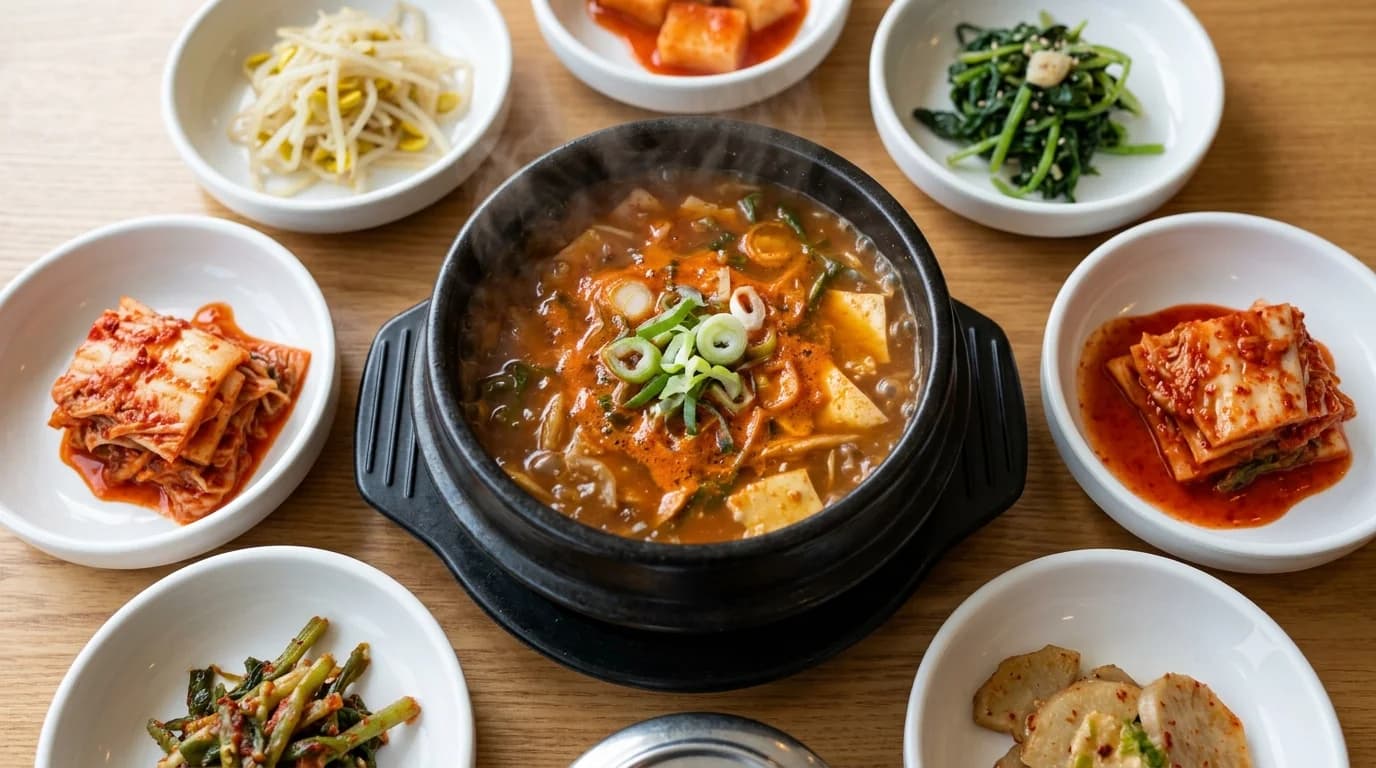
I ordered just one stew—the rest of the dishes were all complimentary.
Since many of the rules at Korean restaurants are the opposite of those in other countries, I’ll start by showing you a table.
You can just take this one form with you.
Situation | A common practice in other countries | Korean Rules |
|---|---|---|
Tips | Typically, 10–20% is expected | None — The total amount on the bill |
Side Dishes | Separate Order·Paid | Complimentary side dishes + free refills |
Water | The server keeps up | Self-service at the water dispenser |
Call an Employee | Wait until you make eye contact | Press the call button or say, "Excuse me!" |
Taxes | Add to Total | Already included in the menu price |
Calculation | At the table | Go directly to the counter |
💰 Tip — It really is 0 won
There is no tipping culture in Korea.
Employees work for a salary, not tips, and good service is expected—it’s not something you have to pay extra for.
If you don't tip, Is the service starting to get a little iffy? — No, nobody expects that in the first place.
In fact, there are even stories of staff members running after customers who leave banknotes on the table, thinking they’ve been left behind.
Gratitude doesn't have to be expressed with money; a simple "goodbye" as you leave is enough.
Korean Bill — The total is the final amount; there is no separate line for tips
Exceptions are Limited to Hotels and Fine Dining Restaurants — Some high-end restaurants include a 10% service charge on the bill.
Since this is also "included," there's no need to list it separately.
🍽 Side dishes — They’re served without having to ask, and if you ask for more, they’ll give you more
If you order one main dish, Side dishesSmall plates—called *ira*—are automatically placed on the table.
Things like kimchi, seasoned vegetables, bean sprouts, and stir-fried fish cakes—are all of these really free?
Yes, even Refills are free, tooThat is.
🍚
A typical selection of basic side dishes — kimchi, seasoned vegetables, and stir-fried dishes
If you want more, just ask a staff member, "Can I have some more side dishes?" These days, restaurants Self-Service BarMany places have self-service stations, so you can just take a plate and serve yourself.
There's no pressure to finish everything—it's okay to leave some.
If there's a self-service bar, help yourself to refills—it's good manners to take only as much as you'll eat.
☕ Water, cutlery, and a call bell — The Land of "Self-Service"
You sat down, but no one brought you any water?
It's not that I'm being rude.
Stuck to the wall Water is self-serveThis notice is a hint—the standard practice is to pour water directly from the water dispenser and drink it.
The same goes for spoons Don't wait—just take it directly from the drawer or container next to the table..
If you need an employee, the one on the table Call BellPress .
You might think, "Isn't it rude to ring the bell?" but it's actually the opposite—in Korea, this is the norm, and the staff actually find it more convenient.
One ring of the call bell = "I'm ready to order" — No need to read the room
🍚 4 Unwritten Rules for Ordering
There's a rule that isn't written on the menu, but everyone knows it.
If you know this chart, you'll never get stuck when placing an order.
Rules | Content | Things to Know |
|---|---|---|
One dish per person | One menu item per person | Mainly in areas with intense competition for cafes and seating; signs are posted |
First Order at a Steakhouse | Usually Serves 2Starting with | Additional orders can be placed in single-serving portions. |
Rice is served separately | At barbecue restaurants and some other restaurants, rice must be ordered separately | Usually around 1,000 to 2,000 won (varies by store) |
No specific order for the courses | Food is served as soon as it's ready. | A culture of sharing dishes like stews and hot pots placed in the center of the table |
Don't be surprised if you're turned down when you try to order just one serving of pork belly at a barbecue restaurant—most places require a minimum order of two to three servings for the first order due to table-setting fees.
And Rice isn't free; it's a separate menu item called "gonggibap."That’s something that surprises everyone at first.
The minimum order at a barbecue restaurant is usually two servings — scissors are the standard tool for cutting meat
These days, there are many stores where you can place orders using tablets or kiosks.
Since most of them support English menus, a great tip is to start by looking for the language button (EN) in the corner of the screen!
✨ Just These Eight Sentences — Practical Korean
I selected only the phrases that are actually used in restaurants.
Even if your pronunciation isn't perfect, I can understand everything because the context makes it clear..
Situation | Korean | Pronunciation (Romanization) |
|---|---|---|
Call an Employee | Hey! | jeo-gi-yo |
Order Now | Please give me this. | Please wait a moment |
Side Dish Refills | Could I have some more side dishes, please? | Please serve a little more banchan. |
Finding Water | Where's the water? | Where is the water? |
Individual plates | Please bring me a side plate. | Please wait a moment. |
Packaging | Do you offer packaging? | po-jang dwae-yo |
Calculation | I'll do the math. | Thank you very much |
Saying Goodbye When Leaving | That was delicious. | It's a bit like that. |
Just pointing at an item on the menu and saying, "I'll have this," takes care of 90% of your order.
The remaining 10% is a smile.
💳 Please pay at the counter
When you're finished eating, don't wait at the table for the check; instead, take the check (or your table number) and The counter near the entranceJust go there.
If we wait for the bill at the table, we'll end up waiting forever.
Pay at the counter on your way out — credit cards are accepted almost everywhere
Credit and debit cards are accepted at almost all restaurants, even small ones (cash is useful at street stalls in traditional markets).
If you want to split the bill with your group, just say, "We'll pay separately," at the counter—many places allow you to pay with your own cards.
Some places, such as snack bars and rice soup restaurants, require payment in advance. Just follow the instructions on the sign at the entrance or the staff’s guidance.
📍 Final Check Before Leaving
Just remember this order when you go to a restaurant for the first time.
Check at the entrance to see if it's a floor-seating (shoes-off) table
Start by opening the table drawer to find the utensils and wet wipes
Locating the Self-Service Water and Side Dishes Corner
To place an order, ring the bell or say, "Excuse me!"
At a barbecue restaurant, the first order is usually one per person
Pay at the counter; no tips required
A simple "Thank you for the meal" as you leave
If you're having trouble communicating, call the Tourist Helpline 1330There is one.
This is a 24-hour free interpretation and information service operated by the Korea Tourism Organization, which provides interpretation assistance—including communication with restaurant staff—in English, Japanese, Chinese, and other languages (from overseas, dial +82-2-1330).
For more details, VisitKorea Official WebsiteYou can check it out here.
What I Leave Behind Instead of a Tip — An Empty Bowl and a Word of Thanks
Instead of a tip, a simple "Thank you for the meal" is enough.
The rule at Korean restaurants boils down to one thing—do what you need to do yourself, without any hassle.
""That was delicious~"If you just remember to say that greeting, you’ll be able to dine like a regular right from your first visit.