Life
The Hidden Danger of the Summer Ocean: The Bell Jellyfish (Small-bladdered Jellyfish) — A Complete Guide to First Aid for Stings
They look as pretty as balloons, but touching them causes a pain like an electric shock—we’ve covered everything from what they are to first aid, and why you should never use vinegar.
The Hidden Danger of the Summer Ocean: The Bell Jellyfish (Small-bladdered Jellyfish) — A Complete Guide to First Aid for Stings
Every summer, small, colorful creatures that look like balloons wash up on the beach.
If you touch it out of curiosity because it looks pretty, you may experience a pain similar to an electric shock, and in rare cases, it could even be life-threatening.
Conical jellyfish (Small-bladder jellyfish)That is.
In particular, as ocean temperatures have risen recently, the areas where they are appearing have been gradually expanding beyond Jeju Island and the southern coast. With this single article From identification to how to tell them apart, their dangers, when they appear, first aid if stung, and what you should never do We've put everything together in one place, so be sure to read this before your summer vacation.
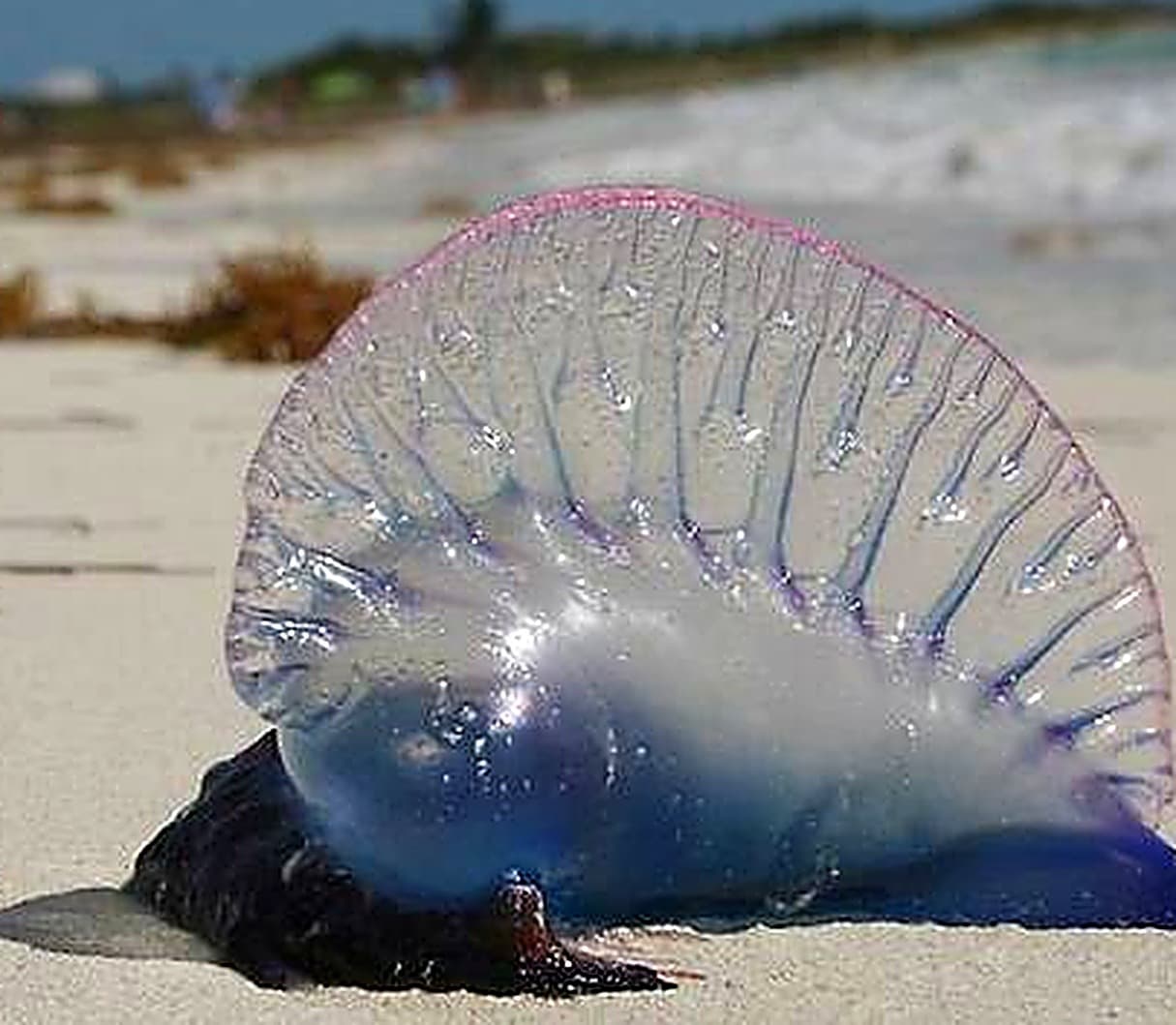
📷 (A photo showing the entire cone jellyfish—ideally one where its blue float is visible on the water's surface)
A cone jellyfish? A jellyfish with a small swim bladder? Are they the same species?
Yes, They are both the same organismIt is the name given to it.
It is called a "bluebottle" or "Portuguese man-o'-war" in English, and its scientific name is PhysaliaThat is.
But here's an interesting fact. Even though the name includes the word "jellyfish," Strictly speaking, it's not a jellyfish.
The bell jellyfish belongs to the class Hydrazoa Colonial organismsThus, several small organisms (parasites) come together to form a single body, each taking on specific roles such as gas exchange, hunting, and digestion. Although it appears to be a single organism, it is actually a collection of many living beings.
What does it look like? — How to tell them apart at a glance
Jellyfish have a distinctive appearance, so once you know what to look for, they’re not hard to identify.
A balloon-shaped swim bladder with a bluish tintThis is its most distinctive feature. It is filled with gas, so it floats on the water's surface.
The size of the swim bladder ranges from as small as From 9 cm to as much as 30 cmIt grows up to that size.
Below the swim bladder Long, Blue TentaclesThey are lying there, and their length is usually several meters, Up to 10 meters, or as long as 50 metersThere have even been reported cases of this.
The most important distinguishing factor is LocationThat's right. While most jellyfish drift through the water, the bell jellyfish, thanks to its swim bladder, Floating on the water It's relatively easy to recognize even from a distance.
How dangerous is it?
Among the jellyfish found along the coasts of Korea, the cone jellyfish is Highly toxic speciesis classified as.
Intense pain, as if I had been electrocutedIt causes this, which is why it is also known as the "electric jellyfish."
At the spot where he was shot, Red streaks resembling whip marks (whip-like lesions) and erythemaThis happens.
In severe cases Nausea, headache, shortness of breath, low blood pressure, shock This can lead to the same systemic symptoms.
Jellyfish venom is a medicine It spreads throughout your whole body in just 5 minutes,, There is also a risk of drowning in the water due to temporary muscle paralysis.
In most cases, the symptoms are limited to severe pain and skin symptoms, but, In rare cases, systemic reactions can be life-threateningIt is possible. That's why it's most dangerous to let your guard down, thinking, "It's probably no big deal."
When, Where Does it appear?
Mainly June–August It appears during the summer.
Traditionally, The coastal waters of Jeju Island and the southern coastIt was mainly found in .
However, As ocean temperatures rise due to global warming, the areas where they appear and their frequency are gradually increasing, and They are present. Since they are now being found earlier in the season and in a wider range of waters than before, it is difficult to feel safe even at beaches along the east and west coasts.
Reports of jellyfish stings are on the rise every year.
Before heading out for a day at the water park National Institute of Fisheries Science Jellyfish Information Site (nifs.go.kr)We recommend checking the appearance information for that area in advance.
First Aid for a Box Jellyfish Sting (Step-by-Step)
If you are shot, do not panic; follow the steps below.
1. Get out of the water immediately. Since muscle paralysis can lead to drowning, you should get out of the water immediately if you feel any pain.
2. Rinse with seawater or saline solution.
Rinse the affected area with clean seawater or saline solution.
Tap water (freshwater)Please do not use this under any circumstances. (The reason is explained in detail below.)
3. Remove any remaining tentacles. — Never use your bare hands.
If a tentacle is attached to your skin, Plastic cards, wooden chopsticks, seashells, a gloved hand Use a tool such as a scraper to remove it.
If you touch it with your bare hands, you could get shocked.
4. Relieve pain with a cold or hot compress.
Apply a cold compress to the swollen area, or
Warm water at around 45 degreesApplying a warm compress can help relieve pain and reduce swelling.
Jellyfish venom is sensitive to heat.
5. If symptoms are severe, seek immediate 119I am reporting this to .
Shortness of breath, Chest pain, Dizziness, HivesIf you experience systemic symptoms, such as a sensation spreading throughout your body, call 119 immediately and go to a hospital.
⚠️ Things You Should Never Do — Especially 'Vinegar'
If you know other methods of first aid for jellyfish stings, they could actually be dangerous.
The cone jellyfish is Areas where we need to take the exact opposite approachThat is why.
❌ Do not apply vinegar (most important)
Although vinegar is sometimes recommended for some jellyfish stings, The cone jellyfish (small-bladder jellyfish) has an acidic venom, so using vinegar actually causes the venom to spread further. The advice circulating online to "apply vinegar or cola" does not apply to this species, Incorrect informationPlease be aware of this. Official guidelines from the Ministry of the Interior and Safety and the National Institute of Fisheries Science also prohibit the use of vinegar.
❌ Do not wash with tap water (freshwater).
Freshwater stimulates the stinging cells due to the osmotic pressure difference, Promotes the spread of the poisonPlease be sure to use seawater or saline solution.
❌ Do not use alcohol to disinfect.
Cleaning agents containing alcohol should also be avoided, as they can increase the release of toxic substances.
❌ Do not rub or wrap with a bandage
If you rub or tightly wrap the affected area, the venom sac may rupture, causing the venom to spread further.
Frequently Asked Questions (FAQ)
Q. Can you die from a sting by a cone jellyfish?
In most cases, the symptoms are limited to severe pain and skin lesions.
However, in rare cases, systemic reactions (such as anaphylaxis) like shortness of breath or low blood pressure may occur, which can be life-threatening; therefore,
If you experience systemic symptoms, you should call 119 immediately.
Q. Is it okay to apply vinegar?
No.
Since the venom of the cone jellyfish is acidic, using vinegar causes the venom to spread further.
The correct method is to rinse it with seawater or saline solution.
Q. Is it okay to touch a dead jellyfish that has washed up on the beach?
No.
The venomous stingers remain active even on dead specimens or detached tentacles.
In particular, because it looks like a balloon, children may be tempted to touch it or put it in their mouths, so you must be especially careful.
Q. My child was shot. What should I do?
Just as with adults, get out of the water immediately, rinse the affected area with seawater or saline solution, and remove the tentacles with a tool.
Since children are smaller and may be more sensitive to the poison, it is safest to go to the hospital immediately if the pain is severe or the symptoms spread.
Q. When should I go to the hospital?
If the pain does not subside even after first aid, or
If you experience shortness of breath, chest pain, dizziness, or hives spreading throughout your body, or if you are stung in a sensitive area such as the eyes, you should seek medical attention immediately.
In Conclusion — The Best Approach Is “Prevention”
While it’s important to know how to administer first aid for a cone jellyfish sting, Not touching it or getting close to it in the first placeThis is the safest option.
Do not enter the water in areas where there is a jellyfish warning.
If you see a blue, balloon-shaped creature floating on the water's surface, stay well away from it.
Even if it looks dead, never touch it with your bare hands.
We inform the children of the risks in advance.
We hope you have a safe and enjoyable time at the beach this summer. 🌊
※ This article was prepared based on public safety guidelines issued by the Ministry of the Interior and Safety’s National Disaster and Safety Portal and the National Institute of Fisheries Science, among others. If your symptoms are severe, please be sure to call 119 and seek treatment at a medical facility.