Visiting Korea
Korean convenience stores: what works with a foreign card, cash, or a passport
Tmoney, payments, parcels and alcohol ID at CU, GS25, 7-Eleven and emart24, and the few tasks where the chain matters
At a glance
Foreign visitors can do most convenience-store tasks with an overseas card and some won in cash. Top up a Tmoney card with cash, and expect the half-price store-to-store parcel services to send the pickup code to the recipient as a KakaoTalk notification and to ask the sender for a Korean return address. For the tasks we could verify, the chain changes your plan only for Tmoney refunds and half-price parcels.
Most of what a foreigner needs from a Korean convenience store works with an overseas card, a little cash in won, and a passport.
There are three exceptions.
Topping up a physical Tmoney card is a cash job.
Some ATMs in Korea don't take foreign cards.
For the cheap half-price store-to-store parcel services, the pickup QR code goes to the recipient's number as a KakaoTalk notification, and the sender needs a Korean return address (both chains; GS25 doesn't accept a store address), plus a mobile number at CU.
For the tasks we could verify, the brand on the sign changes your plan in two cases: how much Tmoney balance you can cash out, and where a half-price parcel can be picked up.
A Korean convenience store lit up at night, shelves visible through the front window.
What works for a foreigner, task by task
The table answers the question you'll actually have at the counter: will this work for me, and what do I need?
"Chain matters" means CU, GS25, 7-Eleven and emart24 handle the task differently in a way that changes your plan.
Task | Works for a foreigner? | What you need | Chain matters? | If it fails |
|---|---|---|---|---|
Pay with an overseas credit or debit card | Yes, usually | A card enabled for overseas use; choose won if the screen asks | No | A second card, or cash |
Pay with Alipay, WeChat Pay or an Alipay+ wallet | Yes at CU and GS25; check at 7-Eleven and emart24 | The app's payment barcode, shown to the cashier | Promotions differ | Card or cash |
Buy a Tmoney card | Yes | Cash is the safe assumption | No | An information center in a Seoul subway station |
Top up a Tmoney card | Yes | Won in cash | No | Subway station top-up machines (cash) |
Cash out a Tmoney balance | Small balances only | The card; a 500 won fee is deducted | Yes, limits differ (see below) | Subway customer service centers in the Seoul area, for part of a balance |
Withdraw cash at an ATM | Not at every machine | A card with a 4-digit PIN | Unverified per chain | A bank's global ATM |
Send a half-price store-to-store parcel | Rarely, as a tourist | Recipient: a mobile number; the pickup code arrives as a KakaoTalk notification. Sender: a Korean return address (both chains; GS25 doesn't accept a store address), plus a mobile number at CU | Yes; CU and GS25 parcels stay within one chain | A Korea Post office |
Buy alcohol or tobacco | Yes, if you're of age | Original passport or residence card if asked | No | None; the age rule is national law |
Throw away trash | Yes, for what you bought there | Sort into the labeled bins | No | Take it with you |
Tmoney, parcel and alcohol rows checked in October 2026 against Tmoney's own guides, CU's and GS25's parcel booking pages and the Youth Protection Act.
Does the chain ever matter?
For card payments and Tmoney top-ups, no.
Walk into whichever store is closest.
For the tasks we could verify, the chain changes your plan in two cases.
First, the store cash-out limit for a Tmoney balance is higher at CU and emart24 than at GS25 and 7-Eleven.
Second, the half-price parcel services at CU and GS25 deliver only to a store of the same chain, so the recipient has to collect from that brand.
Foreign-wallet promotions (discounts with Alipay, WeChat Pay or UnionPay) differ by chain and month, but they're a bonus, not a reason to cross the street.
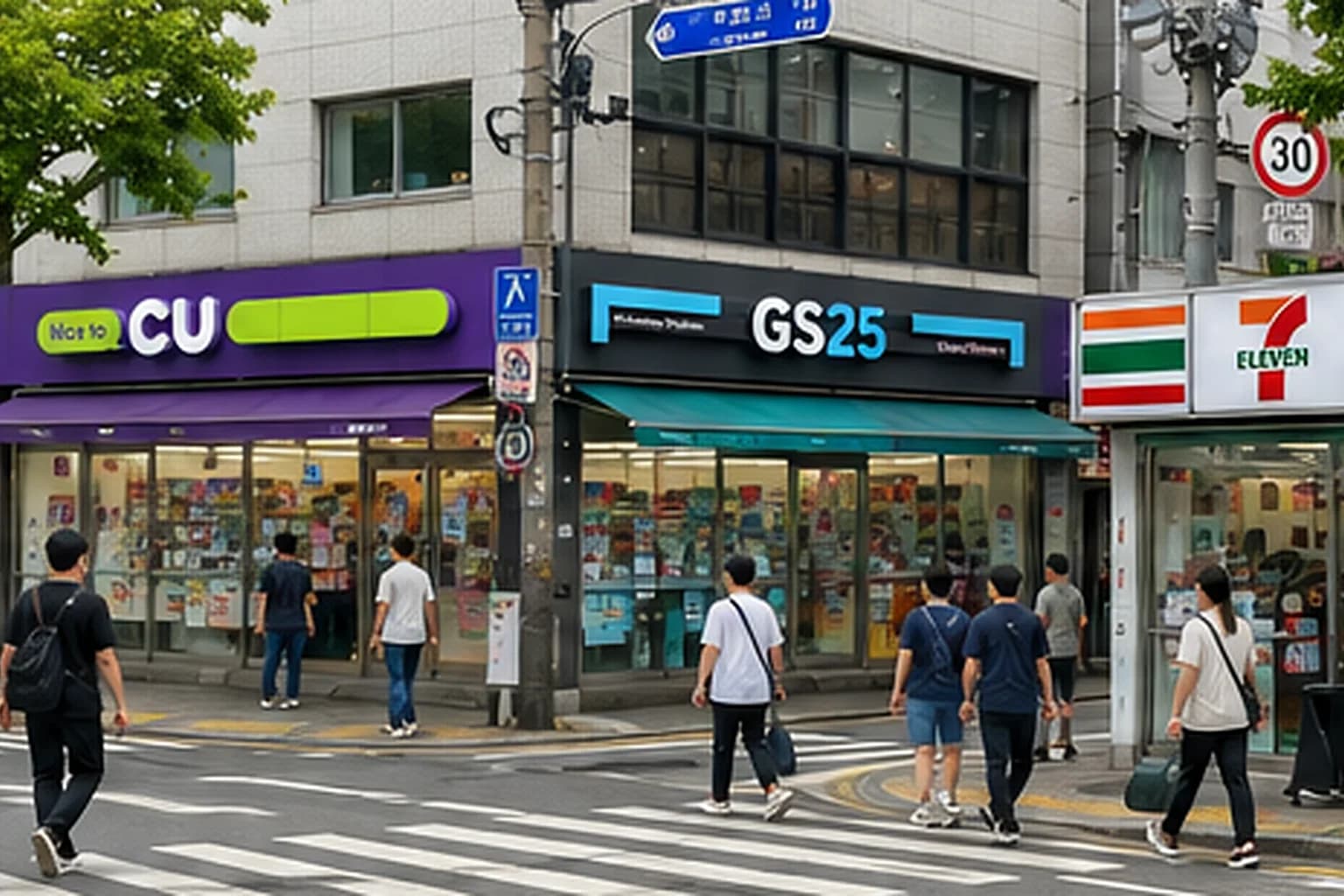
Three different convenience store chains within one block of a Seoul street.
Tmoney at the counter: buy, top up, cash out
Tell the cashier the amount you want to add, hand over the card and pay in won.
Tmoney's own guide for foreign travelers says not to count on a foreign credit card for topping up a physical card.
It calls cash the most reliable method at convenience stores.
Carry a few 10,000 won notes for top-ups.
If you have no won yet, a bank's global ATM is the safer bet for cash; check any machine for foreign-card logos before you insert a card.
VISITKOREA lists 3,000–5,000 won for a general Tmoney card.
Whatever you pay for the card itself is never refunded.
Only the stored balance is.
Cashing out what's left at the end of a trip
Store refunds have a ceiling, and it depends on the chain. The store pays out your remaining balance in cash, minus a 500 won service fee, but only if the balance is within the limit below.
Chain | Store refund limit on the balance | Fee |
|---|---|---|
GS25 | Under 20,000 won | 500 won |
7-Eleven | 20,000 won or less | 500 won |
CU | 30,000 won or less | 500 won |
emart24 | 30,000 won or less | 500 won |
Limits and the 500 won fee are from Tmoney's official refund guide, checked October 2026.
Stores can't do partial refunds.
Subway customer service centers in the Seoul area can refund part of a balance, 10,000–50,000 won in 10,000 won steps, which lets you bring a larger balance down.
VISITKOREA says balances over 50,000 won can be refunded only at Tmoney Town in Seoul Station.
At Tmoney Town, Tmoney's guide says refunds of balances over 50,000 won need ID, and refunds of 100,000 won or more are paid into a bank account the next day; its ATM refund needs an account in the cardholder's own name.
Without a Korean bank account, the simplest plan is to spend the balance down.
Often the simplest move is to spend the leftover balance on your last convenience-store purchase, since Tmoney is accepted as payment at participating stores.
A transit card being topped up at the counter, paid for in won notes.
Fares, the Climate Card, WOWPASS and paying for transit with an overseas card are covered in our transit payment guide for foreign travelers.
Paying: overseas cards, Alipay and WeChat Pay
Foreign cards are widely used at convenience-store counters.
CU's foreign-card sales in Seoul's tourist areas grew year on year in the first half of 2026. If a card is declined, try a second card or cash, and pay in won if the terminal asks.
Mobile wallets are well established.
As of 2022, CU accepted Alipay, WeChat Pay and UnionPay, and had added Alipay+ partner wallets such as AlipayHK.
At GS25, Alipay and WeChat Pay made up 97.7% of foreign customers' payments in 2025. You open the payment barcode in your app and the cashier scans it.
1+1 and 2+1 promotion stickers on shelf price tags.
The 1+1 and 2+1 stickers mean buy one get one free, or buy two get a third free.
The free item isn't added for you.
Take the full number of items to the counter yourself.
Half-price parcels: where a short trip usually hits a wall
CU and GS25 both run a half-price store-to-store parcel service, and both are built around a mobile number.
CU asks for the sender's and the recipient's mobile numbers, and both chains send the pickup QR code to the recipient as a KakaoTalk notification.
Neither booking guide mentions a text-message fallback, so a recipient without KakaoTalk on that number may not get the code.
The recipient shows that code at the destination store, which has to be a store of the same chain.
If nobody collects the parcel within 4 days of it reaching the store, both chains send it back, and CU collects the return postage from the sender on delivery.
GS25 asks for a home or work address for that return, because it can't send a parcel back to a store.
These store-to-store services suit a resident sending something within Korea, and rarely a tourist.
Neither chain's booking guide says whether a non-Korean number can receive the pickup code.
If you don't have a Korean number, or you're sending something abroad, try a Korea Post office instead; its English site covers international parcels and express mail.
If you're deciding whether a Korean number is worth getting, our airport SIM and eSIM guide covers what one unlocks.
Alcohol and tobacco: the birth-year rule
Korea's Youth Protection Act bars the sale of alcohol and tobacco to anyone under 19. Birth year decides it, not your birthday: from January 1 you count as old enough if you turn 19 at any point that year.
In 2026, that means anyone born in 2007 or earlier.
Bring your original passport or residence card if you might look under 30. The law requires the seller to check age and punishes sales to anyone under 19, so cashiers can refuse a sale when in doubt.
The law doesn't list which documents count, so an original government ID is the safest choice.
Using the store as a kitchen
Lunch boxes and frozen meals print heating times by microwave wattage on the package, so match the time to the wattage on the store's machine.
Remove foil lids and sauce sachets before heating.
Microwaves, a hot water dispenser and a window-side eating counter inside a convenience store.
An automatic ramyeon cooker: the bowl on the burner and a hand on the start button.
Clearing up is your job.
Pour leftover broth into the liquid waste sink or bucket if the store has one, not into the general bin, and sort the rest into the labeled bins.
For how sorting works outside the store, see our guide to throwing away trash in Korea.
How this article was prepared
Sources checked
- Tmoney card refund guide (official, Korean)Linked page is in Korean— Store refund limits per chain (GS25 under 20,000 won; 7-Eleven 20,000 won or less; CU and emart24 30,000 won or less), 500 won fee, card price not refunded, partial refunds of 10,000–50,000 won in 10,000 won units only at subway customer centers and head office
- Tmoney blog, convenience store guide for foreign travelers— Operator's own spelling Tmoney; don't assume a foreign credit card can top up a physical card; cash is the most reliable top-up at stores; card price not refundable; Tmoney accepted at participating stores
- VISITKOREA transportation cards page— General Tmoney card 3,000–5,000 won; sold at convenience stores and Seoul subway information centers; reloadable at station machines; refunds over 50,000 won only at Tmoney Town in Seoul Station; Climate Card and WOWPASS spellings
- Youth Protection Act, English translation (Korea Legislation Research Institute, Act No. 20423, Mar. 26, 2024)Linked page is in Korean— Youth = under 19, excluding those who turn 19 that year from January 1; no selling drugs harmful to youth such as alcohol and tobacco to youth (Article 28(1)); sellers must verify age and identity (Article 28(4)); penalty in Article 59
- Korea Herald on GS25 foreign payments (January 2026)— Alipay and WeChat Pay were 97.7% of GS25 foreign transactions in 2025; UnionPay discount promotion
- News Tomato on CU overseas payment methods (May 2022)— CU accepts Alipay, WeChat Pay and UnionPay, and added AlipayHK through Alipay+
- Wise guide to ATMs in South Korea— Not all ATMs accept foreign cards even with network logos; Global ATM labels; 4-digit PIN; choose local currency over DCC
- Korea Herald via Asia News Network on tourist spending at convenience stores (August 2026)— Foreign-card sales at CU stores in Seoul tourist areas rose year on year in the first half of 2026
- CU half-price parcel booking notes (CU Post, Korean)Linked page is in Korean— CU store to CU store only; sender's and recipient's mobile numbers required; pickup QR code sent to the recipient's number as a KakaoTalk notification; parcels not collected within 4 days of arrival go back to the sender's address
- GS25 half-price parcel precautions (GS Postbox, Korean)Linked page is in Korean— GS25 store to GS25 store only; returned if not collected within 4 days including the arrival day; return address must be a home or work address, not a GS25 store
- GS25 half-price parcel guide (GS Postbox, Korean)Linked page is in Korean— Destination must be a GS25 store; the recipient shows staff a pickup QR code sent as a KakaoTalk notification; prepaid only
- About KakaoTalk (Kakao Corp.)— Messenger name spelled KakaoTalk by its operator, Kakao Corp.
- CU official site— Brand spelling CU
- 7-Eleven Korea official siteLinked page is in Korean— Brand spelling 7-Eleven (logo styled 7-ELEVEN); operated by Korea Seven
- emart24 official siteLinked page is in Korean— Brand spelling emart24
- Korea Post English site— Official English name Korea Post; international parcel and EMS services
- Alipay+ consumer page— Spellings Alipay and Alipay+
- WeChat Pay official English site— Wallet name spelling
- UnionPay International official site— Card network name spelling UnionPay
- AlipayHK official site— Wallet name spelled as one word, AlipayHK
Related reading
Paying for Korean subways and buses in 2026: Tmoney, Climate Card, WOWPASS or your own card?
Most visitors should start with a Tmoney card topped up with cash. A Climate Card pass pays off on Seoul stays of three to seven days at three or more paid rides a day, even counting the 3,000 won card. Foreign cards can buy passes at newer machines but can't be tapped at the gates yet.
Christmas in Seoul 2026: market dates, light shows and which ones you need to book
Gwanghwamun Market (11 Dec–10 Jan, from 17:30, free) is Seoul's main Christmas market. Before 11 December, head for the department store displays in Myeongdong, Jamsil and Yeouido instead.
Olive Young tax refund, foreigner discounts and sale dates: what to know before you pay
Show your physical passport and Olive Young takes 5–8% off any single receipt of 15,000 won or more at the till. Visitors can't join the Korean membership, but can earn CJ ONE points by signing up with just an email.
Can you rent a car in Korea on your foreign licence? Permits, insurance and the bills that come later
Visitors can rent in Korea with a paper IDP from a Geneva or Vienna convention country or a bilateral-agreement country, valid for one year from entry; after that, or without one, you need a Korean licence.
Lotte World tickets for foreigners: official prices, the foreigner-only pass, and whether After4 or Magic Pass is worth it
Foreign visitors usually pay least with a reseller's foreigner-only day pass (about 41,000–42,500 won), which undercuts even the official After4 ticket at 52,000 won.
Best Korean Spa in Seoul for Foreigners: Which Jjimjilbang to Pick by Neighbourhood
For a first visit or a night in central Seoul, go to Sparex Dongdaemun; Club K Seoul suits long Gangnam stays, and Aquafield suits couples and families by day.