Korean Food
Korean BBQ in Korea: meat cuts on the menu, price per 100g, and ordering for your group
Price per 100g, Hanwoo labels and grades, cut names, and what to do when you're eating alone
At a glance
Choose the restaurant by group size and budget, then compare menus using the price per 100g, not per serving. Before paying Hanwoo prices, check the origin label. Solo diners often face a two-serving minimum.
Korean BBQ mostly goes wrong at the door or on the menu, not at the grill.
You pick a place that doesn't suit your group, or you compare two menus whose "servings" weigh different amounts.
Sometimes you pay Hanwoo prices for beef whose label you never checked.
This guide covers those three decisions for eating in Korea, and what changes if you're alone.
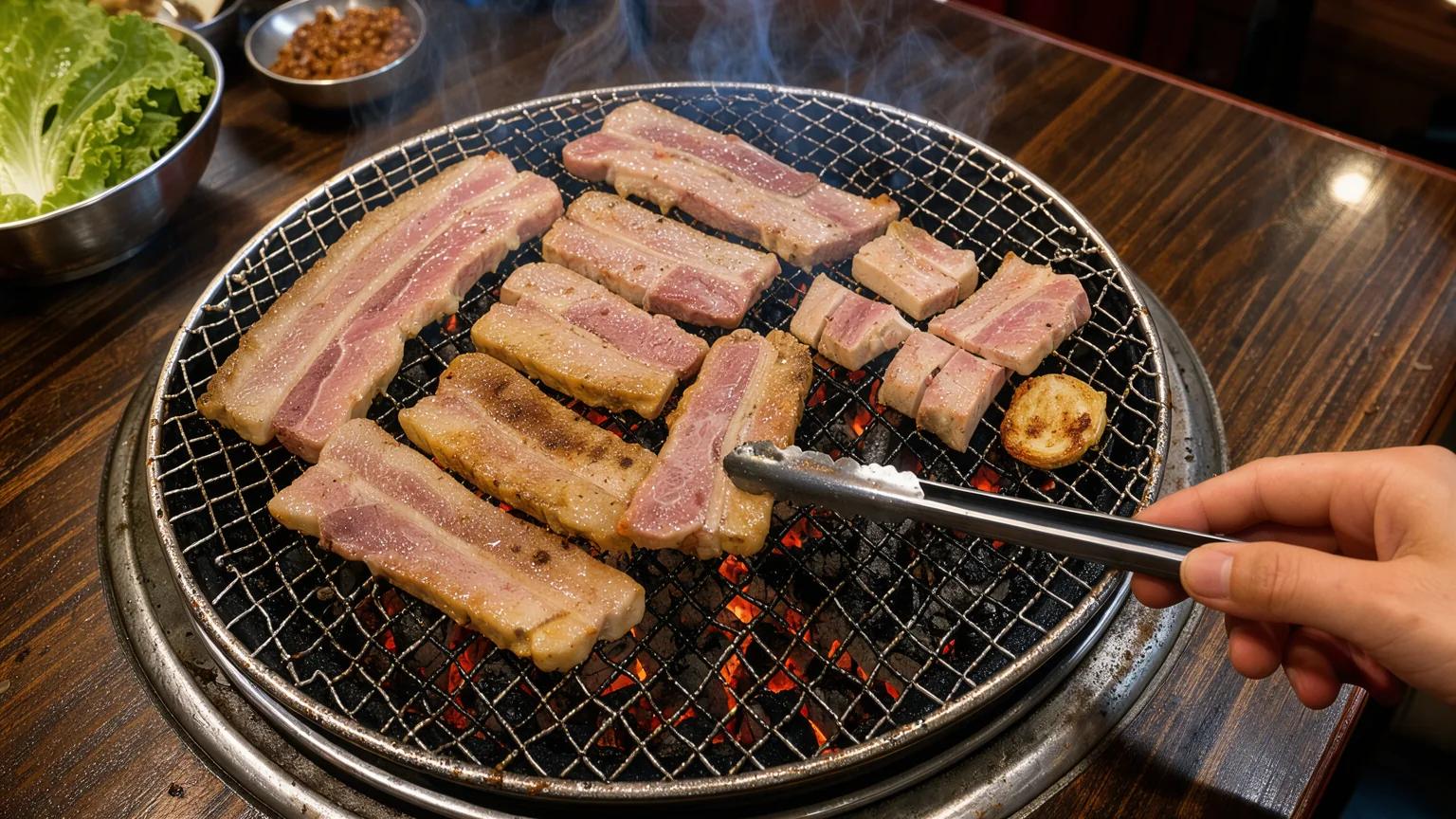
A charcoal brazier is lowered into the centre of the table after ordering.
Which kind of BBQ place fits your group?
Decide this first, before cuts or grills.
The type of restaurant decides how the meat is priced and what the bill will look like.
Restaurant type | Best for | How the bill works | Who usually grills (common pattern; ask) |
|---|---|---|---|
Pork joint (samgyeopsal and other pork cuts) | 2–4 people, a first BBQ meal, casual nights | Priced by weight or serving; Seoul's pork belly average was per 200g in June 2026, so 200–400g of meat comes to roughly 21,000–43,000 won a person at that average (our calculation) | Usually you |
Galbi house (marinated or plain short ribs, beef or pork) | Families, mixed groups, guests who want something familiar | Check beef or pork, and saeng (plain) or yangnyeom (marinated), then compare per 100g | Often staff |
Hanwoo specialist | Special occasions, beef lovers, groups splitting a few cuts | Priced by cut and grade; even in shops, grade-1 Hanwoo tenderloin cost per 100g in July 2026 | Often staff |
Butcher-shop style (you pick meat at a counter, then grill it at a restaurant) | Beef lovers who want to choose their own cut | The counter price for the meat, plus a separate fee at the restaurant where you grill it | Usually you |
All-you-can-eat self-serve | Big appetites, students, larger groups on a fixed budget | Ask whether there's a time limit | You |
Offal place (gopchang, makchang, daechang) | Adventurous eaters, late nights, people who already like pork belly | Ask what one serving weighs before you order | Often staff |
The pork average is the Korea Consumer Agency's Seoul figure for June 2026, reported on 1 August 2026. The tenderloin price is retail data from the Korea Institute for Animal Products Quality Evaluation for July 2026. The grilling column is a common pattern, not a rule; if you'd rather not grill yourself, ask before you order: "Guwo juseyo?" (Will you grill it for us?)
How to compare two menus: use the price per 100g
The number to compare is the price per 100g.
A "serving" (il-in-bun) is whatever weight the restaurant decides it is, and pork belly servings run from about 100g to 250g.
That's why the Korea Consumer Agency converts every serving to 200g before comparing prices.
A rule introduced in 2013 asked restaurants to show meat prices such as bulgogi and ribs per 100g.
When the rule began, a reporter checked about 10 meat restaurants in Seoul and found none showing a per-100g price.
One restaurant that said it had complied still listed servings, such as 170g or 250g, rather than a per-100g price.
So don't count on the menu doing the sum for you: convert each serving price to a price per 100g, as here with the Seoul average and a made-up second menu:
Menu | What it says | Price per 100g |
|---|---|---|
Seoul pork belly average, June 2026 | 21,321 won for 200g | 21,321 ÷ 200 × 100 = 10,660.5 won |
Hypothetical menu B | 18,000 won for 150g | 18,000 ÷ 150 × 100 = 12,000 won |
Do the same sum with each menu's price and grams, then compare the per-100g figures and pick the lower one; here menu B is the dearer meat despite its smaller bill.
Reading the cut names on the menu
Most menus print cut names in Korean.
English menus and camera translation apps can get them wrong.
Use the romanized names below as a key, and keep the warnings in mind.
Pork
Menu name | What it is | Marinated? | Notes |
|---|---|---|---|
Samgyeopsal | Pork belly, layered meat and fat | No | The default first order |
Moksal | Pork neck/shoulder | No | Leaner than belly; dries out if overcooked |
Hangjeongsal | Pork jowl/neck, a small fatty cut | No | Chewy and juicy; not every place sells it |
Galmaegisal | Pork skirt (diaphragm) | Usually no | Translation trap: "galmaegi" also means seagull, and some apps print that |
Gabrisal | A thin cap of meat from the top of the pork loin | No | Specialty cut |
Dwaeji galbi | Pork ribs | Often | Check the saeng/yangnyeom label |
Raw pork cuts side by side, from fatty belly to leaner neck.
Beef
Menu name | What it is | Notes |
|---|---|---|
Chadolbaegi | Brisket point, shaved paper-thin | Cooks in seconds |
Deungsim / kkotdeungsim | The loin along the back; kkot ("flower") means heavily marbled | Translation trap: English menus translate it as both "sirloin" and "rib-eye", so ask which part you're getting |
Salchisal | Chuck flap | Well-marbled specialty cut |
Galbi / LA galbi | Short rib; LA galbi is cut thin across the bones | Often sold marinated |
Woosamgyeop | Thin-sliced beef belly | Check the price per 100g |
Two words that change the price
Saeng means fresh and unmarinated.
Yangnyeom means marinated, usually in sweet soy. The sugar burns quickly, so ask for a fresh grill plate when the old one blackens.
Marinated short ribs caramelise at the edges on the grill.
Offal
Gopchang is small intestine.
Makchang is not intestine at beef places: it is the abomasum, the fourth stomach. At pork places, makchang means the end of the pig's large intestine, the rectum.
Daechang is large intestine.
Order offal at a place that specialises in it, because the cleaning and pre-cooking make a big difference.
Is it really Hanwoo? Check the origin label first
Restaurants must label where the beef and pork they serve come from.
For domestic beef the label must also name the type, so one line can tell you whether you're paying for Hanwoo.
Look for it on the menu, on a wall board, or on a separate origin sign.
What the label says | What it means |
|---|---|
Domestic, Hanwoo (gungnaesan hanu) | Korean native cattle |
Domestic, yugu | Raised in Korea for meat: beef breeds, crossbreeds, or dairy-breed cattle that never calved. Domestic, but not Hanwoo |
Domestic, dairy cattle (jeotso) | Meat from dairy cows that have had calves |
A country name (USA, Australia, and so on) | Imported beef from that country |
Several origins listed | A mix, listed from the largest share down |
These label forms follow the origin-labelling rules for restaurants, checked in October 2026.
For beef, "domestic" on its own is an incomplete label: the type should follow it. If the menu charges Hanwoo prices and the type is missing, ask before you order: "Hanu-yeyo?" (Is it Hanwoo?) Selling domestic yugu or dairy beef as Hanwoo is one of the violations government origin inspectors look for, and they use on-site test kits that tell Hanwoo from other beef.
What 1++ does and doesn't tell you
The Korea Institute for Animal Products Quality Evaluation grades beef, and its quality grades are 1++, 1+, 1, 2 and 3. Since a reform announced by the Ministry of Agriculture, Food and Rural Affairs in late 2019, the grader scores marbling, meat colour, texture and fat colour separately, and the lowest of those scores becomes the final grade.
That same reform lowered the marbling needed for 1++ and 1+.
1++ used to mean marbling number 8 or 9, and it now covers 7, 8 and 9, with 9 the most marbled.
Meat sellers have to show that number next to the grade.
What the grade does tell you:
How the carcass scored on marbling, meat colour, texture and fat colour.
With a number such as 1++(9), where it sits within the top grade.
What it doesn't tell you:
The cut, how it was aged, or how the kitchen handles it.
Whether the meat is Hanwoo. The same grade scale covers beef in general, so check the origin label as well.
How it compares with grading systems abroad. Comparisons like "1++ = A5 Wagyu" come from marketing, not from the official standard.
A menu that shows only the top grade, without a marbling number, is not specific. Beef with marbling number 7 was graded 1+ before the reform, and the ministry expected the share graded 1++ to rise from 12.2% to 20.1%.
At top prices, ask which number it is: "Mabeulling myeot beon-ieyo?" (What's the marbling number?)
Eating alone: the two-serving minimum
Expect many traditional BBQ restaurants to require at least two servings.
It's a house rule that each restaurant sets for itself, so it varies.
What to do:
Look for signs or menu notes saying one-person orders are welcome.
In Korean this is "1-in ganeung" (one person possible); the sign starts with the digit 1, and a camera translation app will confirm it.
Look for solo-format restaurants, where each diner gets an individual grill station.
Seoul has some.
Go outside peak dinner hours, when a table for one is easier to get.
If you're happy to order two servings, ask at the door before you sit down.
At the Seoul pork average, two servings of 200g cost a little over 40,000 won.
Booking ahead can be hard for visitors, because Korean reservation and waitlist apps have often required a local phone number or a Korean messenger ID.
Catch Table is an exception: its English version lets foreigners sign up with just an email address, so check whether your restaurant is listed there, and whether a deposit can be paid with a foreign card.
Walking in early, before the dinner crowd, needs nothing set up in advance.
Ordering, step by step
Order the cut and number of servings: "samgyeopsal, i-in-bun juseyo" (two servings of pork belly, please). Start small, because adding more is easy.
Side dishes, lettuce and dipping sauces usually come automatically.
For refills and the other general restaurant rules, see our guide to tipping and banchan refills.
As the meat runs low, order a meal to finish: doenjang-jjigae (soybean paste stew), naengmyeon (cold noodles), or fried rice made on the grill.
Side dishes, lettuce and sauces are set out before the meat arrives.
To make a wrap, lay a lettuce or perilla leaf in your palm.
Add a piece of meat, a little ssamjang (soybean and chilli paste), and garlic or green onion if you like.
Fold it and eat it in one bite.
For unmarinated beef, try the sesame oil and salt dip instead of ssamjang.
A lettuce wrap with grilled pork, ssamjang and garlic.
On a cauldron-lid grill, fat runs down to the rim, and kimchi or bean sprouts cook in it there.
At charcoal places the meat picks up smoke flavour.
Gas grills give steadier heat.
Neither is a sign of quality: compare the per-100g price and the origin label instead.
Kimchi cooks in the rendered pork fat at the edge of a cauldron-lid grill.
How this article was prepared
Sources checked
- Seoul Shinmun report on menus after the per-100g rule began (2 Jan 2013)Linked page is in Korean— The duty applied from 2013; none of about 10 BBQ restaurants the reporter checked in Seoul showed a per-100g price
- Segye Ilbo report on Korea Consumer Agency eating-out prices (1 Aug 2026)— Seoul samgyeopsal at 21,321 won per 200g in June 2026; pork belly servings of about 100g to 250g are converted to 200g so prices can be compared
- Korea Consumer Agency English site— Official English name of the agency behind the eating-out price data
- Herald Business report on beef prices (7 Jul 2026)— Grade-1 Hanwoo tenderloin at 15,031 won per 100 grams in July 2026, from the grading institute's distribution data
- Asia Business Daily report on Majang Livestock Market (14 Aug 2026)— Customers pick their own meat and grill it at nearby restaurants, paying an additional fee at the restaurant
- Act on Origin Labeling of Agricultural and Fishery Products, English text on FAOLEX— Article 5(3): restaurants must label the origin of covered products, and for beef the type of meat as well
- Enforcement Decree of the Act on Origin Labeling, English text on FAOLEX— Article 3(5): beef and pork served after cooking are among the covered items; Article 4: applies to rest and general restaurants
- KB Think guide to restaurant origin labelling (9 Sep 2025)— Domestic beef shows its type (Hanwoo, yugu, dairy cattle); imported beef shows the country; mixes are listed from the largest share; labels go on menus and boards or a separate origin sign
- Seoul Metropolitan Government news site on reading beef labels (12 Sep 2012)Linked page is in Korean— Yugu comes from beef breeds, crossbreeds, dairy steers and dairy heifers that never calved; dairy beef comes from cows that have calved
- NAQS notice of its summer 2026 origin-label crackdown, posted by MAFRA (14 Jul 2026)Linked page is in Korean— Inspectors target restaurants selling domestic yugu or dairy beef as Hanwoo, using test kits that tell Hanwoo from other beef
- MAFRA press release on the beef grading reform (26 Nov 2019)Linked page is in Korean— Lower marbling thresholds for 1++ and 1+; 1++ shown with marbling number 7, 8 or 9; final grade is the lowest of marbling, meat colour, texture and fat colour; former 1+(7) beef now counts as 1++; 1++ share expected to rise from 12.2% to 20.1%
- MAFRA explanation on 1++ marbling numbers (5 Dec 2019)Linked page is in Korean— 1++ changed from marbling numbers 8 and 9 to 7, 8 and 9; meat sellers must show the number and the price from 1 Dec 2019, with a six-month grace period
- Ministry of Agriculture, Food and Rural Affairs English site— Official English name of the ministry; uses the spelling Hanwoo
- KAPE Livestock Products Grading page (English)— Beef quality grades 1++, 1+, 1, 2 and 3; official English name of the institute in the page footer
- iVisitKorea guide to solo-friendly restaurants in Seoul (Mar 2026, updated Jul 2026)— Traditional BBQ places require at least two portions; solo-format places with individual grill stations exist in Seoul
- KOREA magazine Policy Review, Ministry of Culture, Sports and Tourism (Apr 2024)— Korean apps for restaurant bookings and queues often required Korean messenger IDs or local phone numbers; foreigners can now sign up for Catch Table with just an email address
- Makchang (Wikipedia)— Beef makchang is the abomasum (fourth stomach); pork makchang is the pig's rectum
- Seoul Metropolitan Government English site— Official English name of the city
Related reading
Jeolla-style kimchi for kimjang: what sets it apart, and a 5 kg batch by weight
Jeolla kimchi stands out for its thick, ground seasoning. For 5 kg of salted cabbage, start with 300 g gochugaru and 350 g jeotgal, then adjust by taste.
Korean persimmons: which ones you can eat firm, and how to ripen, dry and store the rest
Only dangam is meant to be eaten firm. Most other fresh Korean persimmons are astringent and have to go jelly-soft, or be dried or frozen, first, so read the label and squeeze before you buy.
Making geotjeori in Korea, from buying the right packs to a small batch
For one small batch of fresh kimchi in Korea, buy one albaechu, coarse sea salt, coarse chili flakes and anchovy fish sauce. If you'd never finish the pantry packs, a kit or ready-made geotjeori is the better buy.
Korean winter street snacks: what to order, what they cost, and how to pay
Carry small won notes. Bungeoppang ran from 3 for 2,000 won to 1,500 won apiece in 2025/26 news reports, some stalls refuse cards, and a transfer-only stall is off-limits without a Korean bank account.
Buying watermelon in Korea — which size fits your kitchen, what it costs, and where the rind goes
No knife or fridge? Buy a supermarket cut tray. A whole melon (about 20,000–30,000 won in 2026) only makes sense for three or more people with a fridge, and the rind goes out as food waste.
How to make cilantro kimchi in Korea, scaled to Korean grocery packs
Cilantro kimchi made at home in Korea is best treated as a fresh side dish. This recipe uses 100 g of cilantro and about 400 g of Korean radish for a batch to eat within two days.