Visiting Korea
Do you have to be naked at a Korean jjimjilbang? Dress rules, age limits, tattoos and sleeping over
The age rules come from national law; tattoo rules are up to each venue
At a glance
You're naked only in the single-sex bath. Everywhere else you wear the uniform you're given. From 48 months, children can't enter the opposite-sex bath. At 24-hour venues, under-19s need a parent, a supervising adult or a signed consent form at night.
At a jjimjilbang you take everything off in one place only: the bath area, which is separated by sex.
Everywhere else you wear the T-shirt and shorts the venue gives you, and men and women share that space.
For most adults that's the whole answer.
What actually turns people away at the door is different.
A child aged four or older can't go into a parent's opposite-sex bath.
A teenager may be refused at night.
A venue can also turn away someone with large tattoos, because that decision is left to each venue.
The sections below cover those rules, then whether a jjimjilbang works as a cheap bed for the night.
To choose a place in Seoul, see our neighbourhood guide to Korean spas in Seoul.
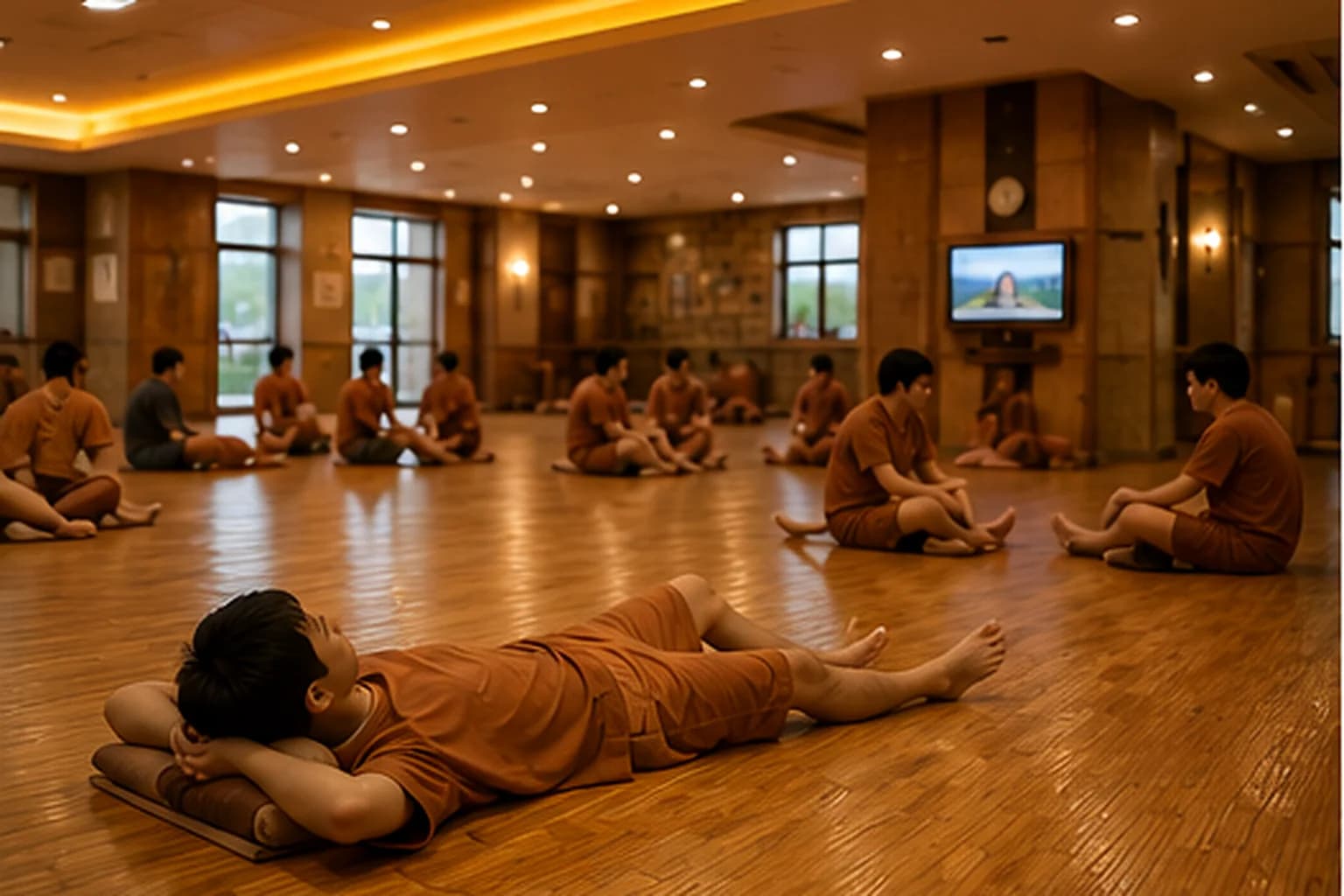
Men and women split at the locker rooms and meet again in the shared uniform area.
Where clothes come off, zone by zone
You pass through the zones in roughly this order.
Only the two in the middle are single-sex, and only one of them requires nudity.
Zone | What you wear | Who's there | What not to do |
|---|---|---|---|
Entrance and front desk | Street clothes, shoes off at the door | Everyone | Walk in wearing shoes |
Locker room | You change here | Your sex only | Take photos or film |
Bath area (showers, tubs, dry saunas) | Nothing, apart from a small towel if you like | Your sex only | Wear a swimsuit, get in a tub before you shower, let hair or towels touch the water, use your phone |
Shared heated rooms, lounge, snack bar | The issued uniform | Everyone | Go about in only underwear or your own clothes, be loud |
Sleeping area (where there is one) | The issued uniform | Everyone, sometimes with separate women's rooms | Leave valuables beside you |
Wearing clothes in the shared heated rooms is a legal requirement: a bathhouse that runs co-ed sweat rooms must have guests wear sweat-room clothing before they go in.
The rest of the table is ordinary bathhouse etiquette.
Small numbered shoe lockers line the entrance; many venues swap this key at the desk for a locker key.
The sequence at the entrance changes a little from venue to venue.
Typically you lock your shoes away, and the desk gives you a locker key along with a uniform and towels.
Some places have you swap the shoe key for the locker key.
The locker key usually comes on a wristband, and it may double as your tab.
Clothes lockers carry the same number as the wristband key.
Do you have to bathe before the heated rooms?
No national rule requires it, so skipping the bath is fine.
If you only want the heated rooms, change straight into the uniform in the locker room and go up to the shared area.
The etiquette rule that matters most is to shower thoroughly before you get into any tub.
Expect to sit at a low shower station rather than stand.
Bring a hair tie if your hair is long.
Most venues give you a towel and basic body wash, but shampoo, conditioner, skincare and a scrub cloth aren't always included, so pack your own.
The rules that can stop you at the door
These cover the situations where a first visit most often goes wrong.
Rows marked Law come from national rules every bathhouse must apply; the rest are venue policy or courtesy.
Your situation | What applies | What to do |
|---|---|---|
Child aged 4 or older with a parent of the other sex | Law: no entry to the opposite-sex bath or changing room from 48 months | Send the child in with an adult of the same sex, or use the uniform area only and ask the desk where the child can change |
Under 19, at a 24-hour venue, overnight | Law: entry restricted during hours each city or province sets between 10pm and 5am, unless a parent or guardian comes along, the venue has their signed consent form, or another supervising adult such as a teacher comes with the teen | Plan teenage visits for daytime, or have a parent come along |
Visible tattoos | Set by each venue; no tattoo clause in the national bathhouse rules | Check the venue's notices or ask at the desk before you pay |
On your period | No legal rule; the usual courtesy is to stay out of shared tubs | Use the uniform area and dry rooms only, or come another day |
Drunk, or ill with an infectious disease | Law: venues must refuse entry | Don't treat a jjimjilbang as the last stop of a night out |
No Korean | Not a barrier in itself | The basic steps are much the same everywhere; pointing at the uniform and locker key is enough |
The Law rows follow the current bathhouse rules annexed to the Public Health Control Act's enforcement rule, as published on Korea's national law database and checked in October 2026.
Children and the opposite-sex bath
Since 22 June 2022, bathhouses may not let anyone aged 4 (48 months) or older into the bath or changing room of the other sex.
The Ministry of Health and Welfare brought the limit down from age 5 with effect from that day, so anything written before then gives an older limit.
The duty sits with the operator rather than the parent.
Under the Public Health Control Act, a bathhouse that breaks the rules it must observe can be ordered to suspend business or close.
So expect staff to turn a child away even if you ask nicely.
Venue rules can be stricter than the law.
For example, Spa Land at Shinsegae Centum City in Busan admits children only from elementary-school age, and elementary pupils must come with a guardian of the same sex.
If you're travelling with young children, check the venue's own age policy before you go.
Teenagers at night
This rule covers bathhouses with heated sweat rooms that are open 24 hours, which in practice means any jjimjilbang that stays open through the night.
Such venues must restrict entry for "youth" during hours each city or province sets between 10pm and 5am.
In Seoul, district guidance gives the full window from 10pm to 5am.
Outside that window this rule doesn't apply, although a venue can still set its own limits.
"Youth" follows the Youth Protection Act, which means under 19. One wrinkle: anyone who turns 19 during the current calendar year is no longer treated as a youth from 1 January.
There are three exceptions:
A parent or legal guardian comes with them.
The venue has a signed consent form from a parent or guardian. It has to give the teenager's name, date of birth and address, the reason for the visit and the permitted date and time, and the parent's or guardian's name, date of birth, address, phone number and relationship to the teenager, with their signature. The form also has a box for the venue to confirm it.
Another supervising adult comes with them. That can be someone looking after the teenager in a parent's place, a teacher from their school, or someone in a similar supervising role.
Because the venue is the one in breach if it lets an under-19 in at night, expect to be asked for ID if you look young.
Keep your passport or residence card on you.
Tattoos
The bathhouse rules have no tattoo clause, so any restriction is the venue's own policy.
In a 2022 report, The Korea Herald quoted one spa's entrance notice: "no admission for guests with tattoos that displease others".
The same report described a hotel that makes guests cover visible tattoos with patches to use its pool, with the same rule in its sauna.
A venue may also publish nothing at all: the Spa Land page at Shinsegae Centum City, for one, has no tattoo notice (checked October 2026).
Yet a third-party ticket listing for the same spa says guests with visible tattoos are not allowed to enter, so a missing notice doesn't mean you'll be let in.
So the dependable check is to show the desk before you pay.
Pointing at the tattoo is enough to ask the question without Korean.
Hot springs vary in the same way: our hot spring guide compares what seven of them publish about tattoos.
On your period
There's no written rule about this.
The usual courtesy is to stay out of the shared tubs.
In practice, either skip the bath and go straight to the uniform area and dry heated rooms, or save the visit for another day.
What you'll pay, and how
Bathhouses must post their prices at the front desk, so you can check them before you pay.
At larger venues, food, drinks and extras may go on your wristband and be settled when you leave.
At Spa Land, for example, the wristband from check-in works as both locker key and digital wallet, and you hand it back for the final tally on the way out.
Example | Entry | Time limit | Hours |
|---|---|---|---|
Spa Land, Shinsegae Centum City (Busan), adult | 4 hours, then 5,000 won per extra hour (6 hours if you spend 10,000 won or more inside) | 09:00–22:00, last entry 21:00 | |
Same, student (born 2008–2019) | Same | Same | |
Typical Seoul jjimjilbang | About 10,000–14,000 won by day, about 13,000–16,000 won at night; some charge 3,000–5,000 won extra for a towel or uniform | Varies; ask at the desk | Most open 24 hours |
Typical neighbourhood bathhouse | About 5,000–8,000 won | Varies | Varies |
Spa Land figures are from its page on the Shinsegae Centum City website, checked on 16 October 2026 (inquiries 1668-2850); the typical rows come from an expat guide (June 2026) and a visitor guide (November 2026).
A body scrub costs extra and happens inside the single-sex bath, where the rules require attendants to be the same sex as the bathers.
An August 2025 report carried by The Korea Times put a 25-minute scrub at Spa Land at .
Each venue sets its own scrub prices, so ask before you lie down.
For the steps and the Korean to use, see our first-timer's guide to Korean body scrubs.
If you only carry a foreign card, have some cash as well.
The expat guide behind the typical prices above notes that many smaller bathhouses take cash only.
A hand towel folded into the "lamb's head" shape, worn in the shared uniform area.
The towel folded into a lamb's head shape is the classic jjimjilbang image.
Fold a hand towel lengthwise into thirds, then roll each end outward twice.
It keeps sweat off your face in the hot rooms, and that's all it's for.
Can a jjimjilbang replace a guesthouse for one night?
It can, for one night, if you can sleep through noise and bright lights and don't mind giving up some security.
Under the Public Health Control Act, a jjimjilbang is a public bath business, a separate category from lodging.
The bathhouse rules even bar it from setting out lodging bedding: it may only provide things like large towels and pillows for a nap or a rest.
Check the following before relying on one:
Is it actually open all night? Not every large spa is. Spa Land in Busan closes at 22:00 and limits stays to 4 hours. In Seoul, Club K Seoul near Seolleung Station lists year-round 24-hour opening on its site, with a 24-hour ticket at (checked November 2026). Some big names in older English guides are gone, though: Dragon Hill Spa in Seoul stopped operating during the pandemic and showed no sign of reopening in November 2026, and another big Seoul spa from those guides has since been demolished. Confirm that the venue is open now before you build a night around it.
Where do your valuables go? Your locker is usually the only thing you can lock. Keep your passport, cash and phone in it, or keep them on you. You'll be asleep in an open room among strangers.
What does sleeping look like? Expect a mat or the heated floor, a towel and a small pillow rather than bedding, rooms that are rarely fully dark, and snoring. Bring earplugs and an eye mask.
What happens overnight? Ask at the desk which rooms stay open through the night and whether a night rate applies.
Are you under 19? The night rule above applies, so a solo teenage traveller can't count on a mat for the night.
A sleeping room with floor mats and a row of single enclosed pods.
It works best for a late arrival or an early flight when a hotel would only give you a few hours.
For anything longer, or if you're carrying expensive gear, book a room.
Neighbourhood bathhouse, big jjimjilbang, or department-store spa?
All three use the same bath etiquette.
They differ in what else you get and who they suit.
Type | What you get | Best for | Watch for |
|---|---|---|---|
Neighbourhood bathhouse (mogyoktang) | Showers, hot tubs, a dry sauna. Usually no co-ed area | A quick, cheap soak; residents' regular bath | Little or no English. Couples and mixed groups split up for the whole visit |
Large jjimjilbang | Baths, co-ed heated rooms, snack bar, sleeping area, often 24 hours | A first full experience, a group of friends, a late night | Teen night rule, mixed sleep quality, tattoo policy varies |
Department-store or resort spa | Larger baths, many themed heated rooms, cleaner and pricier | Families with school-age children, a half-day outing | Often daytime hours and time limits, and age rules can be stricter than the law (Spa Land admits children from elementary-school age) |
If the only adult with a child aged 4 or older is of the other sex, nobody can take the child into the bath.
Look for a venue with a co-ed uniform area the two of you can share, and check its own age policy before you go.
If you want somewhere to spend the night, choose a large 24-hour jjimjilbang and confirm that it's open.
If you only want a hot soak, a neighbourhood bathhouse is enough.
How this article was prepared
Sources checked
- Enforcement Rule of the Public Health Control Act, Annex 4 (Korea Law Information Center, official PDF)Linked page is in Korean— Current bathhouse rules (amended 14 July 2026): refusals, age 4 (48 months), issued clothing in co-ed sweat rooms, no lodging bedding, prices at the desk, same-sex staff, youth hours set by each city or province within 22:00–05:00, exceptions, consent form
- Annex 4 text copy (Nepla legal wiki)— Unofficial copy that matches the official PDF on the bathhouse items used here: age 4 (48 months), the provincial youth-hours clause, the three exceptions and the consent-form contents
- Ministry of Health and Welfare press release, 21 June 2022Linked page is in Korean— Amended rule in force from 22 June 2022: the opposite-sex age for bath and changing rooms drops from 5 to 4 (48 months), and mental illness is removed from the entry-ban list
- Ministry of Health and Welfare press release, 29 September 2019Linked page is in Korean— Proposal to let local governments set the overnight youth restriction at 24-hour jjimjilbangs to suit local conditions such as transport, instead of one fixed 22:00–05:00 window
- Geumcheon-gu Office (Seoul), businesses with youth entry limitsLinked page is in Korean— Updated December 2025: jjimjilbangs come under the Public Health Control Act and restrict youth from 22:00 to 05:00; youth means under 19, counted by birth year
- Public Health Control Act, English translation (Korea Legislation Research Institute)Linked page is in Korean— Article 2: public bath business, which includes heated sweat-room services, and lodging business are separate types; Article 11: suspension or closure orders when a business breaks its health control obligations
- Youth Protection Act, English translation (Korea Legislation Research Institute)Linked page is in Korean— Article 2(1): youth means a person under 19, excluding anyone who turns 19 during the year from 1 January
- YTN, 21 June 2022Linked page is in Korean— The age-4 (48-month) rule from 22 June 2022; bans on infectious-disease patients and drunk people stay in place
- Shinsegae Centum City, Spa Land information page— Checked 16 October 2026: 09:00–22:00, last entry 21:00; adult 26,000 won, student 21,000 won (born 2008–2019); 4 hours, then 5,000 won an hour, or 6 hours with 10,000 won spent inside; elementary age and up with a same-sex guardian; no tattoo notice; 1668-2850
- The Korea Times (syndicated from SCMP), 27 August 2025Linked page is in Korean— Writes Spa Land and Shinsegae Centum City; 35,000 won for a 25-minute scrub; nudity in the single-sex sections and issued pyjamas in the mixed area; the wristband is locker key and wallet, settled at check-out
- The Korea Herald, 25 October 2022— Tattoo rules are set venue by venue: a spa's entrance notice refusing guests whose tattoos displease others, and a hotel that makes tattooed guests cover up in its pool and sauna
- Castpick via Daum, 17 August 2024— Dragon Hill Spa had not reopened since stopping business during the pandemic; another big Seoul spa from older guides has since been demolished and became a car park; Spa Rex has reopened
- Time Out Seoul, Dragon Hill Spa listing (2015)— English spelling of the spa's name; the listing predates its closure
- Seoulstart, Korean spa and jjimjilbang guide (updated June 2026)— Expat guide: Seoul jjimjilbangs about 10,000–13,000 won by day and 13,000–16,000 won at night; some charge 3,000–5,000 won extra for a towel or uniform; neighbourhood bathhouses 5,000–8,000 won; most jjimjilbangs open 24 hours; many small bathhouses cash only
- Busan Metropolitan City English site— English spelling of Busan and Centum City
- Seoul Metropolitan Government English site— English spelling of Seoul
- Ministry of Health and Welfare English site— The ministry's own English name
- Ticket listing, New World SPA LAND admission (Travel Expert)— Third-party ticket listing for Spa Land Centum City; states that guests with visible tattoos are not allowed to enter
- LG U+ visitor guide to jjimjilbangs, updated 3 November 2026— Sparex Goodmorning City at 14,000 won by day and 16,000 won at night; Club K Seoul open 24 hours; some places don't provide scrub or body towels
- Creatrip, first-timer guide to jjimjilbangs (2026)— Most jjimjilbangs provide clothes, towels and basic body wash; shampoo, conditioner and skincare are not always included
Related reading
Korean body scrub (seshin) for first-timers: what happens, what it costs, what to say
For a first Korean body scrub, walk up to the scrub corner in a big bathhouse and pay about 20,000–40,000 won on top of entry. Private shops cost more but take bookings.
What to wear in Korea in December and through winter: city temperatures, layers, shoes for ice
For Seoul in December, wear three layers that open at the front, plus a hat, mittens and waterproof shoes with deep tread. Busan and Jeju are milder but windy. Mornings in Chuncheon are about 3°C colder than in Seoul, and in Daegwallyeong about 6°C colder.
Best Korean Spa in Seoul for Foreigners: Which Jjimjilbang to Pick by Neighbourhood
For a first visit or a night in central Seoul, go to Sparex Dongdaemun; Club K Seoul suits long Gangnam stays, and Aquafield suits couples and families by day.
Korean hot springs without a car: which one to pick, what to wear, and how to get there
First-timers and couples should pick Paradise Spa Dogo; Sincheon-tang is the cheap all-rail option, and Hurshimchung in Busan bans tattoos.
Christmas in Seoul 2026: market dates, light shows and which ones you need to book
Gwanghwamun Market (11 Dec–10 Jan, from 17:30, free) is Seoul's main Christmas market. Before 11 December, head for the department store displays in Myeongdong, Jamsil and Yeouido instead.
Olive Young tax refund, foreigner discounts and sale dates: what to know before you pay
Show your physical passport and Olive Young takes 5–8% off any single receipt of 15,000 won or more at the till. Visitors can't join the Korean membership, but can earn CJ ONE points by signing up with just an email.