Korean Food
Buying watermelon in Korea — which size fits your kitchen, what it costs, and where the rind goes
Whole, quarter, cut pack or mini melon by living situation, dated KAMIS prices, the regional season calendar, and food-waste rules
At a glance
No knife or fridge? Buy a supermarket cut tray. A whole melon (about 20,000–30,000 won in 2026) only makes sense for three or more people with a fridge, and the rind goes out as food waste.
At a Korean market, the real question usually isn't which watermelon is sweetest.
It's whether you can deal with a 6–8 kg fruit at all.
If you're in a hotel with no knife or fridge, buy a cut tray and you're done.
If three or more of you share a flat with a fridge, a whole melon is the better deal, as long as you know where the rind goes afterwards.
Whole watermelons stacked for sale by the fruit at a Korean supermarket.
Which format should you buy?
Pick the format by your kitchen first, then by how many people are eating.
Labels and app listings are in Korean script, so point your phone's camera translation at the label; watermelon is "subak" in Korean.
Your situation | Buy this | Why |
|---|---|---|
Hotel, no knife, no fridge | Cut watermelon cup or tray | Ready to eat; finish it the same day |
1–2 people with a small fridge | Cut pack (200–800 g) or a mini "apple watermelon" | No leftover half taking over the fridge |
2–3 people with a knife and fridge | Quarter melon | Fits a fridge shelf, with less rind to deal with |
3+ people or a family, staying a week | Whole melon | Lowest price per kilo; plan for the rind |
Gift or something new to try | Black-skinned watermelon | Distinctive look; slightly sweeter in April–May |
Pack sizes are Lotte Mart's, and the April–May sweetness gap comes from government horticulture research; both were checked in October 2026.
Lotte Mart, for example, sells cut watermelon in 200 g, 400 g and 800 g packs and now stocks it all year.
Its small cut-fruit packs grew from 150 g to 200 g in May 2026 but kept the price.
In late June its 400 g cup of prepared watermelon sold for .
Quarter melons are sold too: in June 2025 the convenience-store chain emart24 listed them at , alongside peeled bite-size pieces at .
Paying is simple in a store.
Korea's official tourism site says most businesses, general shops included, accept major international credit cards, though some stores don't, so keep a little cash as a backup.
What does a whole watermelon cost in 2026?
In 2026 the average retail price of a top-grade whole watermelon ran roughly 20,000–30,000 won, and it moved a lot from month to month.
Here are dated figures from KAMIS, the official price service run by the Korea Agro-Fisheries & Food Trade Corporation:
Date | Top-grade retail price, per fruit | What was going on |
|---|---|---|
2026-05-08 | Early heat brought summer demand forward; April 2026 was the third-warmest since 1973 | |
2026-07-21 | Larger plantings and good weather; about 25% below a year earlier |
KAMIS figures as reported in the Korean press on 2026-05-11 and 2026-07-22, re-checked in October 2026.
To check today's figures, open the retail section on KAMIS and look up watermelon.
The site is in Korean only, so use your browser's translation feature.
When is watermelon in season in Korea?
You can buy Korean watermelon in almost any month, because different regions harvest at different times.
Summer is the main season, but there's fruit on the shelves outside it too.
Region | Main season | What to know |
|---|---|---|
Haman-gun, Gyeongsangnam-do | Winter to spring | The main production area of winter watermelons, per a 2020 news report |
Gochang-gun, Jeonbuk State | Summer | Geographical Indication No. 116 since 2024-09-20; the premium GI line first shipped on 26 May 2025 |
Nationwide | Summer | Bigger July shipments left late-July 2026 wholesale prices a third below 2025 |
Seasons come from news reports on Haman and Gochang and the agriculture ministry's summer market release, all checked in October 2026.
In May 2025 Gochang-gun began selling premium GI Gochang watermelons through its online mall, and only fruit of 8 kg or more and 12 Brix or more qualifies.
That makes them large and premium, so they suit a family or a gift better than a solo trip.
Government horticulture researchers say black-skinned melons grown over winter and shipped in April–May average about 1 Brix sweeter than a regular melon's 11 Brix, with no difference from July on.
The mini "apple watermelon" weighs 2 kg or less, with skin thin enough to peel with a knife like an apple.
Where does the rind go?
In Korea, watermelon rind is food waste, not general waste.
It goes in a food-waste bag or your building's food-waste bin, and you should cut it up first.
Cut the rind into small pieces. Seoul's food-waste standard asks for bulky produce to be chopped, and one district's guide names watermelon, because large pieces can break the processing machines.
Let the pieces drain, or press out as much water as you can. Food-waste fees are charged by volume or weight.
Put the pieces in a food-waste bag sold by your district, or in the food-waste bin your building uses.
Keep stickers, plastic wrap and the supermarket net out of the bag.
How you pay depends on your district and your building.
In Seoul's Gangdong-gu, for example, houses and buildings with fewer than 20 households use district food-waste bags at 100 won per liter.
Complexes of 20 households or more may use RFID bins instead, at 130 won per kilo.
If you're not sure, ask your building manager or check your district office's website.
In a hotel you can usually leave cut-fruit packaging in the room bin.
In a short-term rental or a share house, you follow the local rules yourself.
For the general system of bags, bins and fines, see How to Dispose of Trash in Korea.
Storing a cut melon
Korea's consumer agency advises eating cut watermelon the same day if you can.
For leftovers, it recommends bite-size pieces in a sealed container in the fridge rather than a film-wrapped half melon.
Pieces in a lidded box also take up less space.
Cubed watermelon in a lidded container on a fridge shelf.
Korean ways to eat it
If you have more melon than you can eat plain, here are some ways to use it up, starting with the Korean classic, hwachae.
Subak hwachae (watermelon punch). Bite-size scoops of watermelon in a cold drink, which can be served in the hollowed-out rind. The modern home version uses milk and lemon-lime soda, with sugar or honey added if the melon is bland.
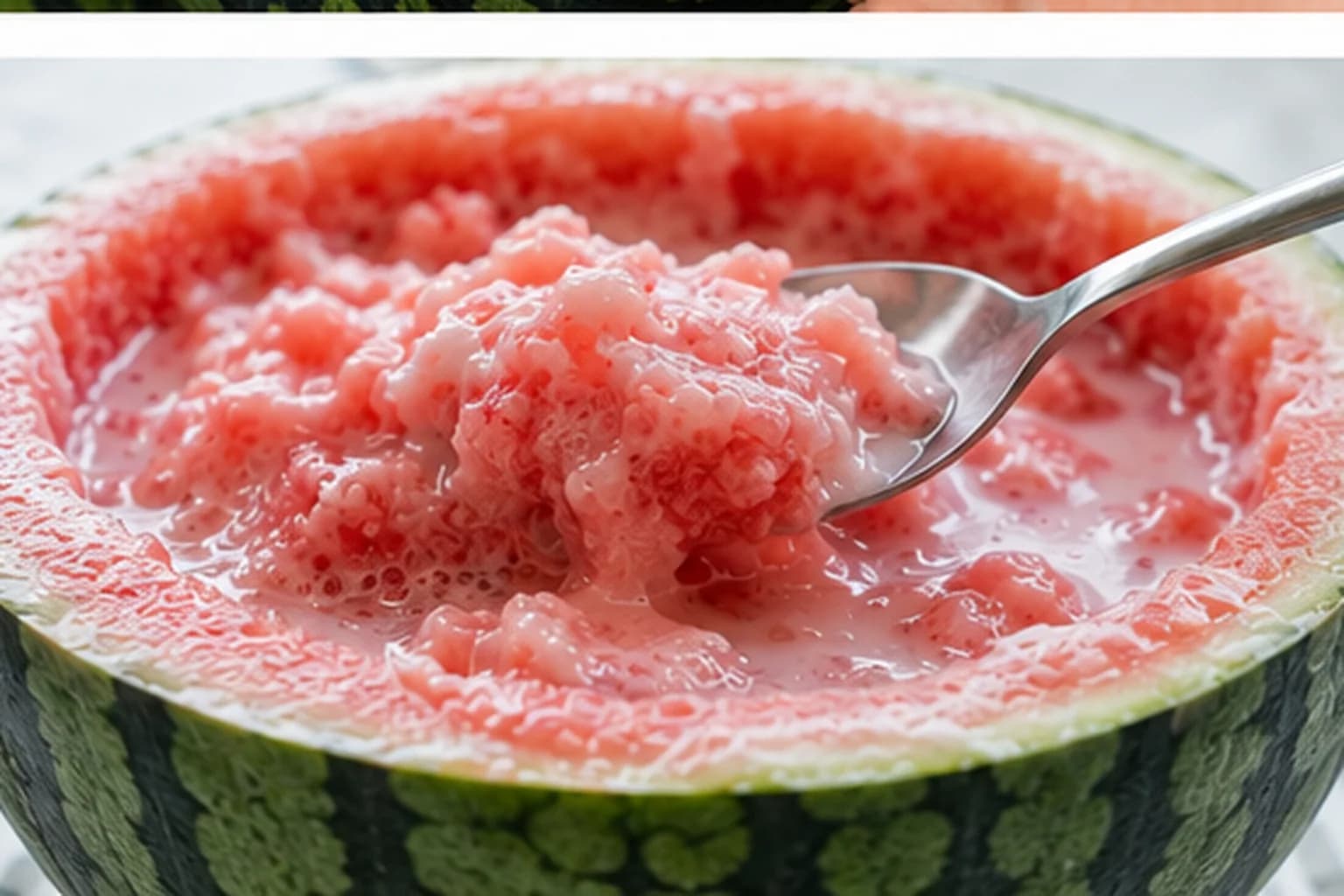
An easy trick if your freezer is big enough: frozen-melon milk "ice cream". Scoop out part of the flesh from a half melon and freeze the half until it's solid. Then pour cold milk over it and scrape with a spoon until it turns into a slushy sherbet. Your freezer has to fit a half melon, so this works best in a family flat.
Watermelon juice. Blend the flesh with ice; a ripe melon doesn't need sugar.
Frozen cubes. Freeze leftover cubes on a tray and use them instead of ice in punch or juice, so the drink doesn't get watered down.
Watermelon punch with scooped melon balls in a milk base.
Frozen watermelon flesh scraped into milk to make a quick sherbet.
How this article was prepared
Sources checked
- Munhwa Ilbo via Daum, watermelon price report (2026-05-11)— Citing KAMIS: top-grade retail price 30,132 won per fruit on 2026-05-08, after early heat pulled summer demand forward; April's national average temperature was the third-highest since 1973
- Asia Economy, watermelon price report (2026-07-22)Linked page is in Korean— Top-grade retail price 22,784 won per fruit on 2026-07-21, 24.8% below a year earlier, as larger planted areas raised the harvest
- MAFRA price release (2026-07-30)Linked page is in Korean— Watermelon listed among summer seasonal produce; late-July 2026 wholesale price of 20,405 won per 8 kg, down 33.5% on 2025, as larger July plantings and good weather raised shipments
- Newsis, Lotte Mart cut fruit (2026-07-23)— Cut watermelon in 200 g, 400 g and 800 g packs, stocked year-round from 2026; small cut-fruit packs went from 150 g to 200 g in May 2026 at the same 2,990 won
- Korea Economic Daily, summer fruit shopping report (2026-07-14)— Lotte Mart sold a 400 g cup of prepared watermelon at 5,990 won in late June 2026
- Cheongnyeon Ilbo (youthdaily.co.kr), emart24 watermelon lineup (2025-06-13)Linked page is in Korean— emart24 listed whole melons under 6 kg (24,000 won) and under 8 kg (32,000 won), a quarter melon (9,900 won) and peeled bite-size pieces (8,500 won)
- VISITKOREA, Korean currency and exchange (2023-03-27)— Most businesses, including general shops, accept credit cards such as Visa, MasterCard and American Express, but some stores do not offer card payment
- KAMIS price information service (Korean only)Linked page is in Korean— Official daily retail price lookup for watermelon; the footer names the operator, Korea Agro-Fisheries & Food Trade Corporation; no English version
- Lotte Mart official English site— Brand spelling Lotte Mart in running English text
- emart24 official siteLinked page is in Korean— Brand spelling emart24 in the logo text
- Asia Economy English edition, Haman watermelon sale (2020-05-04)— Spellings Gyeongsangnam-do and Haman-gun; Haman-gun described as the main production area of winter watermelons
- Jeonbuk State, English site— Official English name Jeonbuk State; lists Gochang-gun
- Jeonbuk Ilbo, premium GI Gochang watermelon (2025-05-21)Linked page is in Korean— Gochang watermelon registered as Geographical Indication No. 116 on 2024-09-20; from 2025-05-26 Gochang-gun sold a premium GI line through its online mall, only for fruit of 8 kg or more and 12 Brix or more
- Rural Development Administration, Nongsaro watermelon varieties (c. 2021)Linked page is in Korean— Government horticulture researchers: winter-grown black-skinned melons shipped in April–May average about 1 Brix above a regular melon's 11 Brix, with no gap after July; apple watermelons weigh 2 kg or less and can be peeled with a knife
- Seocho-gu Office, food waste sorting guide (Korean, updated 2026-08-20)Linked page is in Korean— Bulky items such as watermelon are to be cut small before disposal, since large pieces can break the processing machines; drain water first; plastic bags are not food waste
- Gangdong-gu food waste disposal guide (Korean, updated 2026-04-21)Linked page is in Korean— Watermelon rind is food waste; squeeze out water and remove disposable plastic bags; bags at 100 won per liter for houses and buildings under 20 households; RFID bins at 130 won per kilo for 20 or more
- Seoul Metropolitan Government, food waste standard in ten languages (2020)— Remove water before disposal; chop large vegetables finely; plastic bags and other objects that cannot be mixed with food are not food waste
- Seoul Shinmun, cut watermelon storage (July 2025)Linked page is in Korean— Korea Consumer Agency's 2015 fridge test: bacteria grew far more on a film-wrapped half than on pieces in a sealed container; it advises eating cut melon the same day and keeping leftovers as bite-size pieces in a sealed container
- Two Plaid Aprons, watermelon hwachae recipe— Modern home version with milk and lemon-lime soda, served in a bowl or the hollowed melon and sweetened with sugar or honey
- Gangseo-gu Office, Haman-gun sister city (English)— Official English page spelling Haman-gun and Gyeongsangnam-do
Related reading
Jeolla-style kimchi for kimjang: what sets it apart, and a 5 kg batch by weight
Jeolla kimchi stands out for its thick, ground seasoning. For 5 kg of salted cabbage, start with 300 g gochugaru and 350 g jeotgal, then adjust by taste.
Korean persimmons: which ones you can eat firm, and how to ripen, dry and store the rest
Only dangam is meant to be eaten firm. Most other fresh Korean persimmons are astringent and have to go jelly-soft, or be dried or frozen, first, so read the label and squeeze before you buy.
Korean winter street snacks: what to order, what they cost, and how to pay
Carry small won notes. Bungeoppang ran from 3 for 2,000 won to 1,500 won apiece in 2025/26 news reports, some stalls refuse cards, and a transfer-only stall is off-limits without a Korean bank account.
Making geotjeori in Korea, from buying the right packs to a small batch
For one small batch of fresh kimchi in Korea, buy one albaechu, coarse sea salt, coarse chili flakes and anchovy fish sauce. If you'd never finish the pantry packs, a kit or ready-made geotjeori is the better buy.
How to make cilantro kimchi in Korea, scaled to Korean grocery packs
Cilantro kimchi made at home in Korea is best treated as a fresh side dish. This recipe uses 100 g of cilantro and about 400 g of Korean radish for a batch to eat within two days.
Korean BBQ in Korea: meat cuts on the menu, price per 100g, and ordering for your group
Choose the restaurant by group size and budget, then compare menus using the price per 100g, not per serving. Before paying Hanwoo prices, check the origin label. Solo diners often face a two-serving minimum.