Visiting Korea
Seoul to Busan: which train, bus or flight fits where you start and where you stay
Which station to leave from by neighborhood, what you can book with a foreign card, and what to do when trains sell out
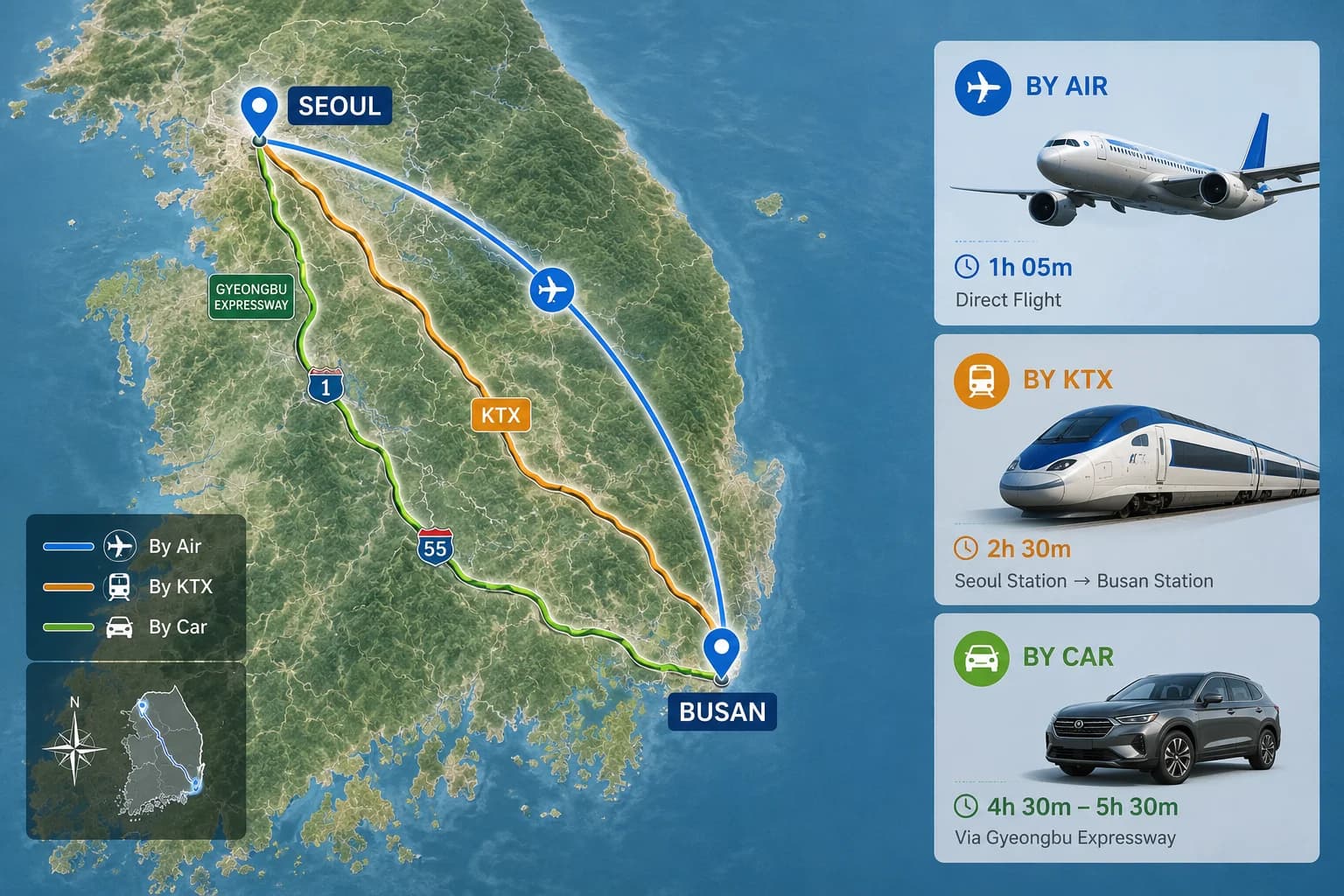
At a glance
For most visitors the answer is a KTX to Busan Station, leaving from Seoul Station or, if you stay in Gangnam, from Suseo. Fly only if you are near Gimpo and the fare is cheap. Take the bus to save money or when every train is sold out.
The answer depends less on the speed of each option and more on two places: where you are in Seoul and where you sleep in Busan.
For most people the KTX from Seoul Station to Busan Station is still the best choice.
Two things changed in September 2026, and one change from late 2025 matters too.
SRT no longer exists as a separate brand.
The Seoul–Busan KTX fare dropped to , according to Seoul Economic Daily.
And since late December 2025 a few KTX-Eum trains have reached the Haeundae side without going through Busan Station.
A KTX high-speed train stands at a platform at Seoul Station.
What changed on 1 September 2026
KORAIL merged KTX and SRT into one high-speed service.
Reports at the time said the SRT app and website would close after 31 August 2026, and the former SRT trains now run as KTX-Sancheon.
In the KORAIL+ app, trains from Seoul Station and Suseo now appear together in one search.
Seoul Economic Daily reported that fares would fall by about 10% on average to the old SRT level, with Seoul Station to Busan in standard class going from 59,800 won to 54,400 won.
Check the Suseo–Busan fare on the booking screen.
The same report listed two smaller changes that help travelers:
Tickets can be changed free of charge within 7 days either side of the travel date, up to 30 minutes before departure.
Delays of 90 minutes or more now earn 75% of the fare back, and 120 minutes or more the full fare.
Which option wins from your part of Seoul
Where you start in Seoul decides the departure point, and where you stay in Busan decides the last leg.
Central and west Seoul (Myeongdong, Jongno, Hongdae, Itaewon): take the KTX from Seoul Station.
Gangnam, Jamsil and Seocho: take the KTX from Suseo.
East and northeast Seoul (Cheongnyangni, Dongdaemun): take the KTX from Seoul Station, or KTX-Eum from Cheongnyangni if you stay on the Haeundae side and a train stops there on your date.
Near Gimpo International Airport: fly only if the fare is cheap, then take the light rail and Line 2; otherwise take the KTX from Seoul Station.
Rome2rio's average KTX time between Seoul Station and Busan Station is about 2 hours 48 minutes, with trains roughly every 20 minutes.
Times from Rome2rio in this guide are averages, so treat them as rough estimates.
Three things decide most of these answers.
Busan Station is in the city center. Busan Station and Nampo are both on Line 1, and Rome2rio puts Seomyeon about 11 minutes away.
Haeundae is the long leg: about 55 minutes on Line 1 and then Line 2, changing at Seomyeon.
If you stay in Haeundae with heavy luggage, a taxi from Busan Station is often worth the cost.
Rome2rio puts that taxi fare at about 18,000–22,000 won.
For the subway legs, a transit card saves buying a ticket each time; see transit payments for foreign travelers.
Flying rarely saves time. Rome2rio lists the Gimpo to Gimhae flight at about 1 hour 5 to 10 minutes.
Before that you need to get to the airport early enough to check in.
From Gimhae, the Busan-Gimhae Light Rail Transit runs to Sasang, where you change to Line 2 for Seomyeon and Haeundae.
The flight comes out ahead only if you start next to Gimpo, stay in west Busan (Sasang and around), or find a fare below the train fare.
KTX-Eum goes straight to the Haeundae side, but only some trains stop there. KTX-Eum trains run from Cheongnyangni Station to Bujeon Station in 3 hours 38 minutes at the fastest, and since 30 December 2025 some also stop at Sinhaeundae Station and Centum Station.
It is also worth checking as a backup, because it runs on a different line from the trains out of Seoul Station and Suseo.
The main hall at Suseo Station in southeast Seoul.
Can you book it with a foreign card and no Korean phone number?
Trains: usually yes, online.
The Korea Herald wrote in July 2026 that train tickets can be bought online with foreign-issued cards, while bus tickets have been more limited.
Express buses: possibly online, but don't plan on paying at the terminal with a foreign card.
In April 2026 the Korea Herald reported that on-site purchases of express bus tickets with overseas-issued cards had been suspended since August 2025. Domestic flights: book on the airline's own website and check its payment options there.
A foreign card can also fail at the final 3-D Secure check on a Korean payment page.
Channel | Foreign card | Korean phone needed? | What to expect |
|---|---|---|---|
KORAIL English website | Accepted, according to the Korea Herald and traveler guides | Not for regular tickets, according to traveler guides (email + reservation password) | The most reliable online route, according to traveler guides |
KORAIL+ app | Some app-store reviews describe foreign cards failing mid-payment | Not stated | Searches Seoul Station and Suseo trains together; its store listing includes English |
Kobus (express bus website) | Planned from August 2026, without membership | Not stated | Not confirmed that this is live; if payment fails, ask at the terminal how you can pay |
Tmoney Go app | Korean-issued cards only | Account required | Not useful for most visitors |
Holiday pre-sales are the exception. The early sale windows for Chuseok and Seollal are reportedly for KORAIL members only and need identity checks with a Korean phone in your own name.
If you can't sign up, plan around the backup options below.
KORAIL membership also earns mileage worth 5% of the fare, which now applies to Suseo trains as well.
Short-term visitors don't need membership for a normal trip.
Book on the KORAIL English website.
When every train shows sold out
Friday evenings, Sunday afternoons and the Chuseok and Seollal holidays are the main problem dates.
Work down this list in order:
Check again closer to departure. Free changes until 30 minutes before departure mean seats can come back on the day.
Try the other departure station. Seoul Station and Suseo trains now appear in one search in the KORAIL+ app, so check every departure from both.
Try KTX-Eum from Cheongnyangni. It runs on a separate line, takes longer (3 hours 38 minutes at the fastest), and arrives in Bujeon or on the Haeundae side.
Take an express or premium bus. Buses leave Seoul Express Bus Terminal about every 30 minutes, but they sell reserved seats only, with no standing.
Take an early flight from Gimpo. On holiday weekends, fares can cost more than the KTX.
From 1 October 2026 tickets go on sale up to two months ahead instead of one, according to a Korean news report from September.
The same report said the foreigner booking page would add French, German and Mongolian, for 10 languages in all.
For a trip on a holiday weekend, book on the day sales open.
The express bus: half the price, an extra hour or more
Buses from Seoul Express Bus Terminal take about 4 hours to Busan, according to Rome2rio.
It lists roughly 27,000–32,000 won for economy seats and 39,000–44,000 won for the class it calls Excellent, with no premium fares shown.
Check the arrival terminal before you buy.
These buses arrive at Busan Central Bus Terminal, by Nopo Station at the far end of Line 1, a long subway ride from Seomyeon and Haeundae.
Reclining single seats in a three-across premium express bus.
If you hope to ride overnight and save a night's accommodation, check for late departures on your date before you plan around it.
Check fares, seat classes and departure times on Kobus.
Flying from Gimpo
Korean Air, Air Busan and several other airlines fly from Gimpo International Airport to Gimhae, according to Rome2rio's flight listings.
The airport time at both ends is what makes the trip long.
Travelers leave the domestic arrivals area at Gimhae International Airport.
Is the KORAIL PASS worth it for Busan?
Not for a simple round trip.
A third-party guide that cites KORAIL's notices lists the cheapest pass at for 2 travel days, while a Seoul–Busan round trip at the new fare is 108,800 won.
At those prices the pass costs about 22,200 won more than the two tickets.
Pass (adult) | Listed price | Cost per travel day |
|---|---|---|
2 travel days | 131,000 won | 65,500 won |
3 travel days | 186,000 won | 62,000 won |
4 travel days | 234,000 won | 58,500 won |
5 travel days | 275,000 won | 55,000 won |
Every pass costs more per travel day than a Seoul–Busan ticket at 54,400 won.
So a pass only pays off if you average more than one ride that long per travel day.
According to that guide, since 11 December 2025 KORAIL has sold only these "select" passes: you choose your travel days within a 10-day window.
The rules it reports:
Eligibility. For foreign visitors with a passport. Korean nationals can't buy it.
Seat reservations. Up to two reserved seats per day; after that you ride standing.
Suseo trains. Coverage of the former SRT services from Suseo has not been confirmed, so ask before relying on the pass from Gangnam.
Holidays. Use can be restricted around Chuseok and Seollal.
How this article was prepared
Sources checked
- Seoul Economic Daily, "Korail to Merge KTX and SRT on Sept. 1, Cutting Fares 10%" (2026-08-05)— Merger on 1 September; fares down 10% on average to SRT levels, Seoul–Busan 59,800 to 54,400 won; SRT renamed KTX-Sancheon; app searches Seoul and Suseo departures at once; free changes; delay compensation; 5% mileage on Suseo trains
- Kyunghyang Shinmun, KTX-Eum Jungang line timetable change (2025-12-15)— Cheongnyangni–Bujeon fastest time cut to 3 hours 38 minutes from 30 December 2025; some trains also stop at Sin Haeundae and Centum
- KoreanKorea, KORAIL PASS prices and calculator— Four select passes sold since 2025-12-11 (131,000 to 275,000 won), 10-day window, 2 reserved seats per day, foreign passport holders only, Suseo coverage unconfirmed, holiday limits; cites Korail notices
- LACHA, KTX and SRT integration guide (updated 2026-09-28)— SRT app and SR website run only through 2026-08-31; post-merger foreign-card guidance for Suseo trains not yet released (promotional source; used only for points marked as reported)
- Seoul Start, KORAIL+ and bus apps for foreign residents— App replaced KorailTalk on 2026-08-03; Google Play reviews describe foreign cards failing mid-payment; international cards can fail at the final 3-D Secure check; Tmoney's app needs an account; buses sell reserved seats only
- Toyoni, booking KTX as a foreigner (updated 2026-09-24)— Global site books regular tickets with an email and reservation password, no Korean phone; holiday pre-sale fares are member-only, and membership needs a phone check in your own name (promotional source)
- The Korea Herald, "Express bus booking to open to foreign-issued cards" (2026-07-01)— Train tickets can be bought online with foreign-issued cards; Kobus to take foreign cards from August 2026 without membership; Tmoney Go stays Korean-card only; photo of the Seoul Express Bus Terminal in Seocho-gu
- The Korea Herald, "S. Korea tops public transport use, but foreign visitor convenience lags" (2026-04-13)— On-site purchases of express bus tickets with overseas-issued cards suspended since August 2025
- MTN, KTX tickets bookable two months ahead from October (2026-09-20)Linked page is in Korean— Booking window extended from one month to two months before departure from 1 October 2026; foreigner booking page to add French, German and Mongolian for 10 languages
- Rome2rio, Seoul Station to Busan Station— KTX average 2h48m with trains about every 20 minutes; Gimpo–Gimhae flights about 1h5m–1h10m by Korean Air, Air Busan and others
- Rome2rio, Seoul Express Bus Terminal to Busan Central Bus Terminal— Buses about every 30 minutes, about 4 hours; economy 27,000–32,000 won and Excellent class 39,000–44,000 won; no premium fares listed
- Rome2rio, Busan Station area to Haeundae— Subway to Seomyeon in about 11 minutes, then on to Haeundae, about 55 minutes in all; taxi about 18,000–22,000 won
- KORAIL corporate English site— KORAIL's own English menu listing the KTX, KTX-Sancheon and KTX-Eum trains, with a KORAIL PASS reservation link
- KORAIL corporate English site, History— KORAIL's history page, with the English forms Seoul Station and Cheongnyangni
- App Store listing, KORAIL+— Official KORAIL+ app of Korea Railroad Corporation; English is among its seven listed languages
- Busan Transportation Corporation, English route mapLinked page is in Korean— Line 1, Line 2, East Line and Busan-Gimhae Light Rail Transit stations, including Nampo, Busan Station, Seomyeon, Nopo, Haeundae, Centum City, Centum, Sinhaeundae, Bujeon, Sasang and Gimhae International Airport
- Korea Airports Corporation, Gimpo International Airport English siteLinked page is in Korean— Official names Gimpo International Airport and Gimhae International Airport; airline names in the flight search, including Korean Air and Air Busan
- Seoul Metropolitan Government, 2024 Seoul Lifestyle Tour brochure (PDF)Linked page is in Korean— English brochure naming Seoul's tourism special zones: Itaewon, Myeongdong, Dongdaemun, Jongno, Jamsil, Gangnam and Hongdae
- Korea Tourism Organization, VisitKorea public holidays— English names of the Seollal and Chuseok holidays
- Busan Metropolitan City, Into K-pop Into Busan transportation guideLinked page is in Korean— Busan Central Bus Terminal at the Nopo Station bus stop; Line 1 between Busan Station and Nopo; light rail from Gimhae International Airport; Line 2 from Sasang
Related reading
Seoul to Gyeongju: which train or bus to take, and how to get from the station into town
Take the KTX from Seoul Station, or from Suseo if you stay in southeast Seoul, and add 15–30 minutes from Gyeongju Station into town. From October to February a Wolji Pond night view fits a day trip on the 20:13; in the lighter months take the 22:38, which arrives after midnight, or stay over.
Seoul to Phoenix Park for a ski day: which route to book, and what the day costs
Most Seoul-based visitors should book the reseller shuttle bus, because it takes foreign cards and needs no Korean number. Using third-party and earlier-season prices, a beginner's ski day cost roughly 150,000–170,000 won plus transport and lessons.
Sungsimdang in Daejeon: which branch sells which cake, when to arrive, and how to get it home cold
Seasonal siru cakes and rolls are sold mainly at the cake shops, not at the main bakery. Arrive before 8 a.m., buy cake first, and pack it in ice if it's over an hour from a fridge.
Christmas in Seoul 2026: market dates, light shows and which ones you need to book
Gwanghwamun Market (11 Dec–10 Jan, from 17:30, free) is Seoul's main Christmas market. Before 11 December, head for the department store displays in Myeongdong, Jamsil and Yeouido instead.
Olive Young tax refund, foreigner discounts and sale dates: what to know before you pay
Show your physical passport and Olive Young takes 5–8% off any single receipt of 15,000 won or more at the till. Visitors can't join the Korean membership, but can earn CJ ONE points by signing up with just an email.
What to wear in Korea in December and through winter: city temperatures, layers, shoes for ice
For Seoul in December, wear three layers that open at the front, plus a hat, mittens and waterproof shoes with deep tread. Busan and Jeju are milder but windy. Mornings in Chuncheon are about 3°C colder than in Seoul, and in Daegwallyeong about 6°C colder.