Visiting Korea
Seoul to Gyeongju: which train or bus to take, and how to get from the station into town
Pick a station by where you stay in Seoul, budget 15–30 minutes from Gyeongju Station into town, and check the late trains before you plan a night at Wolji Pond
At a glance
Take the KTX from Seoul Station, or from Suseo if you stay in southeast Seoul, and add 15–30 minutes from Gyeongju Station into town. From October to February a Wolji Pond night view fits a day trip on the 20:13; in the lighter months take the 22:38, which arrives after midnight, or stay over.
The train ride is the short part of a trip from Seoul to Gyeongju.
On 16 October 2026, most KTX trains from Seoul Station reached Gyeongju Station in about 2 hours to 2 hours 20 minutes.
That station is on the city's outskirts, though, so add 15–30 minutes by taxi or bus to reach Hwangnidan-gil, the tombs or Donggung Palace and Wolji Pond.
Express buses take about 3 hours 45 minutes but stop at a terminal in town.
The short answer: take the KTX from Seoul Station, or from Suseo Station if you're staying in southeast Seoul.
Take the bus only if saving money matters more than time.
If you want Wolji Pond after dark and a bed in Seoul, the 20:13 KTX works in the darker months, roughly October to February; in the lighter months it means the 22:38, which reaches Seoul Station after midnight.
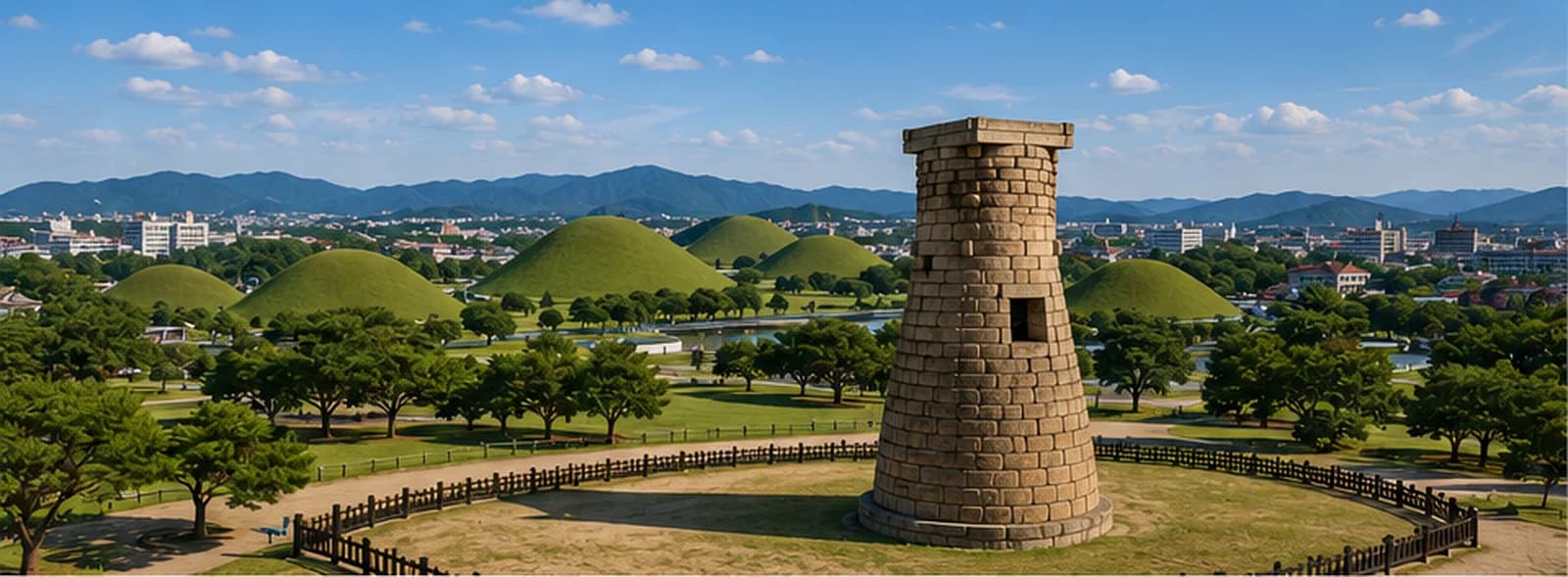
Cheomseongdae Observatory with the Daereungwon tomb mounds behind it in central Gyeongju.
Which train or bus fits where you're staying in Seoul?
Choose the departure point by where you're staying, not by the train's speed.
Trains from Seoul Station and Suseo take about the same time on board.
KTX-Eum trains from Cheongnyangni, handy for north and east Seoul, take roughly half an hour longer.
What differs is the trip across Seoul and how many trains there are.
Option | On board | Adult fare, one way | Departures a day | Then into town |
|---|---|---|---|---|
KTX from Seoul Station | About 2h–2h20m on most trains | About , standard class | About 30 | Taxi about 15 min, bus 20–30 min |
KTX or KTX-Sancheon from Suseo Station | About 2h–2h15m | , standard class | 9–10 | Taxi about 15 min, bus 20–30 min |
KTX-Eum from Cheongnyangni Station | About 2h30m–2h55m | , standard class | 9, plus 2 ITX-MAUM trains that take about 4h | Taxi about 15 min, bus 20–30 min |
Express bus from Seoul Express Bus Terminal | About 3h46m | , Excellent class (the one standard bus costs 24,700 won) | 10 | Walk about 10 min to Hwangnidan-gil |
Train and bus figures come from third-party listings checked in October 2026. The one standard-class bus a day, at 17:10, costs , and premium seats cost 47,700–57,200 won.
Check your own date on KORAIL's English booking site before you pay.
From southeast Seoul, the train still wins door to door.
Suseo to Gyeongju takes about 2 hours to 2 hours 15 minutes, and the ride into town 15–30 minutes, so 2 hours 15 minutes to 2 hours 45 minutes in all.
The bus takes 3 hours 46 minutes plus a 10-minute walk, or 3 hours 56 minutes, so the train saves more than an hour.
The bus saves 6,200 won in Excellent class (42,900 − 36,700) and 18,200 won on the 17:10 standard bus (42,900 − 24,700).
It makes sense when trains are sold out, or when you'd rather step off in the center than change to a city bus.
Older guides quote 49,300 won from Seoul Station.
KORAIL said it would cut KTX fares by an average of 10% when it merged KTX and SRT on 1 September 2026, according to Seoul Economic Daily, and 49,300 won less 10% is about 44,400 won.
The former SRT trains from Suseo now run as KTX-Sancheon.
A KTX train at a platform in Seoul Station.
Two booking traps
Search for Gyeongju, not Singyeongju. The high-speed station opened as Singyeongju Station, and the transport ministry approved renaming it Gyeongju Station in December 2022. The old downtown Gyeongju Station closed in December 2021, when its lines were moved.
Older guides may still use the old name for the station on the outskirts.
Check the journey time before you pay. Most Seoul Station trains take about 2 hours to 2 hours 20 minutes; about 8 trains a day take 2h47m–3h17m, and the slowest of those, numbered in the 700s, are KTX-Eum trains that also stop at Cheongnyangni.
If you're leaving from Seoul Station, pick one of the faster trains.
Train tickets can be bought online with foreign-issued cards, the Korea Herald reported in July 2026. The same report said Kobus, the express bus booking site, would start accepting foreign cards in August 2026. The Seoul–Busan guide covers buying tickets and rail passes in more detail; Gyeongju tickets work the same way.
Getting from Gyeongju Station into town
A taxi is the quicker way from the station to the historic center, and the bus the slower one.
From Gyeongju Station to | City bus | Bus time | Taxi time |
|---|---|---|---|
The bus terminals, for Hwangnidan-gil and Daereungwon | 50, 51, 70, 710 and 711, among others | About 20–30 min, then a 10-min walk | About 15 min |
Bulguksa Temple | 711 (about 10 a day) or 700 (about 4 a day) | About 47–55 min | About 30 min |
Route numbers and ride times come from two travel guides checked on 16 October 2026, so check the stop sign at the station for current routes.
If neither direct bus to Bulguksa is due soon, take any bus to the terminals, then bus 10 or 11. Pay with a Tmoney card, which can be used on all public transport and bought at convenience stores nationwide.
The transit payment guide explains how to get and top up a card.
Can you see Wolji Pond at night and still get back to Seoul?
Yes, as long as you take one of the last trains back.
Donggung Palace and Wolji Pond is open 09:00–22:00, with last admission at 21:30, and adult admission is .
Both timetable listings checked in October 2026 show two late KTX trains from Gyeongju Station to Seoul Station: the 20:13, arriving at about 22:20–22:30, and the 22:38, arriving at 00:42. One listing also shows a 21:35 (arriving 23:49) and a 22:03 (arriving 00:11), so confirm those on KORAIL's English booking site for your date.
The pavilions at Donggung Palace reflected in Wolji Pond after dark.
Leave the pond 45 minutes before your train, which allows up to 30 minutes for the taxi plus time to find one and reach the platform.
That means leaving by about 19:30 for the 20:13, or just before closing time for the 22:38. How long you get there after dark depends on the season:
Roughly October to February. It gets dark early, so even the 20:13 leaves you time at the pond after dark.
Spring and summer. The evenings stay light much longer, so a night view means the 22:38 or staying over; check the sunset time for your date.
Arriving after midnight. The 22:38 reaches Seoul Station at 00:42, so check the last subway for your route, or plan on a taxi from the station's taxi rank.
By bus. The last express bus to Seoul left Gyeongju at 21:30 on a listing checked in October 2026. At 3 hours 46 minutes it arrives at about 01:16 (21:30 + 3:46), so if you came by bus and want the night view, stay over.
Staying in southeast Seoul. Trains back to Suseo are fewer. A listing checked for late October 2026 showed 11–12 a day, the last at 22:51, which arrives after midnight.
Woljeonggyo Bridge, rebuilt in 2018, is lit at night too.
Add it if you're staying over, and skip it if you're catching a train back.
The old town: what's free and what isn't
The old-town sights span about a 30-minute walk end to end, according to one day-trip guide.
Daereungwon Tomb Complex, a park of 23 tombs from the Silla kingdom, has been free since 4 May 2023 and, per a 2023 report, is open daily 09:00–22:00. Cheonmachong, a tomb inside the park, still charges its own admission.
Cheomseongdae Observatory, which the culture ministry calls Asia's oldest surviving astronomical observatory, is lit at night and a short walk from Wolji Pond.
Hwangnidan-gil, a street of cafes and restaurants in renovated hanok, runs alongside Daereungwon, so it fits before or after the tombs.
Hanok-roofed cafes and snack shops along Hwangnidan-gil.
Bulguksa Temple: give it a morning
Bulguksa Temple and Seokguram Grotto were registered together as a UNESCO World Heritage Site in December 1995. Both stopped charging admission on 4 May 2023. From the bus terminals in town, bus 11 takes about 34 minutes to Bulguksa and bus 10 about 42 minutes.
Bus 12 runs on to the Seokguram parking lot infrequently, roughly hourly on some timetables, so check the timetable at the Bulguksa stop; the grotto is a walk from the parking lot.
Seeing Bulguksa and the night view on one day trip, with a train to catch, is too much.
If you can only fit one, choose Bulguksa when you're heading back in the afternoon and Wolji when you can take a late train.
The stone stairways up to the main gate of Bulguksa Temple.
Summer: a pool day instead of Bulguksa
Gyeongju World, an amusement park in the city, also runs a water park, California Beach.
Check this year's season and tickets before you plan around it.
With a spare summer day, it can replace Bulguksa on the second day.
Swimmers in the wave pool at California Beach in summer.
What to eat between sites
Gyeongju's local snacks are mostly breads.
Gyeongju bread (gyeongju-ppang). A thin pastry packed with sweet red-bean paste.
Barley bread (chalbori-ppang). Two soft, pancake-like rounds made with glutinous barley and filled with red bean.
10-won bread (sibwon-ppang). A waffle shaped like an old 10-won coin, with stretchy cheese inside.
Melted cheese stretching from a 10-won bread pulled in half.
A two-day plan that follows the transit
Go out on a morning train, then take a taxi or bus straight to the terminal area.
Spend the first day on Hwangnidan-gil, Daereungwon and Cheomseongdae, and finish at Wolji Pond and Woljeonggyo Bridge after dark.
On the second day, take a city bus to Bulguksa, or spend a summer day at California Beach.
Then take a taxi or bus to Gyeongju Station for an afternoon train.
For a day trip, drop Bulguksa.
Spend the afternoon in the old town, see Wolji after dark and take the 20:13 from October to February.
In the lighter months, take the 22:38, which reaches Seoul after midnight, or stay over if the night view matters.
How this article was prepared
Sources checked
- Seoul Station to Gyeongju KTX timetable for 16 Oct 2026 (Korea Charts)— 29 KTX trains; 21 take 2h01m–2h21m and 8 take 2h47m–3h17m; standard adult fare 44,600 won; public data portal data dated 16 Oct 2026
- Gyeongju to Seoul Station KTX timetable for 16 Oct 2026 (Korea Charts)— Departures after 20:00 at 20:13 (arrives 22:26), 21:35 (23:49), 22:03 (00:11) and 22:38 (00:42)
- Gyeongju to Seoul Station high-speed timetable (asamaru)— Checked in October 2026: after 19:00 only 19:07, 20:13 (arrives 22:21) and 22:38 (arrives 00:42) on every date listed, with no 21:35 or 22:03
- Suseo to Gyeongju high-speed timetable (asamaru)— Updated 16 Oct 2026; KTX and KTX-Sancheon; 9 trains on 16–18 Oct, 10 on 19–22 Oct, 2h01m–2h17m; standard adult fare 42,900 won; 11 trains back to Suseo on 16 Oct, the last at 22:51
- Seoul Express Bus Terminal to Gyeongju express bus timetable (asamaru)— Checked in October 2026: 10 buses a day, 3h46m; one standard bus at 24,700 won (17:10), five Excellent-class at 36,700 won, four premium at 47,700–57,200 won; last bus from Gyeongju to Seoul at 21:30
- Seoul Economic Daily, "Korail to Merge KTX and SRT on Sept. 1, Cutting Fares 10%" (5 Aug 2026)— Merger from 1 Sept 2026; KTX fares to fall an average of 10% to SRT levels; SRT renamed KTX-Sancheon; names Suseo Station
- KORAIL corporate English site— KORAIL's own English site; spellings KORAIL, KTX, KTX-Sancheon, KTX-Eum and ITX-MAUM; links to the English booking site, whose station list shows Gyeongju
- KORAIL corporate English site, History— Lines to Singyeongju opened on 28 Dec 2021; English spellings Singyeongju and Cheongnyangni
- Cheongnyangni to Gyeongju high-speed timetable (asamaru)— Checked in October 2026: 9 KTX-Eum trains a day (701–717) taking 2h37m–2h54m at 42,900 won standard, plus 2 ITX-MAUM trains taking about 4 hours
- Segye Ilbo on the Singyeongju Station rename (26 Jan 2023, in Korean)— Transport ministry committee approved renaming Singyeongju Station as Gyeongju Station on 28 Dec 2022; old downtown Gyeongju Station closed in Dec 2021 when its lines moved
- The Korea Herald, "Express bus booking to open to foreign-issued cards" (1 Jul 2026)— Train tickets can be bought online with foreign-issued cards; Kobus to take foreign cards from August 2026 without membership; caption names the Seoul Express Bus Terminal
- Koreatodo Gyeongju day-trip guide— Buses 50, 51, 70, 700, 710 and 711 among those from the station to the express terminal (18–20 min), then a 10-min walk to Hwangnidan-gil; 711 and 700 to Bulguksa; 11 and 10 from the terminal; 12 to Seokguram; sights within a 30-min walk; older 49,300-won fare
- Trip.com Korea guide to Gyeongju by train (in Korean)Linked page is in Korean— From Gyeongju Station: Hwangnidan-gil about 30 min by bus or 15 by taxi, Bulguksa about 50 by bus or 30 by taxi; station on the city's outskirts; older 49,300-won KTX fare
- VisitKorea, Donggung Palace and Wolji Pond— Official English name; open 09:00–22:00, last ticketing and admission 21:30; adults 3,000 won
- Ministry of Culture, Sports and Tourism, "A day in Gyeongju" (Apr 2024)— Names Daereungwon Tomb Complex (23 tombs, incl. Cheonmachong), Cheomseongdae (Asia's oldest extant astronomical observatory), Woljeonggyo Bridge (restored 2018), Hwangnidan-gil and Silla; night lighting at Cheomseongdae, Wolji and the bridge
- Kyongbuk Maeil on Daereungwon admission (19 Apr 2023, in Korean)— Daereungwon free from 4 May 2023, open daily 09:00–22:00; Cheonmachong keeps its admission charge
- Kyongbuk Maeil on temple admission waivers (2 May 2023, in Korean)— Bulguksa and Seokguram among the temples dropping admission from 4 May 2023
- Korea Heritage Service, Seokguram Grotto, Gyeongju— Official English names Seokguram Grotto and Bulguksa Temple; jointly registered as UNESCO World Heritage in December 1995
- VisitKorea, Transportation Cards— Spelling Tmoney; cards work on all public transportation and are sold and loaded at convenience stores nationwide; names Seoul Station
- VISITKOREA, Gyeongju World feature (26 Sep 2025)— Official tourism page: from Gyeongju Station (KTX), a taxi (about 30 minutes) or city bus 1150 to Gyeongju World; its California Beach water park opens in summer
Related reading
Seoul to Busan: which train, bus or flight fits where you start and where you stay
For most visitors the answer is a KTX to Busan Station, leaving from Seoul Station or, if you stay in Gangnam, from Suseo. Fly only if you are near Gimpo and the fare is cheap. Take the bus to save money or when every train is sold out.
Seoul to Phoenix Park for a ski day: which route to book, and what the day costs
Most Seoul-based visitors should book the reseller shuttle bus, because it takes foreign cards and needs no Korean number. Using third-party and earlier-season prices, a beginner's ski day cost roughly 150,000–170,000 won plus transport and lessons.
Everland from Seoul: which ticket is actually cheaper, and which route fits where you're staying
Everland sells day passes on its Korean site, on an official English site for international visitors and through resellers. Here is how to compare them on your date, and which route from Seoul still gets you home after closing.
Sungsimdang in Daejeon: which branch sells which cake, when to arrive, and how to get it home cold
Seasonal siru cakes and rolls are sold mainly at the cake shops, not at the main bakery. Arrive before 8 a.m., buy cake first, and pack it in ice if it's over an hour from a fridge.
Olive Young tax refund, foreigner discounts and sale dates: what to know before you pay
Show your physical passport and Olive Young takes 5–8% off any single receipt of 15,000 won or more at the till. Visitors can't join the Korean membership, but can earn CJ ONE points by signing up with just an email.
What to wear in Korea in December and through winter: city temperatures, layers, shoes for ice
For Seoul in December, wear three layers that open at the front, plus a hat, mittens and waterproof shoes with deep tread. Busan and Jeju are milder but windy. Mornings in Chuncheon are about 3°C colder than in Seoul, and in Daegwallyeong about 6°C colder.