Visiting Korea
Korea Transit Payments for Foreign Travelers — T-money, Climate Card, WOWPASS, Overseas Cards at a Glance
Your first 30 minutes after landing: what to buy to ride the subway (2026 edition)
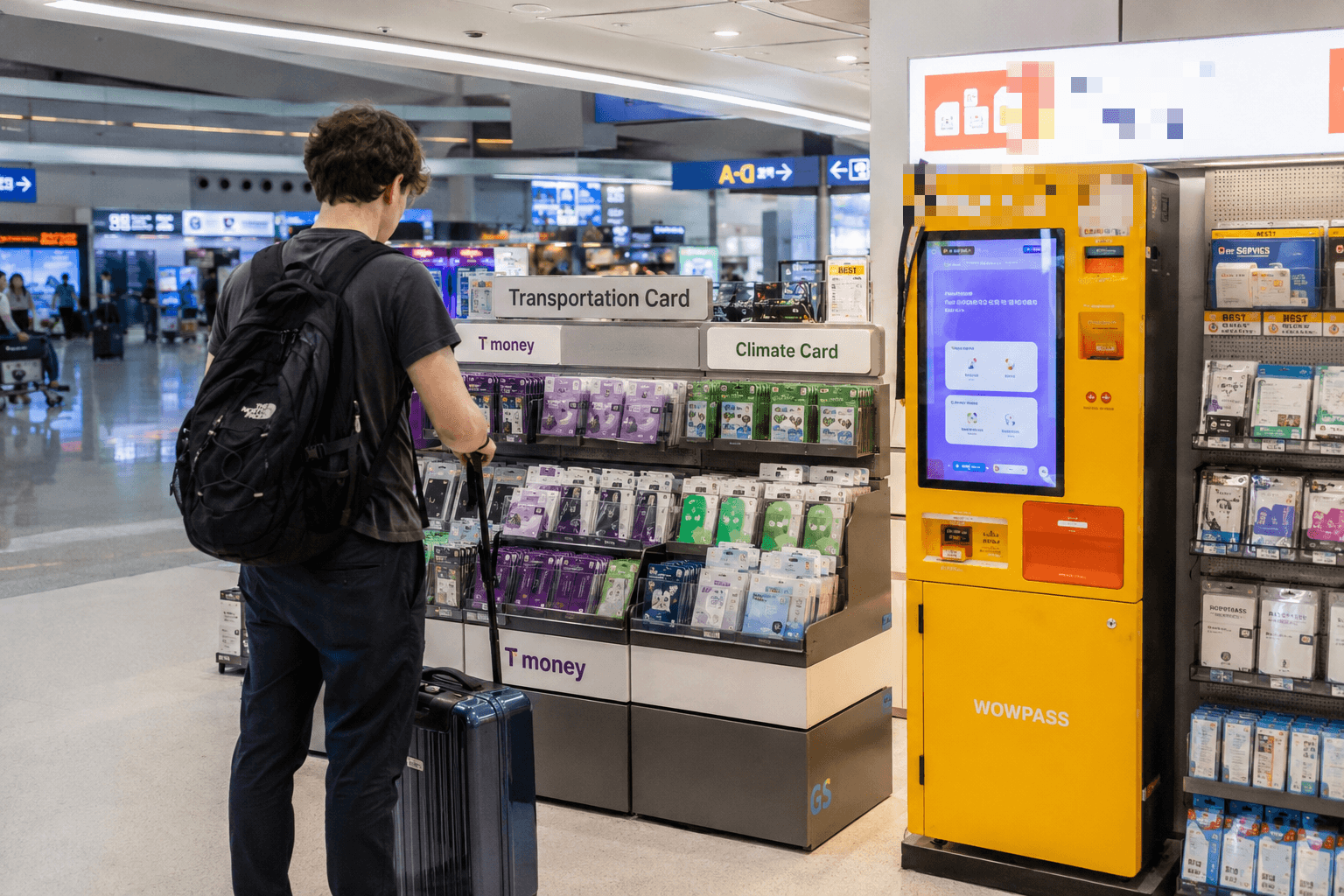
At a glance
One table compares T-money, the Climate Card, WOWPASS, and contactless overseas cards by price, where to get them, and coverage — then matches each travel style to a pick. Updated for 2026.
The first place you get stuck after landing in Korea is right in front of the subway turnstiles. "Do I need to buy a card? Can't I just tap my own credit card? And what is this Climate Card thing?" The good news: your options expanded a lot in 2026. The bad news: that's exactly why it got more confusing. This post is one decision table that settles it. It puts price, where to buy, and coverage in a single table, then tells you what to pick for each travel style. This isn't a made-up "I was there" review — it's a guide compiled from official sources.
The goal: sort this out within 30 minutes of landing — all you have to decide is what to buy
At a Glance — 5 Payment Options Compared
Conclusion table first. The five below are every option foreign travelers actually choose from.
Payment option | Card / issuance fee | Where to buy | Top-up & payment | Coverage | Best for |
|---|---|---|---|---|---|
T-money | 3,000–4,000 won (non-refundable) | Convenience stores, airport, stations | Cash top-up (new 2026 machines also take overseas cards) | Nationwide public transit + convenience-store payments | Most travelers, anyone going beyond Seoul |
Climate Card (tourist pass) | Card + 1-day pass from | Station info centers, ticket machines, convenience stores | Can be bought with overseas credit cards (from Mar 2026) | Seoul subway & city buses, unlimited | Anyone riding 4+ times a day within Seoul |
WOWPASS | (non-refundable) | Yellow kiosks (airport, Myeongdong, etc.) | Top up with foreign cash / overseas cards | Payments + transit (built-in T-money), nationwide | Anyone who wants exchange, payments, and transit on one card |
Contactless overseas card / Apple Pay | 0 won (your own card as-is) | — | At gates and ticket machines, just tap | Mainly Seoul subway (expanding) | Short stays, card-only travelers |
Single-journey ticket | deposit (refunded on return) | Station ticket machines | Cash | That one ride only | Riding just once or twice |
Subject to change — prices, coverage, and overseas-card support keep evolving. For the latest details, check VISITKOREA and each official channel.
This table answers 90% of it. Staying in Seoul and riding a lot: the Climate Card. Also going regional, or want one card for everything: T-money. The rest is preference. Below, each one in more depth.
Base Fares First — What One Ride Costs
The fare table explains why you buy a card at all: with a card, the base fare is lower and transfers are free.
Category | Transit card (T-money, etc.) | Single-journey / cash |
|---|---|---|
Subway base fare | about | about + deposit (refunded on return) |
City bus | about | Similar or slightly higher |
Transfer discount | ✅ Free/discounted within a set time after alighting | ❌ None |
Distance surcharge | Added per zone beyond a set distance | Same |
Subject to change — these are 2026 Seoul-metro-area fares and vary by region, distance, and timing. For exact amounts, check the VISITKOREA transportation guide.
Use transfers well and the card pays for itself in no time
Getting a T-money — Where and for How Much
The safe default. It works on subways and buses nationwide, and even pays at convenience stores. You buy an empty card and load cash onto it — a prepaid, rechargeable card.
Item | Details |
|---|---|
Card price | 3,000–4,000 won (varies by design, non-refundable) |
Where to buy | Airport convenience stores/ticket counters, convenience stores nationwide (GS25, CU, 7-Eleven, emart24, Ministop), subway stations |
First top-up | When buying the card, say "chungjeon (charge)" and hand over cash |
Where it works | Subways, city/village buses nationwide, some taxis + convenience-store and vending-machine payments |
Subject to change — price and design vary by store.
The card price itself is not refundable, so remember that only the remaining top-up balance can be refunded.
One card can also cover a group — several people can tag in one after another on the same card (fares charged together). But transfer discounts apply per person, so with a bigger group, separate cards win.
One phrase is all it takes: "T-money, charge 10,000 won"
Topping Up — What Changed in 2026
This is where foreign travelers got most confused. Bottom line: in 2026, some ways to top up with an overseas card finally opened.
Top-up location | Cash | Overseas credit/debit card |
|---|---|---|
Convenience store | ✅ | ❌ (still blocked — fee issues) |
Newer self-service station ticket machines | ✅ | ✅ (many stations on Seoul Lines 1–8; Visa/Mastercard from 2026) |
Older station top-up machines | ✅ | ❌ |
Subject to change — the stations with new machines and supported card networks keep expanding. A fee of roughly 3.7% on average is said to apply to overseas cards. Check on-site notices and official channels for exact stations and fees.
The new 2026 ticket machines added English menus and overseas-card payments
Climate Card — If You'll Ride Unlimited in Seoul
If you'll ride a lot within Seoul, this may be your answer. Buy a pass and Seoul's subway and city buses are unlimited for the covered period.
Pass type | Price | Notes |
|---|---|---|
1-day | Pays off at 4+ rides a day | |
2-day | ||
3-day | Fits a packed 3-day Seoul itinerary | |
5-day | ||
(physical card) | + | One-time cost, reusable |
Subject to change — tourist-pass lineups and prices get adjusted seasonally. For the latest passes and coverage, see the Seoul's official Climate Card guide.
The 'unlimited' catch — what counts as unlimited is what matters
WOWPASS — Exchange, Payments, and Transit on One Card
Popular as a foreigner-only card. Feed it foreign cash or an overseas card and it converts to Korean won on the card — a prepaid card that then pays anywhere in Korea, with T-money built in.
Item | Details |
|---|---|
Card price | about (non-refundable, not a deposit) |
Where to get it | Yellow WOWPASS kiosks — Incheon Airport T1/T2, Myeongdong, Hongdae, Dongdaemun, Seoul Station, Busan, etc. |
Top-up | Foreign banknotes (USD, EUR, JPY, etc.) or overseas Visa/Mastercard/UnionPay |
Strength | In-store payments with no foreign transaction fee, settled in won, and doubles as a transit card |
Good to know | The transit (T-money) balance loads with Korean cash only (separate from the foreign-currency balance) |
Subject to change — fees ( balance withdrawal, reissue, etc.), exchange rates, and kiosk locations may change. For the latest, check the official WOWPASS site.
If you want exchange, payments, and the subway on a single card
Just Tap Your Overseas Card — Riding Without Buying Anything
If even buying a card feels like a chore, some doors have been opening since 2026.
Method | Status (2026) | Caution |
|---|---|---|
Buying single/period tickets with an overseas card at new station machines | Works at many Seoul subway stations | Only at stations with the machines |
Apple Pay (Mastercard + iPhone) gate tap-to-ride | Rolling out, mainly on the Seoul subway | Limited cards, devices, and sections |
Tapping the overseas credit card itself at the gate | Not fully rolled out yet (expanding in stages) | Buses will come later |
Subject to change — as of 2026 this is the fastest-moving area of all. Supported cards, stations, and devices grow constantly, so before departure, double-check the latest status on VISITKOREA and the Seoul city official guide.
Phone only, no card — but which cards work where is still limited
So What Do I Pick — By Traveler Type
That was a lot of tables, so here it is in one line each.
If this is you | Pick |
|---|---|
First time in Korea, Seoul + regions, want the safe choice | T-money (+ top up at new machines) |
4+ rides a day within Seoul, staying several days | Climate Card (+ T-money for the airport leg) |
Want exchange, card payments, and transit combined | WOWPASS (T-money built in) |
Short 2–3 days, can't be bothered to buy, use what you have | Contactless overseas card / Apple Pay (T-money as backup) |
Planning just one or two rides | Single-journey ticket (deposit refunded) |
There's no single right answer — pick or mix to match your itinerary
Refunds & Returns — Reclaiming Balances Before You Leave
Leaving money behind is a waste. Each card has its own way to get it back.
Card | Balance refund | Card price |
|---|---|---|
T-money | Balance refunded at convenience stores (small fee, capped amount) | Card price not refunded |
Climate Card | Separate rules for refunding unused period | Physical card price not refunded |
WOWPASS | Withdraw balance via app/kiosk (fee applies) | Card price not refunded |
Single-journey ticket | — | deposit back at refund machines |
Subject to change — refund caps, fees, and procedures may change. Check each official channel (convenience-store notices, WOWPASS, etc.). [info] When you're done with a single-journey ticket, drop it into a deposit refund machine and comes right out. Before flying home, return any single-journey cards rolling around in your pocket.
Pre-Departure Checklist
Get one card at the airport on day one (T-money or WOWPASS)
First top-up of 10,000–20,000 won (cash, or overseas card at new machines)
Seoul-heavy itinerary? Work out which Climate Card pass pays off
On buses: tag both when boarding and when getting off — don't forget.
Treat overseas-card tap-to-ride as a "maybe" — bring a backup card
Collect balance and deposit refunds before departure
Settle on one card, and Korean public transit stops being a barrier.
Official channels — prices, timetables, and overseas-card support change often; check once more before you set off.
General transportation guide — VISITKOREA
Climate Card — Seoul city official
T-money — T-money official
WOWPASS — WOWPASS official
Sources:
How this article was prepared
Sources checked
- VISITKOREA 공식 안내— 본문에서 안내한 참고 링크
- 서울시 공식 안내— 본문에서 안내한 참고 링크
- wowpass.io 참고 자료— 본문에서 안내한 참고 링크
- tmoney.co.kr 참고 자료Linked page is in Korean— 본문에서 안내한 참고 링크
- blog.trazy.com 참고 자료— 본문에서 안내한 참고 링크
- 서울시 공식 안내— 본문에서 안내한 참고 링크
- 서울시 공식 안내— 본문에서 안내한 참고 링크
- wowpass.io 참고 자료— 본문에서 안내한 참고 링크
- VISITKOREA 공식 안내— 본문에서 안내한 참고 링크
Related reading
Korean Convenience Stores: Everything You Need to Know in One Chart — From the Differences Between the Three Major Chains to T-money
A Comparison of the Strengths of CU, GS25, and 7-Eleven; the Order of Buttons for Cooking Instant Noodles; T-money Top-ups (Cash Only); and Proven Winning Combinations—Everything You Need to Know About Using Convenience Stores, Summarized in 5 Tables.
When Should You Visit Korea? — This Chart Has All the Answers
From cherry blossom, fall foliage, and fireworks festivals to the rainy season, typhoons, and holiday closures, we’ve compared a full 12 months of travel in Korea—weather, events, and traffic congestion—all on a single chart — a summary of the best times to visit by destination.
The Real Reason Google Maps Is Only Half-Functional in Korea — But These Two Alternatives Are All You Need
We’ve compiled everything into a single table—from the reasons why walking and driving navigation are blocked in South Korea (19 years of map export restrictions) to English language settings for Naver Maps and Kakao Maps, and even handy tips for paying via taxi apps.