Life
How to Dispose of Trash in Korea — How to Dispose of Trash You’re Carrying
It disappeared in 1995, and is now gradually making a comeback.
At a glance
Trash collected on the street should be disposed of in trash cans at convenience stores, subway stations, or cafes, while trash from your lodging must be placed in volume-based waste bags stamped with the name of your district. Mixing the two is subject to a fine.
Hello.
Today, I’m going to talk about trash—that thing you find yourself holding from the very first day you arrive in Korea.
To get straight to the point, South Korea's trash is Where did it come from?It splits off—something that happened on the road Convenience stores, subway stations, and cafes In the trash can; for trash generated at the lodging, use the designated bags with the neighborhood name printed on them.
Just knowing this one line solves most of the problem, but the issue is that the street trash can... I can't see it very well.That's the point.
So, I started by addressing why it’s missing, and then I organized a guide on where to dispose of different items depending on the situation.
I'm walking down the third block with my cup in hand, and there's still no trash can in sight
Why aren't there any trash cans on the street?
It's because I deliberately moved the trash can.
1995 Pay-as-You-Throw SystemAs the policy was implemented, the number of people secretly dumping household and commercial trash into street bins increased, so,
Local governments have opted to remove the bins altogether.
The justifications cited were illegal dumping, foul odors, and visual pollution.
Here's how the number of street trash cans has changed in Seoul.
Point of View | Street Trash Cans in Seoul | What happened? |
|---|---|---|
1995 | 7,607 | Implementation of Pay-As-You-Throw System — Demolition Begins |
2007 | 3,707 | To less than half in 12 years |
2013 | 4,476 | Accumulation of complaints regarding inconveniences → Policy shift |
2019 | 6,940 | Peak Replenishment |
2022 | 4,956 | Decrease Again |
Expansion Goals | 7,500 | Goal of Restoring Levels to Those Before the Pay-As-You-Throw System |
Source: Seoul Shinmun report (2024). As these figures are subject to change based on local government policies, please check with the relevant district office for current figures.
The two-compartment horizontal trash cans recently installed have separate openings for general waste and recyclables.
That is to say It's not that I can't get rid of them because I don't have them; I'm in the process of getting rid of them and putting them back.It's a transitional period.
That's why there are significant differences from neighborhood to neighborhood.
There are quite a few in tourist hubs like Myeongdong and Hongdae, but almost none in residential areas.
What should I do with the trash I'm holding right now?
If you can't find the bin on the street, following the steps below will almost certainly solve the problem.
This single ticket is all a traveler needs.
Where | Can I throw it away? | Conditions |
|---|---|---|
Around the subway station turnstiles | ○ | Most stations have separate bins for general waste and recyclables. |
Inside and in front of the convenience store | △ | What I bought at that storeThe Only Principle |
Cafes and Fast-Food Restaurants | ○ | Cups and packaging materials purchased in-store. Sort them at the tray return station. |
Horizontal Trash Can | △ | You'll find them in busy commercial districts, but they're almost nonexistent in residential areas. |
Hotel Rooms | ○ | No need to worry about sorting — the hotel will take care of it |
Guesthouses and Airbnb | △ | As instructed by the host. Many places require social distancing. |
On an envelope in front of someone else's house | ✕ | Illegal dumping |
Convenience store trash cans are designated based on items purchased at that store
Trash from your lodging — You’ll need to buy trash bags first
This is where the true Korean style begins.
In South Korea, general waste collection fees are not funded by taxes, but rather Envelope costI'll take it.
Pay-as-you-throw bagsThe moment you bought the (jongnyangje bongtu, volume-rate bag), you paid the processing fee.
So, there's one rule.
At accommodations (hotels, motels, guesthouses), you can simply throw your trash in the provided trash cans, but,
If you're on a long-term trip staying at an Airbnb (private home), you'll need to buy trash bags~
The envelopes vary by district, and you cannot use envelopes from other districts. If you put out a bag you bought in Mapo-gu in Gangnam-gu, they won't pick it up.
Fortunately, the bags sold at the local convenience store were already from that neighborhood, so, If you just buy it at a nearby convenience store, it'll be the right one..
Item | Content |
|---|---|
Where to Buy | Convenience stores, neighborhood grocery stores, and large supermarkets (stored behind the register—not on the shelves) |
Residential Capacity | 1, 2, 3, 5, 10, 20, 30, 50, 75, 100 liters |
Ideal for travelers and solo travelers | 10 L or 20 L |
Price | Varies by type and capacity — Check at the register |
Payment | We accept both cash and domestic and international credit cards. No Korean phone number or identity verification is required. |
Capacity specifications are based on local government guidelines. Prices vary by local government, so no specific figures are provided.
Pay-as-you-throw bags in Jung-gu, Seoul (from left: general-use, recycling, and food waste bags)
It is divided into four categories — General / Food Waste / Recyclables / Special Waste
There are four broad categories, and among these, You need to buy bags for general waste and food waste. There are only two.
If you put out your recyclables clean, you won't have to pay for the bags.
So, the better you separate them, the less it costs—that’s the intent behind this system.
Category | What | How |
|---|---|---|
General Waste | Items that aren't recyclable and aren't food waste | The pay-as-you-throw bags for that district |
Food Waste | Food Waste That Can Be Used as Animal Feed or Compost | Bags designated for food waste or bins designated for food waste |
Recycling | Paper, Glass, Cans, Plastic, Vinyl | Sort by material; no bags needed |
Special | Discarded appliances, batteries, fluorescent lights, and expired medications | Designated collection bins or community centers and pharmacies |
The Essentials of Living in a Studio Apartment: Two Envelopes and a Recycling Basket
Confusing Items — This Chart Is the Real Deal
This is the part that even Koreans get confused about every time.
In particular, Things that look like food but aren't food.
There is only one criterion.
Can it be used as animal feed or compost?.
If it doesn't crumble and is hard, it's not food.
Item | Where to? | Why |
|---|---|---|
Chicken, pork, and beef bones; fish bones | General (Pay-as-You-Throw Bags) | Can't use it as feed |
Clam and Oyster Shells | General | Excluding shellfish shells |
Egg and Quail Egg Shells | General | Exclude the eggshells |
Peach and Persimmon Seeds, Hard Shells | General | Cannot be crushed |
Onion skins, vegetable roots | General | The fibers are tough |
Tea bags, coffee grounds | General | Tea leaves are not food waste |
Fruit peels (apples, tangerines, etc.), rice and side dishes | Food | Suitable for animal feed and compost |
Paper Cup | General | Double-sided coating |
Shipping labels, receipts | General | Thermal Paper·Coating |
Plastic wrap, tablecloth, rubber gloves | General | It's plastic, but it cannot be recycled |
Toothbrushes, toys, CDs and DVDs | General | Composite Materials |
Plastic bottle | Recycling | Peel off the label and press |
Plastic bags, snack bags | Recycling | Collect them in a clear bag, separate from the plastic |
Glass Bottles (Soju, Beverages) | Recycling | After rinsing |
Can | Recycling | Empty the contents and |
Corrugated cardboard box | Recycling | Removing Tape and Shipping Labels |
Source: Seoul Metropolitan Government’s Waste Separation Guidelines. Details may vary by local government, so please refer to your local district office for definitive information.
The three items on the left are general waste; only the apple peels on the right are food waste.
If it looks like food, it's food. — This misunderstanding is the most common mistake.
Eating chicken and throwing the bones into the food waste bin—that’s exactly the kind of thing that gets you in trouble.
When Should You Drop It Off? — Even If You Use the Right Envelope, You’ll Be Fined If the Time Is Wrong
I'll put it out tonight. Most areas designate the period from the evening (usually between 6:00 p.m. and 9:00 p.m.) until the early morning of the next day, before trash pickup, as the designated collection time.
If you put it out in the morning or in broad daylight, it’s a violation even if the bag is marked correctly.
The days of the week are also designated for each item.
For example, in Mapo District, general waste and food waste are collected Sunday through Thursday, while clear PET bottles and plastic bags are collected on Wednesdays.
The exact day and time are based on the district where you live.Please check the district office website or the bulletin board in the building.
Violation | Level of Administrative Fines |
|---|---|
Littering Cigarette Butts | 50,000 won (per transaction) |
Failure to Use Pay-As-You-Throw Bags; Violation of Designated Collection Days and Times | Starting in the 100,000 won range |
Illegal Dumping of Household Waste (Repeated Offenses/Heavy Offenses) | Up to 1 million won |
Basis: Articles 8 and 68 of the Waste Management Act. The actual amount of the fine varies depending on local ordinances and the number of violations detected—check with your local district office for exact criteria.
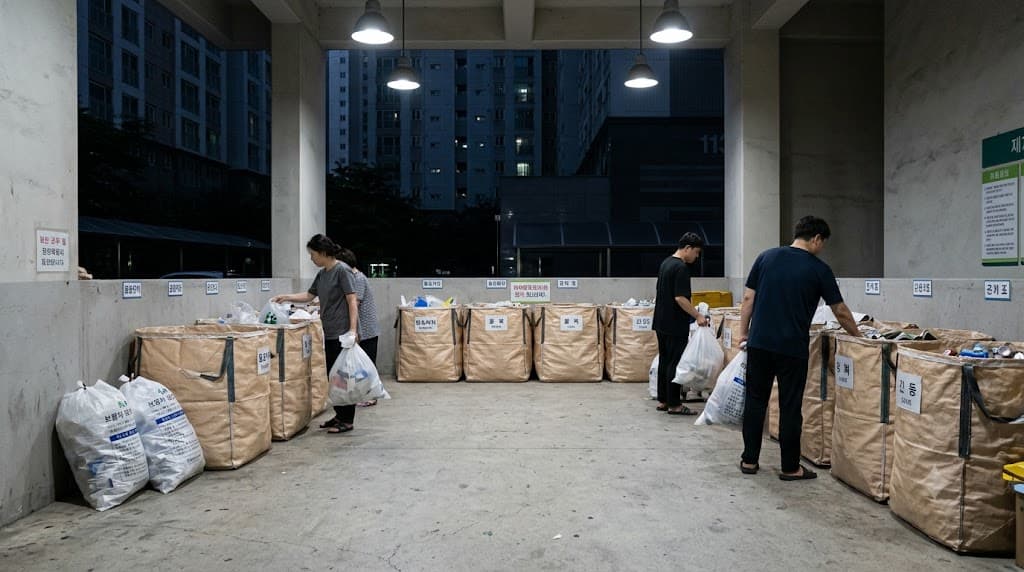
At the apartment complex's recycling station, which is open in the evening, the bags are separated by material type.
Large items won't fit in the bag — Sticker, and Free Pickup
The process is completely different when you move or dispose of furniture and appliances.
Items that don't fit in the envelope are You must register in advance and affix the sticker (registration certificate) Take it.
If you just leave it out there, that’s illegal dumping.
Things to Throw Away | Method | Cost |
|---|---|---|
Furniture, mattresses, bicycles, etc. | Report via the district office website/app or a community service center → Pay the fee → Print and attach the report receipt | Fees by Item |
Large Household Appliances (Refrigerators, Washing Machines, TVs, Air Conditioners) | Free Door-to-Door Pickup of Old Appliances Reservations — By Phone 1599-0903, Web, KakaoTalk | Free |
Small Appliances | If you have five or more, they are eligible for free pickup. For small quantities, please use the collection bins at community centers or residential complexes. | Free |
Bulky Waste Collection Permit—Waste will not be collected without this. (Designs vary by region.)
Many people buy stickers thinking they have to pay to dispose of their refrigerators, but, Free in-home pickup for large appliances, starting with just one unitThat is.
I'll come to your house and pick it up.
I highly recommend this!!
We are open weekdays from 8:00 a.m. to 6:00 p.m. and closed on weekends.
Just the right amount for every situation
Hotel Stay — You don't have to buy anything. Just put it in the trash can in your room.
Airbnb and Guesthouses — Start by asking your host, “How do I take out the trash?” Many places already provide trash bags.
Studio Apartments · Long-Term Stays — At the convenience store, pick up those old pay-as-you-throw bags and food waste bags. Check the building bulletin board for collection days and times.
On the street — First, check the subway station; then, check cafes and convenience stores. If there aren’t any, take it back to your lodging.
Bones, Shells, and Tea Bags — Not food. Regular envelope.
Moving & Major Appliances — To report stickers, call 1599-0903 (toll-free) for home appliances only.
In South Korea, trash is categorized based on "where it comes from" rather than "what it is."
A single food container with a lid will solve most odor problems.
Rather than saying it’s a country without trash cans, A country where everyone is responsible for taking their own trash homeIt's close to that.
It feels a little awkward carrying a cup around for the first few days, but once you buy a pack, it just becomes second nature.
And this rule—they won’t cut you any slack just because you’re a tourist—but once you know it, it’s not that hard to follow.
Let's all work together to preserve nature and protect the environment.😘
How this article was prepared
Sources checked
- 서울시 분리배출 기준 안내— 종량제봉투·음식물·재활용 품목 구분 확인
- 서울시 중구청 재활용품 분리배출— 재활용 배출 방법 확인
- 서울시 중구청 영문 쓰레기 배출 안내— 구별 전용 봉투 원칙·영문 안내 확인
- 서울Pn — 길거리 쓰레기통, 30년 만에 돌아오나— 가로 쓰레기통 철거 배경·연도별 개수·확충 계획 확인
- 찾기쉬운 생활법령정보— 폐기물관리법 제8조·제68조 무단투기 과태료 근거 확인
- 뉴스1 — 담배꽁초 과태료 상향 검토— 담배꽁초 무단투기 과태료 5만원·상향 논의 확인
- 폐가전 무상방문수거— 대상 품목·예약 방법·운영시간 확인
- 서울시 영문 — 음식물쓰레기 기준 10개 언어 배포— 외국인용 다국어 안내 자료 존재 확인
- 성남시 자원순환 플랫폼 — 종량제봉투 안내— 가정용 봉투 용량 규격 확인
Related reading
AX, Plug-ins, Connectors, MCP — Confusing Terms in the AI Era: Clarified in One Chart
When I turn on the news, it’s all about AX; at work, people keep saying, “Plug in the connector”; and in group chats, everyone’s talking about MCP. To be honest, for a while, I thought all these terms meant the same thing. But when I took a closer look at each one—wow, I realized they were all on completely different levels!
YouTube Course Scams: Avoid Them If You See This Pattern — A Complete Guide to Tactics, How to Spot Them, and Refunds
"10 million won in passive income per month," "Achieve financial freedom by starting a business with no capital." Once the YouTube algorithm latches onto this, videos like these pop up endlessly. The problem is that this isn't just empty hype—it's a well-designed sales funnel.
The Hidden Danger of the Summer Ocean: The Bell Jellyfish (Small-bladdered Jellyfish) — A Complete Guide to First Aid for Stings
The cone jellyfish (small-bladdered jellyfish) is a highly toxic creature that appears on Korean beaches during the summer; even dead specimens or detached tentacles retain their stinging ability. If stung: ① Get out of the water immediately → ② Rinse with seawater or saline solution → ③ Remove tentacles with a tool → ④ Apply cold or warm compresses; if systemic symptoms occur, call 119 immediately. Unlike other jellyfish, vinegar, tap water, and alcohol can spread the venom further, so they must never be used.