Living in Korea
Need a toilet in Korea? Head for the subway station, and check which side of the gates it's on
The 15-minute free re-entry rule, which lines are left out, and where to go when the station is closed
AI-generated image
At a glance
Public toilets in Korea are free, and a subway station is the surest bet. In the Seoul area most lines let you tap out to use one and re-enter within 15 minutes at no cost, but AREX, Shinbundang and Incheon lines don't.
If you need a toilet now, go to the nearest subway station.
Public toilets in Korea are free, and most subway stations have restrooms.
The only thing to work out is which side of the fare gates it's on, and whether stepping out will cost you another fare.
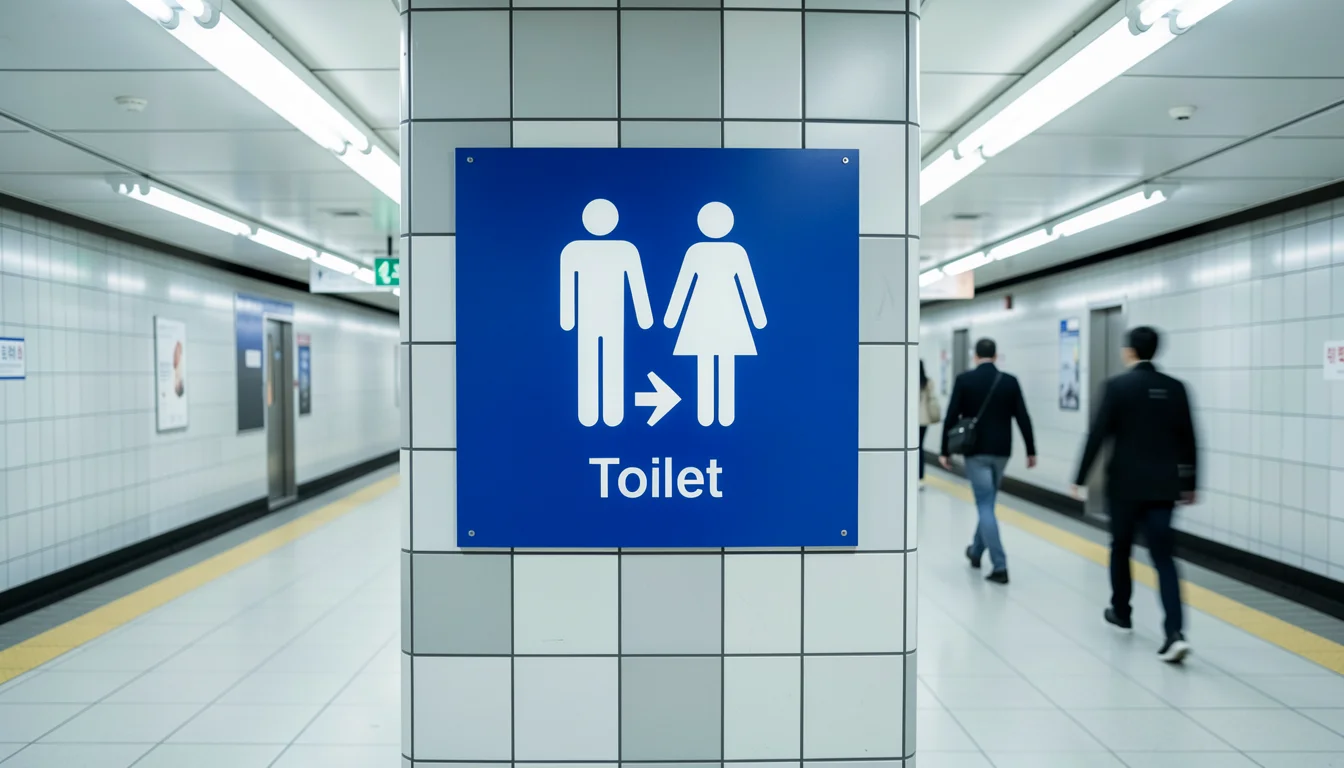
Restroom signs hang above the fare gates in a Seoul subway concourse.
Already on the subway? Check the gates first
If the station's restroom is inside the paid area, just use it.
You won't touch the gates at all, so the fare rules don't come into it.
Don't assume it is, though: some station restrooms are inside the gates and some are outside.
The station signs tell you which it is before you commit.
A restroom sign on your side of the gates means it's in the paid area; one pointing past the gates or toward an exit number means you'll have to leave.
Stepping out to use the restroom: who pays again?
On most Seoul-area lines, it costs nothing.
If you tap out and tap back in at the same station, on the same line, within 15 minutes, the re-entry counts as a transfer and you don't pay a new base fare (currently by card).
Whether the waiver applies depends on who runs the line, though, not on which city you're in.
Lines | Free re-entry within 15 minutes? | Since |
|---|---|---|
Seoul Metro's sections of Lines 1–8 (not the stretch of Line 7 west of Seoul), and Line 9 | Yes | 1 July 2023 (10 minutes), 15 minutes from 7 October 2023 |
Ui-Sinseol Line and Sillim Line | Yes | 7 October 2023 |
KORAIL sections of Lines 1, 3 and 4, plus the Suin-Bundang Line, Gyeongui-Jungang Line, Gyeonggang Line and Seohae Line | Yes | 20 June 2026 |
AREX, Shinbundang Line, Gimpo Goldline, Yongin Everline and other privately run lines outside Seoul's scheme, plus Incheon's two subway lines and the stretch of Line 7 west of Seoul | No | — |
Coverage comes from the Seoul city government's 2023 announcements and the national government's June 2026 announcement, checked October 2026.
The conditions are the same on both systems:
Same station, same line. If you tap out of Line 3 at a transfer station and come back through the Line 5 gates, you pay again.
A transit card. You need a prepaid or postpaid transit card such as Tmoney; foreign contactless bank cards aren't confirmed to qualify. For which card to get, see our guide to paying for Korean subways and buses.
Once per trip. You can't stack two restroom stops on the same journey.
The Climate Card, Seoul's unlimited pass, is a special case: the official material doesn't say how its gates treat a quick same-station re-entry, so if the gate refuses your card, use the call button.
The rule described here is for the Seoul metropolitan network.
Don't assume subways in other cities do the same.
Not near a station? Where to go next
On the street, try these in order:
A subway station entrance. Even if you aren't riding, a restroom outside the gates is free to walk into.
Department stores and large malls. They usually have restrooms on several floors, and nobody expects you to buy anything.
Designated open restrooms. Seoul runs a program, under its own ordinance, that funds privately owned restrooms opened to the public.
A café, as a customer. See the café section below.
Convenience stores are a poor bet.
Many have no customer restroom, so don't plan around one.
Searching for a restroom on your phone
NAVER Map and KakaoMap both show nearby public restrooms when you search for one.
The Seoul Metropolitan Government points people to exactly this, alongside its own map site (map.seoul.go.kr, in Korean only).
Results are more reliable when you search in Korean.
The word is hwajangsil; copy the Korean spelling from a translation app or your keyboard's Korean layout once, and save it in your notes.
On the city's map site, use your browser's translate feature and follow City Life Map → Public Restrooms.
These listings come from public data and can lag behind reality.
When it's late, check the opening hours on the listing before you walk anywhere.
For setting up the map apps themselves, see Does Google Maps work in Korea?.
Late at night, on a long bus ride, or in a park
After the last train. At night, search the maps for public restrooms and check that the listing shows 24-hour opening, or head for a 24-hour business where you're a customer.
On an intercity or express bus. Don't count on a toilet on board, so go before you board.
In parks and riverside areas. Public restrooms are common, but older ones may be basic.
Check the next section before you go in.
Café toilets and door codes
Many café restrooms are shared with the rest of the building and have a keypad on the door.
The code is often printed at the bottom of your receipt or posted near the counter.
If you can't find it, ask the staff.
A restroom door code is printed at the bottom of a café receipt.
Using a café's restroom without ordering is considered rude.
If you're desperate, buy a drink or use a station or open restroom instead.
Don't share a café's door code with people who aren't customers.
What you'll find inside
Toilet paper goes in the toilet. Since 1 January 2018, public toilet rules have kept wastebaskets out of toilet stalls, and women's stalls have a small bin for sanitary products only.
Wet wipes don't break down, so keep them out of the bowl.
A few older restrooms, particularly in parks, may still have a bin; for anything else you need to throw away, see where to throw away trash in Korea.
A shared paper dispenser hangs by the entrance of an older public restroom.
Paper isn't always in the stall. Some older restrooms only have a shared dispenser by the entrance, so look before you go in, or carry a small pack of tissues.
Squat toilets still turn up. You'll mostly see them in older buildings.
There's usually a Western-style stall as well; the pictogram on each stall door tells you which is which.
If nothing turns up
Call the 1330 Korea Travel Helpline: dial 1330 from a Korean number, or +82-2-1330 from a foreign phone.
It runs 24 hours a day in English, Japanese and Chinese.
The online call on the VISITKOREA 1330 page is free over Wi-Fi; dialing from a foreign phone costs whatever your carrier charges for international calls.
How this article was prepared
Sources checked
- Korea.kr policy news, 15-minute re-entry on KORAIL metropolitan lines (15 June 2026, in Korean)Linked page is in Korean— From 20 June 2026 on KORAIL-run Lines 1, 3, 4, Suin-Bundang, Gyeongui-Jungang, Gyeonggang, Seohae; private lines (AREX, Shinbundang, Gimpo Goldline, Uijeongbu and Yongin LRT), Incheon Lines 1–2 and Line 7 Kkachiul–Seoknam excluded; transit cards; once per trip; 1,550 won
- Seoul Media Hub, re-entry window extended to 15 minutes (2023)Linked page is in Korean— 15 minutes from 7 October 2023, same station, counted as one transfer, Seoul-run line sections, Line 9, Ui-Sinseol and Sillim added
- Seoul Media Hub, 10-minute re-entry pilot (2023)Linked page is in Korean— Pilot began 1 July 2023
- Seoul Metropolitan Government, Climate Card (English)— Official English name Climate Card; line names in its station table: Suin–Bundang, Gyeongui–Jungang, Gyeonggang, Seohae, Ui-Sinseol, Sillim, Shinbundang, Gimpo Goldline
- Seoul Metropolitan Government guide to finding restroomsLinked page is in Korean— Public restroom layer on the city's map site; searching for restrooms on NAVER Map and Daum/Kakao maps
- Seoul Metropolitan Government public restroom management systemLinked page is in Korean— Seoul ordinance on open restrooms, support for privately owned open restrooms
- Seoul city map site (map.seoul.go.kr, Korean only)Linked page is in Korean— Official city map with a public restroom layer
- Seoul Media Hub, no bins beside toilets in subway restrooms on Lines 1–8 (2017)Linked page is in Korean— Removal of stall wastebaskets in subway restrooms
- Segye Ilbo on public restroom wastebaskets (2019)— Bins beside toilets abolished from 1 January 2018; sanitary bins in women's stalls; some parks still had bins
- VISITKOREA 1330 Korea Travel Helpline— 1330 inside Korea, +82-2-1330 from a foreign phone, free voice call over Wi-Fi, chat options
- Hanam City English page on Tourist Interpretation 1330— 24-hour service in English, Japanese and Chinese
- KORAIL corporate English site— Operator's own English site; spelling KORAIL
- AREX Express Train guide— Airport Railroad's English site; spelling AREX
- NAVER Map— Official service name
- KakaoMap— Official service name
- VisitKorea, Transportation Cards— Spelling Tmoney; cards work on public transportation
- Yongin Everline operator siteLinked page is in Korean— Operator's English name Yongin Everline
- Incheon Metropolitan City English siteLinked page is in Korean— City's own English site; spelling Incheon