Living in Korea
Where to throw away trash in Korea when there's no bin in sight
What to do with an empty cup, a bottle or a snack wrapper on the street, and how to sort trash before you leave a rental
At a glance
On the street, finish or empty your drink, then look for a subway station or bus-stop bin, or carry the trash home. In a rental, follow the host's sorting, with general waste in the local prepaid bag.
You've finished your coffee, the cup is empty, and you've passed three blocks without seeing a bin.
In Korea the answer isn't a hidden bin you keep missing.
Empty the cup, try the nearest subway station or a bus stop, and if those fail, carry it back to where you're staying.
Two things change that answer: whether the trash came from a shop you're standing in, and whether you're about to board a Seoul bus.
A pedestrian carries an empty takeout cup along a city street with no bin in sight.
Why are there so few street bins?
Bins were removed on purpose.
When the volume-based waste fee system (jongnyangje) started in 1995, households began paying for trash through prepaid bags.
Street bins turned into a free way to dump household trash, so many local governments took them out.
Seoul has been bringing some back.
It started a 30-bin pilot of a new design in three tourist zones in April 2024 and set a goal of 7,500 street bins citywide by the end of 2025. A Seoul council member pointed out in November 2024 that installations were lagging behind the budget, with 5,793 bins in place at the end of September.
Seoul Open Data Plaza publishes the yearly count by district, most recently for December 2024.
What this means on the ground: the pilot put the new bins in tourist zones, so a busy main street is a better bet than a quiet residential lane.
What to do with the item in your hand
Find your item, try the first option, and use the fallback if it fails.
"Your own shop" means the café or store you bought the item from.
What you're holding | Try first | If that fails | Watch out for |
|---|---|---|---|
Takeout cup with ice or leftover drink | The café you bought it from; many cafés have a pour-out sink or liquid bin | A station leftover-drink bin if there is one, then a street bin once the cup is empty | Don't pour drinks into a general bin, a planter or a drain |
Empty takeout cup | The shop you bought it from | Subway station bin or street bin | Make sure it's really empty: a cup with a drink in it can get you refused on a Seoul bus |
Plastic bottle or can | Recyclable slot of a street or station bin | Carry it home and rinse it there | A capped bottle can go on the bus; an open can or a bottle with a straw can't |
Street-food skewer, wrapper or paper tray | The stall itself (some keep a bin for their own customers) | General slot of a street bin | Wrap the skewer tip so it doesn't tear the bag |
Cup noodles or a snack eaten inside a convenience store | The store's own bins, sorted into liquid, cups and general waste as the labels show | — | Treat these bins as meant for items bought in that store |
Shopping bag of packaging or receipts | Take it back to where you're staying | — | Never put bagged trash in a street bin |
Cigarette butt | Ashtray at a designated smoking area | Put it out and carry it | A butt on the ground counts as illegal dumping |
Bin layout and labels vary by place.
Follow what the bin itself says.
Convenience stores: ask, or buy something
The bins inside a convenience store are generally treated as a courtesy for customers who eat or drink there, not as public bins.
In August 2025 a store owner posted a complaint in an online community after a passer-by dumped a large bag of unsorted trash from their car and left without buying anything.
The owner said it happens about once a week.
If you need to throw something away, buy something small or ask first.
For using the store's hot-water dispenser and eat-in counter, see our convenience store guide.
Subway stations are the most likely bet, but not a guarantee
Seoul Metro stations often have bins on the platform or in the concourse.
The operator tried leftover-drink bins at three stations in September 2018 and removed them because they didn't work well.
By August 2019 an improved 18.9-litre version was in use at 40 spots across 11 stations.
We couldn't find a current official list of which stations have bins, so treat the station as the best place to try, not a sure thing.
Can you take a coffee onto a Seoul bus?
Usually not, if it's in a disposable cup.
Since 4 January 2018, an amendment to Seoul's city bus ordinance has let drivers refuse passengers carrying food or drinks that could spill.
Passengers who eat on board can be asked to get off.
According to the Seoul Metropolitan Government's guidance:
Not allowed: drinks or ice in disposable cups, takeout food in disposable cups (tteokbokki, chicken), several cups in a carrier, and cans or bottles that are open or have a straw.
Allowed: capped plastic bottles, unopened cans, sealed tumblers and thermoses, boxed chicken or pizza, and bagged groceries.
The guidance doesn't say anything about empty cups.
An empty cup has nothing to spill, but it's simplest to get rid of it before you board.
Because the rule comes from a Seoul ordinance, it covers Seoul city buses.
Bus stops don't come with a guaranteed bin, though some have one.
A 2018 study by the Daejeon Sejong Research Institute, reported by Seoul Shinmun, found 40% more litter at bus stops without bins than at stops with them.
Since you can't count on a bin at the stop, finish the drink before you leave the café.
How to find a bin
We couldn't find an official bin map made for travelers.
Your options, from most to least practical:
Head to busy streets. Look along main roads and in tourist areas rather than in residential lanes.
Check the station. Look on the concourse near the ticket gates and on the platform.
Use the open data if you're settling in. Seoul publishes a street bin installation file (latest file dated November 2025), and some districts publish their own; Jongno-gu's quarterly file on the Public Data Portal is one example. These are spreadsheets, not a live map, but they show which streets get bins in your neighbourhood.
None of these needs a Korean phone number or an app account.
What the fines actually are
Fines are set under Articles 8 and 68 of the Wastes Control Act and collected by the city or district.
Paju City's published schedule shows how the amounts step up:
Violation | Fine |
|---|---|
Dropping litter you're carrying (cigarette butt, tissue) | |
Dumping household waste in a makeshift bag, such as a plastic shopping bag | |
Leaving trash from a break or an outing, such as a picnic | |
Dumping household-type waste generated by a business |
The amounts are from Paju City's fine schedule page, checked in October 2026. Seoul's Jung-gu Office lists fines of 100,000–1,000,000 won for illegal disposal, depending on the district (gu).
For visitors, the bag row is the one to remember: a shopping bag of household trash left in or next to a street bin counts as dumping, not littering.
Staying in a rental: the check-out routine
Hotels and motels usually handle sorting for you, so use the bin in your room.
Short-term rentals, officetels and guesthouses often expect guests to sort, and the host's instructions override everything below.
Many hosts leave bags and a recycling spot; if yours hasn't, message them before you buy anything.
A studio setup with two bags and a recycling basket.
Pour out liquids. Empty cups, bottles and cans into the sink and give them a quick rinse.
Pull out recyclables. Clear PET bottles go out empty and compressed with the label off. Cans and glass go out rinsed. Vinyl and snack bags go clean, in a clear bag of their own, separate from plastic. Cardboard goes flattened with the tape removed. Recyclables don't need a paid bag.
Separate food waste. Rice, side dishes, vegetable scraps and soft fruit peels go in the building's food waste bin or a food waste bag. If the building has its own system, ask the host how it works.
Bag everything else as general waste. Use the prepaid volume-based bag for the district you're staying in. Seocho-gu's English guide, for example, says they're sold at designated shops such as marts and convenience stores. A small size is plenty for a short stay.
Put it out at the right time and place. Use the building's collection area. For curbside pickup, Jung-gu's rule is sunset to midnight, and collection days vary by district.
The items that trip people up
Seoul's English guidance warns that the wrong items in food waste can break processing machines and get in the way of recycling.
As a rule of thumb, anything hard, bony or fibrous goes in general waste.
Item | Where it goes |
|---|---|
Chicken, pork or beef bones; fish bones | General waste |
Shells of clams, oysters, crab; eggshells | General waste |
Peach or persimmon pits, nut shells | General waste |
Onion skins, vegetable roots | General waste |
Tea and herbal grounds | General waste |
Fruit peels (apple, mandarin), rice, side dishes | Food waste |
Receipts, delivery slips | General waste |
Cling wrap, rubber gloves, dirty wrap film | General waste |
Paper cup | Rinse it and recycle it if it's plain paper; put it in general waste if it's coated on both sides |
Seoul's standard covers about 60 items, and districts may differ slightly.
Bones, eggshells and a tea bag are general waste; only the apple peel is food waste.
One easy mistake is putting fried-chicken bones in the food waste.
Bones go in general waste, not food waste.
A lidded food waste caddy by the kitchen sink.
If you're staying long enough to set up a household, the Seoul Metropolitan Government has published its food waste standard in ten languages, including English.
Your district office (gu office) can point you to it, along with collection days for your area.
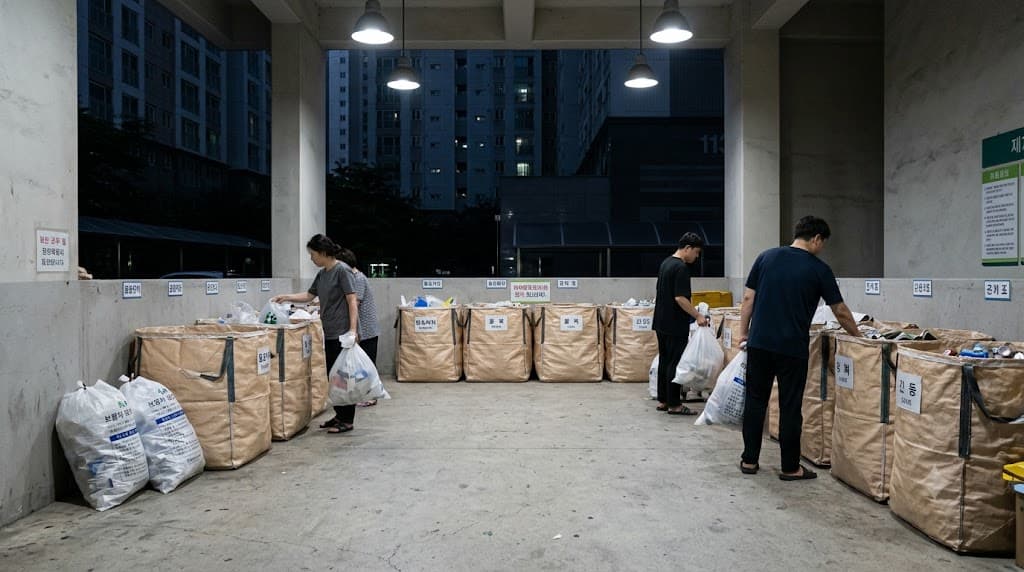
An apartment recycling area with a separate sack for each material.
How this article was prepared
Sources checked
- Seoul Metropolitan Government, Transportation news — food and drink on city busesLinked page is in Korean— Takeout-cup restriction on Seoul city buses since 4 January 2018 under a Seoul ordinance; what is banned and what is allowed; drivers may refuse boarding, and passengers who eat on board may be made to get off
- Seoul Shinmun — Will street bins return after 30 years? (23 September 2024)Linked page is in Korean— Bins removed after the 1995 volume-based fee system; 30-bin pilot in three tourist zones in April 2024; target of 7,500 bins by end of 2025; a 2018 Daejeon Sejong Research Institute study found 40% more litter at bus stops without bins
- Seoul Shinmun — council member criticizes the street bin expansion (7 November 2024)Linked page is in Korean— 5,793 street bins at the end of September 2024, up 413 in a year, while the bin budget rose to 3.82 billion won
- Seoul Open Data Plaza — street bin installation information (OA-15069)Linked page is in Korean— Installation file dated November 2025 (updated 6 April 2026) and a yearly count by district up to December 2024
- Public Data Portal — Jongno-gu street bin fileLinked page is in Korean— English title Jongno-gu, Seoul_Street trash can; updated quarterly
- Public Data Portal — English home page— English name of the national open data portal at data.go.kr
- Seoul Metropolitan Government Media Hub — subway station facilities (9 August 2019)Linked page is in Korean— Drink bins first went into three stations in September 2018 and were removed as defective; improved 18.9-litre bins were at 40 spots across 11 stations by August 2019
- Sidae — convenience store owner's complaint about outside trash (12 August 2025)— A passer-by dumped unsorted trash from a car without buying anything; the owner posted about it in an online community and says it happens about once a week
- Paju City — fine schedule for illegal waste disposalLinked page is in Korean— Fines under Wastes Control Act Articles 8 and 68: 50,000 won for carried litter, 200,000 won for a makeshift bag or for trash from a break or outing, 1,000,000 won for business waste; checked October 2026
- Korea Legislation Research Institute — Wastes Control Act (English)Linked page is in Korean— English statute title; Article 8 prohibition against dumping wastes; Article 68 administrative fines
- Jung-gu Office (Seoul) — English waste disposal guide— Bag colours, disposal from sunset to midnight, collection days set by district, fines of 100,000–1,000,000 won depending on the district
- Seocho-gu (English) — garbage disposal guideLinked page is in Korean— Volume-based bags are sold at designated shops such as marts and convenience stores; only bags designated for your area may be used
- Seoul Metropolitan Government — separate disposal standardsLinked page is in Korean— PET bottles, vinyl, cans, glass, paper cups and receipts; bones, shells and onion skins are not food waste
- Seoul Metropolitan Government (English) — food waste standard in ten languages— What is not food waste: bones, shells, eggshells, hard pits, tea grounds; wrong items can break processing machines; guide available in ten languages
- Gangdong-gu Office — press release on other districts' bags (12 January 2016)Linked page is in Korean— Bags from other Seoul districts allowed only temporarily for new movers; bags from outside Seoul not accepted
- Gangdong-gu Office (English) — greetings page— English name of the district office as written on its own English site
- Seoul Metropolitan Government (English) — Jamsil and Seongsu busiest subway stations (24 February 2025)— Uses the English name Seoul Metro for the operator of Seoul Subway Lines 1–8
- Seoul Metropolitan Government (English) — Seoul Open Data Plaza— Uses the English name Seoul Open Data Plaza for the city portal at data.seoul.go.kr
- Seoul Shinmun — English-language report on Nepali migrant workers (1 October 2019)Linked page is in Korean— The paper's own English text refers to itself as the Seoul Shinmun
- Daejeon Research Institute (English) — historyLinked page is in Korean— Lists the launch of the Daejeon Sejong Research Institute on 31 October 2016 and the September 2025 change to Daejeon Research Institute