Living in Korea
Can you drink tap water in Korea? How to decide for your own home
Testing your tap for free in Seoul, the purifier rental fees that hit after the "mandatory" period, and what changed on bottled water in 2026
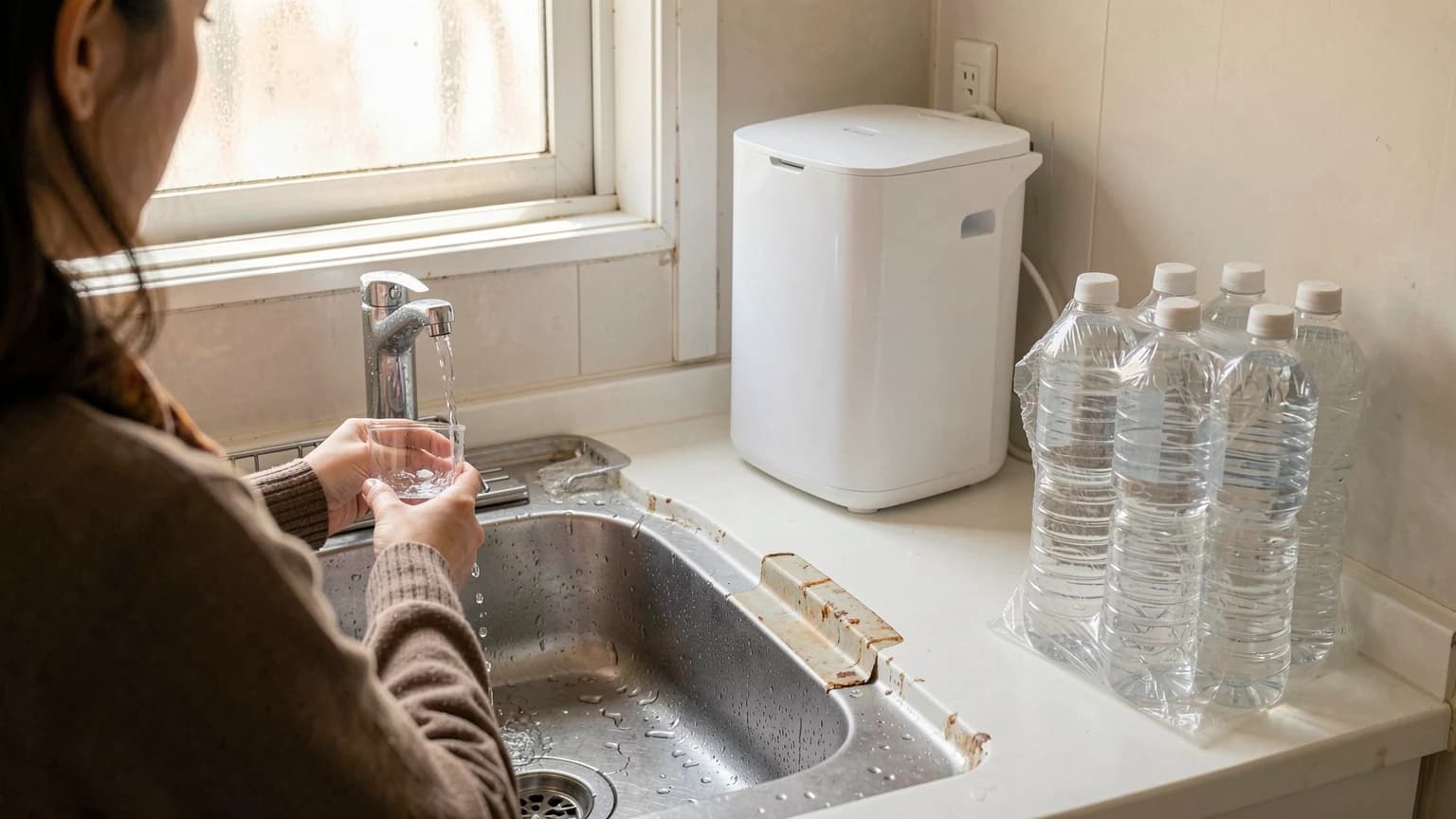
At a glance
In Korea the question is less the treated water than your building's pipes and tank. Seoul tests your tap for free, and a purifier rental rarely suits anyone leaving within about three years.
Seoul says none of the free home water tests it ran through June 2026 exceeded the drinking water standards.
Whether the water is fine at your own tap depends on something the treatment plant can't control: the pipes and any storage tank inside your building.
So you don't need to decide whether Korean tap water is safe in general.
You need to know what condition your building's plumbing is in and how long you're staying, and in Seoul you can get a free test that answers the first part.
Why Koreans say "it's safe" and "don't drink it" at the same time
Both statements are partly true, and that's why new residents get conflicting answers.
The city says treated water is safe.
People who avoid it are mostly worried about the pipes it travels through on the way to their tap.
The environment ministry's 2024 national survey (home visits to 72,460 households between 22 April and 30 June 2024, published 5 December 2024) shows how people actually handle it.
Since late 2025, that ministry has been the Ministry of Climate, Energy and Environment.
Households could give more than one answer:
37.9% drink tap water, either straight or boiled.
53.6% drink water from a purifier.
34.3% buy bottled water.
66% use tap water for cooking (purifier water not counted).
Among people who don't drink tap water, the top reason (34.3%) was worry about impurities from old water pipes, and 13.2% named the chlorine smell.
Seoul Water's English page on its home water test says the same thing: some people trust the treatment plants but are reluctant to drink because of how their building's pipes or water tanks are managed.
Indoor pipes and tanks are part of the building, which is why Seoul helps households pay to replace old indoor pipes rather than replacing them itself.
A newer apartment complex and a 30-year-old villa can get the same water from the street and deliver something quite different to your sink.
Tap, purifier or bottled: what each costs you besides money
The table compares effort, paperwork and what happens when you move.
It gives no rental or bottled-water prices, because those vary by company and promotion.
Check the contract or the sales page.
Option | Daily effort | Contract and paperwork | When you move or leave Korea |
|---|---|---|---|
Tap, straight | None | None | Nothing to cancel |
Tap, boiled or as barley tea | Boil, cool and refrigerate a jug | None | Nothing to cancel |
Purifier, rented | Low; a technician usually handles filters | Multi-year contract; documents vary by company | Relocation, removal and cancellation fees can apply |
Purifier, bought outright | You buy and change filters yourself | Purchase only | You own it; take it or sell it |
Bottled, from a store | Carrying heavy packs home | None | Nothing to cancel |
Bottled, delivered | Ordering and storing packs | Shopping account; many Korean apps verify by phone | Close the account |
Table compiled from the Korea Consumer Agency's purifier rental findings (January 2026) and Seoul Water's English pages, checked November 2026.
On cost alone, tap is far cheaper than the other two.
Seoul Water puts its tap water at about 0.51 won per liter.
Test your own tap for free if you live in Seoul
Seoul's Arisu Quality Verification System sends someone to your home to test your tap water for free.
The Seoul Metropolitan Government says any household in Seoul can apply, and its pages don't mention a nationality requirement.
You do need to book ahead.
What gets tested
The in-person test measures five items on the spot: residual chlorine, turbidity, pH, iron and copper.
Iron and copper point to corroding pipes, and residual chlorine shows whether the disinfectant is still working.
The test takes about five minutes and you get the result right away.
A contactless version is also available.
You fill a clean container about halfway with tap water and leave it at your door on the agreed day, and staff collect it.
This version tests four items, leaving out residual chlorine because that reading becomes less accurate as the sample sits.
Results come by text message about two to three days later.
How to book
Pick a slot. Since 10 March 2026, in-person tests also run on weekday evenings until 21:00 and on weekends and public holidays from 09:00 to 18:00.
Call Seoul's 120 helpline for English. Dial 02-120, press 9 and then 1 for English. Seoul Water's English site lists the English line as open on weekdays from 09:00 to 18:00.
Or use another channel. You can also book through your local waterworks office or the Seoul Water Headquarters website, whose booking pages are in Korean.
Say which version you want. Ask for in-person if you want the chlorine reading, or contactless if no one can be home.
Have your full address ready, including the building and unit number.
A text message with the result is easier to deal with if your phone has a Korean number.
Ask the operator how they'll send results if yours doesn't.
If the result is bad
If your water fails the basic guidelines, Seoul Water runs an additional seven-item test that includes bacteria.
Then the city works out the cause and tells you what to do next, such as cleaning the water tank, replacing old pipes or adjusting the tank's water level.
It can also inspect and clean pipes and connect you to its funding for replacing old indoor pipes.
Outside Seoul, check your local water utility's website or call center to see whether it offers a home test.
Programs and names differ by city.
Why tap water smells of chlorine, and what Seoul suggests
Chlorine is added at the treatment plant so the water stays protected from bacteria all the way to your tap.
A faint chlorine smell means the disinfectant is still there.
It doesn't mean something is wrong.
Seoul's guidance for reducing the smell, from a 2013 city explainer, is simple:
Run the tap for two to three minutes in the morning to flush out water that sat in the pipes overnight.
Fill a glass or ceramic container and leave it uncovered somewhere clean for 20 to 30 minutes.
Add a green tea bag, lemon, mint or herbs to water you've drawn.
Boiling water for tea or barley tea is the other common habit.
It's how many Korean households already drink tap water.
Renting a purifier: the period that matters is not the one you think
A purifier rental contract has two lengths, and confusing them is the most common complaint.
Contract period. The whole rental term. In the cases the Korea Consumer Agency published, this was 60 months.
Mandatory-use period. The minimum time you commit to. In the same cases, this was 36 months.
Once the mandatory-use period ends, there's no cancellation penalty.
If contract months remain, you can still be charged a removal (collection) fee, and some companies also ask you to repay a registration fee they waived when you signed up.
In January 2026 the Korea Consumer Agency analyzed 83 relief requests about cancellation costs filed between 2022 and June 2025. In 77.1% of them (64 cases), the customer had cancelled after the mandatory-use period.
In one case, a customer who cancelled in month 37 of a 60-month contract was billed for removal and the registration fee.
Of 10 rental companies surveyed, only one stated this clearly in its key contract terms.
After the agency's recommendation, the other nine revised their contracts.
What the official guideline says about penalties
Korea's consumer dispute resolution standard, issued under the Korea Fair Trade Commission's system, sets these benchmarks for long-term rentals:
Situation | Guideline penalty |
|---|---|
You cancel during a mandatory-use period longer than 1 year | 10% of the rent for the remaining months of that period |
You cancel during a mandatory-use period of 1 year or less | 30% of the remaining mandatory-period rent or 10% of total rent, whichever is less |
You move abroad during the contract | 50% off the penalty, with supporting documents |
You move to an area the company can't service | Cancellation without penalty |
Rules as excerpted in the appendix of the Korea Consumer Agency's May 2025 rental advisory.
The standard was last amended on 18 December 2025, so check the current text before you rely on a row.
Removal fees are charged on top of the penalty, and under the same standard only if the contract states and explains them.
These are guidelines for settling disputes, not a legal cap.
Your contract can set different terms.
If a dispute starts, the Korea Consumer Agency handles complaints, and the national consumer hotline is 1372.
Should you rent at all?
Your answer depends on how long you'll stay at this address, not how long you'll stay in Korea.
Leaving or moving within about three years, or not sure. Don't rent. A mandatory-use period like the 36 months in the agency's cases outlasts your stay, and cancelling early means a penalty plus a likely removal fee. Use tap water (tested if you're in Seoul), boiled water or barley tea, bottled water, or a purifier you buy outright.
Staying put for the full contract term. A rental can make sense if you want filter changes handled for you. Sign only after the company answers the questions below in writing.
Before signing, ask:
How many months is the mandatory-use period, and how many months is the whole contract?
What does it cost to cancel in month 12, month 24 and right after the mandatory-use period?
Is there a removal fee or a waived registration fee I'd repay, and how much is it?
What does relocation within Korea cost, and what happens if I move abroad?
Which documents do you need from a foreign resident (residence card, Korean bank account, Korean phone number), and can I pay with a foreign card?
Requirements for foreign residents differ by company, and we found no official rule on them, so get the list in writing.
Also check whether your apartment already has a purifier included, and whether it's still under someone else's contract, before you sign a new one.
Bottled water: no labels since 2026
Since 1 January 2026, bottled water sold online or in multi-packs in stores has to be label-free.
Single bottles sold in stores have a one-year grace period, so you'll still see labeled bottles through 2026.
Product information has moved off the bottle wrapper.
The cap top shows the product name and a QR code, and multi-packs carry them on the wrap or the carry handle.
Scanning the code brings up five key details, including the manufacturer and its location, the ingredients and the expiry date.
If you want to check who makes a brand and where, scan the cap code.
Empty bottles go out as clear PET in your building's separate recycling.
Now that most have no label to peel off, it takes one step less.
Collection days and bin locations differ by building.
Our guide to throwing away trash in Korea covers how to sort them.
If carrying multi-packs home is the reason you're considering a purifier, try delivery first.
It costs you a shopping account, not a multi-year contract.
How this article was prepared
Sources checked
- Environment ministry press release PDF, 2024 tap water drinking survey (5 Dec 2024)Linked page is in Korean— Attachment of the korea.kr briefing: 72,460 households visited 22 Apr–30 Jun 2024; 37.9% tap incl. boiled, 53.6% purifier, 34.3% bottled (multiple answers); 66% cook with tap; reasons for not drinking: old pipes 34.3%, chlorine smell 13.2%
- Seoul Water English site, Arisu Quality Verification System— Official English name; free for all Seoul households; 5 items; extra 7-item test including bacteria if guidelines are not met; pipe and tank advice
- Seoul Water English site, main page— 120 foreign-language ARS: press 9 then 1 for English, weekdays 09:00–18:00; "Seoul Water Headquarters" naming
- Seoul Water English site, Funding for the Replacement of Old Indoor Water Pipes— Partial city funding for replacing rusty indoor pipes
- Seoul Water English site, How to Enjoy Arisu— Cost cited as 0.51 won per liter; home quality check by phone
- Seoul Metropolitan Government environment news, evening and holiday water testsLinked page is in Korean— From 10 Mar 2026: weekdays until 21:00, weekends and holidays 09:00–18:00; 5 items, about 5 minutes, on-site result; free, by reservation; three booking channels
- Seoul Media Hub, contactless water test (19 Oct 2026)Linked page is in Korean— No home test exceeded drinking water standards through June 2026; booking by 120, waterworks office or website; door-side sample, 4 items, text result in 2–3 days; pipe cleaning and replacement support after a bad result
- Seoul Media Hub, chlorine smell explainer (2013)Linked page is in Korean— Chlorine is added to protect water until it reaches the tap; run the tap 2–3 minutes; leave in an open glass or ceramic container 20–30 minutes
- Korea Consumer Agency press release PDF, purifier rental contracts (14 Jan 2026)Linked page is in Korean— 83 relief requests (2022 to June 2025), 77.1% (64) after the mandatory period; 60-month contracts with 36-month mandatory periods in the cases; month-37 case billed 150,000 won for removal and registration fee; 1 of 10 firms disclosed clearly; all 9 others revised contracts
- Korea Consumer Agency press release PDF, purifier rental termination costs (30 May 2025)Linked page is in Korean— Appendix excerpt of the consumer dispute resolution standard for long-term rentals: 10% and 30%-or-10% penalty rules, removal fees only if stated and explained in the contract, no penalty when moving where regular servicing is impossible, 50% off when emigrating
- Korea Consumer Agency English site— Official English name of the agency
- National Law Information Center, Consumer Dispute Resolution StandardLinked page is in Korean— Current text: Korea Fair Trade Commission Notice No. 2025-14, in force 18 Dec 2025
- Korea Fair Trade Commission English site— Official English name of the commission behind the consumer dispute resolution standard
- Korea.kr policy briefing, label-free bottled water from 2026 (26 Jan 2026)Linked page is in Korean— Online and multi-pack products label-free from 1 Jan 2026; single bottles in stores get a 1-year grace period; product name and QR code printed on the cap top or multi-pack wrap and handle; the QR code shows five key details including manufacturer, ingredients and expiry date
- Ministry of Climate, Energy and Environment English site— Current official English ministry name after the October 2025 reorganization
- Seoul Metropolitan Government English site— Official English name of the city government
Related reading
How to run a Korean gas boiler in winter and read the city gas bill
With your own gas boiler, the bill is metered gas × heat factor × your supplier's rate per MJ, plus a basic charge and 10% VAT. When you go out, lower the setting rather than switching off, and in a freeze keep the power on.
Need a toilet in Korea? Head for the subway station, and check which side of the gates it's on
Public toilets in Korea are free, and a subway station is the surest bet. In the Seoul area most lines let you tap out to use one and re-enter within 15 minutes at no cost, but AREX, Shinbundang and Incheon lines don't.
Where to throw away trash in Korea when there's no bin in sight
On the street, finish or empty your drink, then look for a subway station or bus-stop bin, or carry the trash home. In a rental, follow the host's sorting, with general waste in the local prepaid bag.