Visiting Korea
Korean body scrub (seshin) for first-timers: what happens, what it costs, what to say
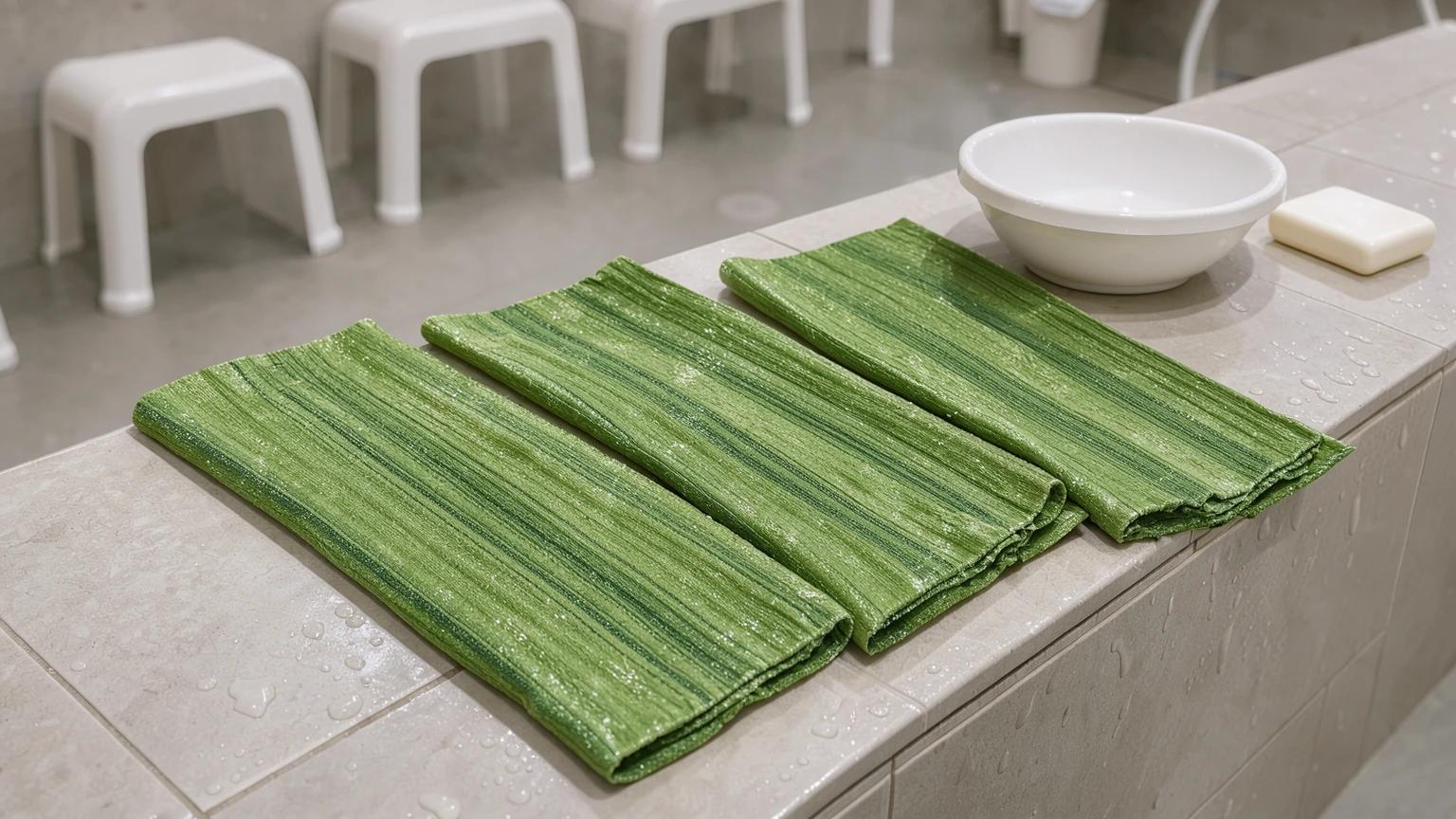
The walk-up scrub corner versus a private scrub shop, six steps from soak to checkout, and the green Italy towel behind it all
At a glance
For a first Korean body scrub, walk up to the scrub corner in a big bathhouse and pay about 20,000–40,000 won on top of entry. Private shops cost more but take bookings.
A Korean body scrub, called seshin, is not a spa treatment you book weeks ahead.
At most bathhouses it is a vinyl-covered table in a corner of the wet area, a scrubber who takes walk-ins, and a fixed price you agree on before you lie down.
If this is your first one, use the scrub corner inside a large jjimjilbang or a neighbourhood bathhouse.
It is the cheapest route, at roughly 20,000–40,000 won on top of the entry fee, and it needs no reservation, no Korean phone number and no app.
Choose a private scrub shop instead if you want a room to yourself and a booked time; some also have staff who speak English.
Expect to pay about twice as much or more.
A man and a woman cannot have this done together.
The scrub happens inside the single-sex bath area, with an attendant of the same sex, as the first-visit jjimjilbang guide explains.
How much does a Korean body scrub cost?
The price depends on the type of venue more than on the city.
Every figure below excludes bathhouse entry; the Damda row is a package.
Where | What you get | Price | Time | Source and year |
|---|---|---|---|---|
Scrub corner | Full body | 20,000–35,000 won | Not stated | Seoulstart, citing 2023 Korean press |
Scrub corner | Back only | About 15,000 won | Not stated | Seoulstart, citing 2023 Korean press |
Spa Land, Busan | Full body | 25 minutes | The Korea Times, 2025 | |
Private scrub shop | Full-body scrub | 50,000–80,000 won | Varies | Seoulstart, citing 2023 Korean press |
Private scrub shop | Scrub with massage | 80,000–100,000 won or more | Varies | Seoulstart, citing 2023 Korean press |
Damda, Seoul | Bath, scrub, milk body care, facial, hair | From | 30-minute scrub within a longer session | Korea JoongAng Daily, 2025 |
Prices are as published in the articles named in the last column, read in November 2026; none of them is an official tariff.
The Korea JoongAng Daily put the traditional walk-in price at about 20,000–40,000 won in 2025, without saying what it covers.
Each venue sets its own scrub price, so ask before you start. The private-shop figures are the oldest in the table, and the one shop price reported in 2025, Damda's 83,000 won basic package, already sits above that range, so treat 50,000 won as a floor that may be out of date.
Entry is charged separately.
Spa Land's operator lists adult admission at 26,000 won on its official page (checked November 2026) and publishes no scrub price at all, which is typical: the scrub is a separate service run from its own corner.
Scrub corner or private scrub shop?
Pick the scrub corner if price matters, if you are already going to a jjimjilbang, or if you want to decide on the day.
The trade-off is privacy.
The table stands in the open bath area, other bathers walk past, and you may need a few Korean words.
Pick a private scrub shop if being scrubbed in front of strangers is the thing stopping you.
You get your own room and a reserved time, and some shops staff for foreign visitors.
The Korea JoongAng Daily described an emerging network of one-on-one scrub shops in 2025, while bathhouse numbers fall.
It counted 9,868 bathhouses in 1999 and about 3,000 in 2022. Maeil Business Newspaper reported in March 2026 that about 40% of customers at Damda, a scrub shop near Hongdae, are foreigners, and that it has managers who handle English, Japanese and Chinese.
Booking channels vary by shop, so check whether a booking page needs a Korean phone number before you rely on it, and read the confirmation and refund terms before you pay.
A same-day slot is not guaranteed.
Check who a shop accepts before you pay.
The same newspaper's August 2025 feature on private shops describes customers arriving in pairs, such as mothers and daughters or friends, and being treated in separate rooms.
We found no shop that publishes a shared session for a man and a woman, and we could not confirm which private shops accept men, so check before booking.
The six steps, from the door to the bill
Pay entry and shower. Undress at your locker, then wash fully before you get into any pool. The rules of the bath area are in the first-visit guide.
Soak in a hot pool for 15–30 minutes. Creatrip suggests 15–20 minutes and Seoulstart at least 20–30. The soak softens the outer layer of skin so that it rolls off under the towel.
Go to the scrub corner and ask. Look for one or more vinyl or rubber-topped tables at the side of the wet area. Tell the scrubber what you want and ask the price. Busy venues run a queue, and the scrubber will tell you how long the wait is.
Lie down and turn when you are told. The scrubber works over your whole body with an Italy towel and rinses you with scoops or buckets of water. Two light taps usually mean turn over. The writer of The Korea Times piece on Spa Land describes exactly this: a vinyl bed, dead skin sloughed off, then buckets of water.
Pay the fixed price you were quoted. At some large venues, such as Aquafield and Spa Land, the scrub goes on your locker key and you pay at the exit. Elsewhere you may pay the scrubber directly, at or before the service, so ask how to pay when you ask the price. Creatrip advises carrying a little cash because some older places still take only cash.
Do not tip. Seoulstart puts it plainly: pay the stated price. The same custom applies across Korea, as in restaurants.
Aquafield is the clearest official example of step 5. Its settlement guide lists the body scrub among the services charged to the locker key, along with food, the shop and massage chairs.
You settle at the desk on the way out, and your shoe locker will not open until you do.
Spa Land works the same way: the wristband is both wallet and locker key, and the total is taken at checkout.
What to say in Korean
Six short phrases cover the whole exchange.
The spellings follow the official Romanization of Korean.
Situation | Say | Meaning |
|---|---|---|
Asking for a scrub | Sesin hae juseyo | A scrub, please |
Asking the price | Eolmayeyo? | How much is it? |
Back only | Deungman hae juseyo | Just my back, please |
Too rough | Salsal hae juseyo | Gently, please |
Too light | Sege hae juseyo | Harder, please |
It hurts | Apayo | That hurts |
Romanization checked against chapter 2 of the National Institute of Korean Language rules in November 2026.
Under those rules the word is spelled sesin.
English-language guides and news articles commonly write seshin, which is closer to how it sounds, so this article uses that spelling everywhere outside the table.
Where can you get one?
Large jjimjilbang usually offer scrubs inside the bath area, according to Creatrip.
Two venues can be confirmed from published information.
LG U+'s jjimjilbang guide, updated in November 2026, says body scrubs and massages are available at Sparex, in the Goodmorning City mall in Dongdaemun.
Aquafield names the scrub in its settlement guide.
Foreign visitors are now a regular part of the crowd at the big venues.
Josun Hotels & Resorts told Maeil Business Newspaper that foreigners made up 8.7% of customers across the three Aquafield branches and Spa Land in 2023, 15.8% in 2024 and 20.2% in 2025.
For choosing a venue by area, use the Seoul jjimjilbang guide by neighbourhood.
The things people worry about
Yes, you are naked on the table. The scrub corner is part of the bath area, where nobody wears anything, and the scrubber works over the whole body.
If that is a dealbreaker, a back-only scrub is shorter and a private shop removes the audience.
Couples are scrubbed separately. Agree a time to meet in the shared, clothed part of the jjimjilbang, and allow for the soak and a possible queue on both sides.
If you are on your period, the question is about using the pools at all rather than about the scrub.
The first-visit guide linked above covers the usual courtesy.
The green Italy towel, and why it is called that
The scrub is done with an Italy towel, a rough viscose mitt about 15 centimetres square that fits over the hand.
The Korea Times reported in 2008 that the mitt was introduced in Busan in the early 1960s and made from viscose rayon imported from Italy, which gave it the name.
A 2003 Korea JoongAng Daily article gives a different version: a towel maker's representative credits a Busan hotel owner who used cloth woven on a machine imported from Italy.
That article adds that nobody seems to know for certain.
The inventor is just as unsettled.
Kim Pil-gon is the name Seoulstart and some other English guides give, and Seoulstart reports utility model filings by him between 1966 and 1969. Wikipedia credits Kim Won-jo of Hanil Textile in 1967. The Korea Times gives a patent date of 1962 and names no one.
Treat any page that states a single inventor as fact with some caution.
Does the colour mean anything?
Wikipedia, and pages that follow it, say pink is softest, green is standard and blue is roughest.
We could not find a manufacturer's statement behind that, and the 2003 article lists the common colours as bright green, red and yellow.
Judge the towel by rubbing it between your fingers, not by its colour.
They are easy to find at Daiso.
Maeil Business Newspaper reported that at one central Seoul Daiso store, where 60–70% of customers are foreigners, the bath-towel category that includes Italy towels sold about 30% more in the second half of 2025 than in the first.
At home the rule is the same as at the bathhouse.
Soak first, for as long as you would before a scrub there, or the towel only scratches.
How this article was prepared
Sources checked
- Korea JoongAng Daily, bathhouse scrub feature (18 August 2025; Daum repost 29 August 2025)— Walk-in scrubbers on rubber mats in a corner of the bathhouse, about 20,000–40,000 won; bathhouse counts for 1999 and 2022
- Korea JoongAng Daily, private scrub shop feature (15 August 2025, Daum repost)— Damda basic package from 83,000 won and what it includes; 30-minute scrub; pairs treated in separate rooms; rise of one-on-one scrub shops
- Maeil Business Newspaper, foreign visitors at spas and scrub shops (29 March 2026, Daum repost)— Damda foreign-customer share and languages; Aquafield and Spa Land combined foreign share 2023–2025; Daiso Myeongdong Station store bath-towel sales
- The Korea Times, Spa Land in Busan (27 August 2025)Linked page is in Korean— 35,000 won for a 25-minute scrub; vinyl bed and buckets of rinse water; wristband as wallet and locker key, settled at checkout
- Seoulstart, Korean spa and jjimjilbang guide (last modified 13 June 2026)— Scrub prices by venue type citing 2023 Korean press; 20–30 minute soak; queue at the table; no tipping; Kim Pil-gon attribution and its dispute
- Creatrip, jjimjilbang first-timer guide (2026)— 15–20 minute soak before a scrub; scrubs offered inside the bath area
- Aquafield settlement guide (official, Korean)Linked page is in Korean— Body scrub listed among services charged to the locker key and settled at the desk on exit; brand spelling
- Spa Land page on the operator's site (official, Korean)Linked page is in Korean— Adult admission 26,000 won; no scrub price published; operator's spelling of the venue name
- LG U+ Korean jjimjilbang guide (updated 3 November 2026)— Sparex in the Goodmorning City mall offers body scrubs and massages
- Korea JoongAng Daily, Italy towels (6 January 2003)— Towel size and colours; Busan hotel owner version of the origin; uncertainty about the name
- The Korea Times, Italy towel business story (17 February 2008)Linked page is in Korean— Introduced in Busan in the early 1960s; viscose rayon imported from Italy; patent dated 1962
- Wikipedia, Italy towel— Kim Won-jo of Hanil Textile, 1967 attribution; colour-coarseness claim without a maker's source
- Linguasia, Korean body scrub explainer (updated 6 August 2024)— Two taps from the scrubber mean turn over
- National Institute of Korean Language, Romanization of Korean, chapter 2 (official, Korean)Linked page is in Korean— Letter values used for the phrase table and for the standard spelling sesin
- Josun Hotels & Resorts official site— Company name spelling
- Daiso Korea official site (Korean)Linked page is in Korean— Brand spelling
- National Institute of Korean Language, English siteLinked page is in Korean— Official English names of the institute and of the Romanization of Korean
- Bathhouse rules, annex to the enforcement rule of the Public Health Control Act (official PDF, Korean)Linked page is in Korean— Bath-area attendants must be the same sex as the bathers
Related reading
Best Korean Spa in Seoul for Foreigners: Which Jjimjilbang to Pick by Neighbourhood
For a first visit or a night in central Seoul, go to Sparex Dongdaemun; Club K Seoul suits long Gangnam stays, and Aquafield suits couples and families by day.
Booking a Korean culture experience in Seoul — what's free, what's in English, and what needs 20 people
If you want to book something this week, the free options need no reservation at all — the Seoul Global Cultural Center's hanbok session and the National Folk Museum's English docent tour. Templestay is the only overnight choice, and Korea House's hands-on programs are closed to solo travelers.
Korean hot springs without a car: which one to pick, what to wear, and how to get there
First-timers and couples should pick Paradise Spa Dogo; Sincheon-tang is the cheap all-rail option, and Hurshimchung in Busan bans tattoos.