Visiting Korea
Booking a Korean culture experience in Seoul — what's free, what's in English, and what needs 20 people
Six bookable programs compared, plus the hanbok rule that decides whether you pay for a palace ticket twice
At a glance
If you want to book something this week, the free options need no reservation at all — the Seoul Global Cultural Center's hanbok session and the National Folk Museum's English docent tour. Templestay is the only overnight choice, and Korea House's hands-on programs are closed to solo travelers.
"I want to learn about Korean culture" is a wish, not a plan.
The gap between the two is a small set of very specific facts: which programs take a booking from one person, which ones are actually run in English, and how many days ahead you need to commit.
This is a comparison of six things you can genuinely sign up for, plus the one rule — the hanbok dress code at the palaces — that quietly decides whether you pay an entrance fee twice.
Everything below comes from the operators' own pages.
Prices, showtimes, and program calendars change, so the last section tells you exactly which numbers to re-check before you pay.
The six programs, side by side
Program | Adult cost | Run in English? | Book how far ahead | Solo traveler? |
|---|---|---|---|---|
Templestay (overnight) | Varies by temple — see below | Only at temples flagged for English | Weeks, for popular temples | Yes |
Saturday Gugak Concert | A seat / B seat | Instrumental performance; free English tour beforehand | Same week is usually fine | Yes |
Korea House performance & cuisine | Not published online — phone to confirm | Performance is non-verbal; staff handle English | Reserve in advance | Yes |
Korea House hands-on programs | Not published online | Group format | Groups only | No — 20-person minimum |
Seoul Global Cultural Center hanbok | Free | Yes — English, Chinese, Japanese staff | Cannot be booked — walk in only | Yes |
National Folk Museum English docent tour | Free | Yes, on a fixed weekly timetable | None | Yes |
Prices and schedules change; confirm on the official page linked in each section below before you travel.
If you only have one condition, here's the single answer
"It has to be free." The Seoul Global Cultural Center hanbok session and the National Folk Museum of Korea English docent tour.
Both cost nothing, and neither requires — or even accepts — an advance booking.
"I only have half a day." The museum tour plus the palace next door.
It's one location, and the tour runs on a published timetable.
"I want to be immersed overnight." Templestay is the only one of the six that is an overnight stay.
Nothing else on this list runs past dinner.
"My Korean is zero." The Saturday Gugak Concert.
It's music and dance, so there's nothing to mistranslate, and the Korea Tourism Organization lists a free English guided tour at 14:00 before the 15:00 show.
"I'm one person." Everything except the Korea House hands-on programs.
That one is the trap, so it gets its own note.
What actually counts as hanbok for free palace entry
This is the rule most people get wrong, and it costs real money when you do.
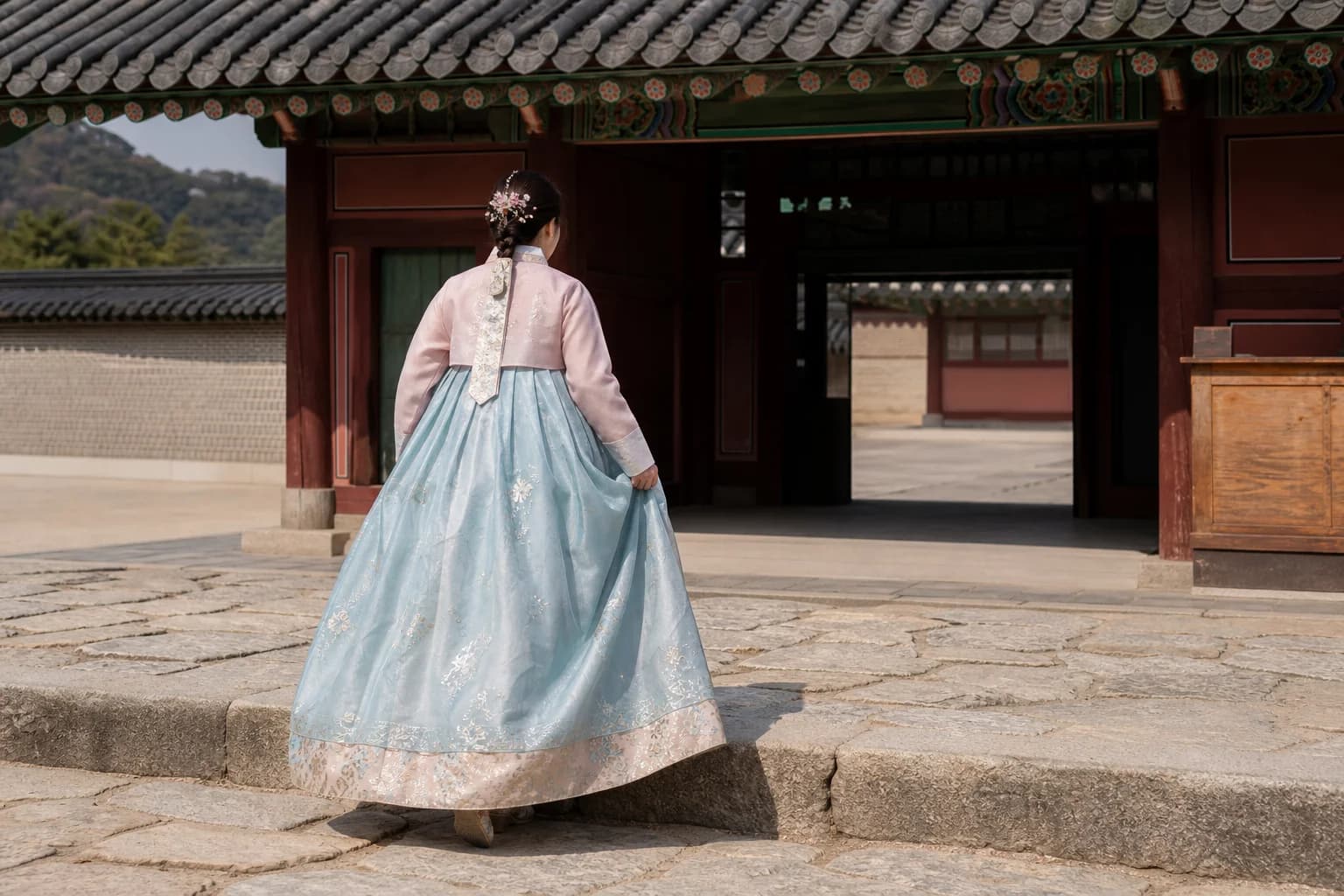
The Royal Palaces and Tombs Center waives admission for hanbok wearers at Gyeongbokgung Palace, Changdeokgung Palace, Deoksugung Palace, Changgyeonggung Palace, Jongmyo Shrine, and the royal tombs.
The Korean-language version of the guideline states the purpose is popularizing hanbok, and that Korean and foreign visitors are treated identically.
The qualifying test is structural, not stylistic.
Both traditional and modernized hanbok count.
What the guideline requires is a top and a bottom: a jeogori with an overlapping collar, plus a skirt or trousers.
Ties and fastenings should be done up, and the lower garment should cover the legs.
What does not qualify, per the same page:
A
jeogoriworn with jeansHanbok trousers or skirt worn with a T-shirt
A
durumagiovercoat worn on its ownA T-shirt-style top sold as modern hanbok, with no overlapping collar
A one-piece hanbok-styled dress with no separate top
A clarification published in May 2026 also confirmed the rule is gender-neutral — men in a hanbok skirt and women in hanbok trousers both qualify — while restating that one-piece hanbok dresses do not.
Is the free entry actually worth renting for?
Only if you wanted to wear hanbok anyway.
As pure ticket savings, the math doesn't work.
Adult admission is at Gyeongbokgung Palace and Changdeokgung Palace, and each at Deoksugung Palace, Changgyeonggung Palace, and Jongmyo Shrine.
There's also an integrated ticket at covering all five, usable once at each within six months.
Changdeokgung's rear garden is ticketed separately at and is not included.
So the absolute ceiling on what a hanbok waives is around ₩6,000 of tickets — and only if you visit all five sites.
Rental shops near Gyeongbokgung advertise well above that for a couple of hours, and most also want a deposit and ID.
Prices vary widely by shop and package, so check the shop's own booking page rather than a summary like this one.
Rent hanbok because you want the photographs.
The free entry is a rounding error.
Gyeongbokgung is closed on Tuesdays, as is Jongmyo Shrine.
Changdeokgung, Deoksugung, and Changgyeonggung close on Mondays instead — so there is no single day when everything is shut, but there's also no day when everything is open.
Gyeongbokgung's hours run 09:00–17:00 in January, February, November and December; 09:00–18:00 in March–May and September–October; and 09:00–18:30 in June–August.
Can you stack two or three in one day?
Two of the six sit inside the same block.
The other three are separate trips across the city.
The Gyeongbokgung cluster. The National Folk Museum of Korea is on the palace grounds at 37 Samcheong-ro.
The museum's exhibitions are free — but the official visiting page is explicit that entering Gyeongbokgung itself requires buying a palace ticket separately.
If you only want the museum, use its own entrance and ask staff at the gate rather than walking in through the palace ticket line.
Free English docent tours run Monday, Wednesday and Friday at 10:30 and 14:30, and Sunday at 10:30, starting from the first-floor information desk with no reservation.
Museum hours are 09:00–18:00 from March to October (Wednesdays until 20:00) and 09:00–17:00 from November to February, with last entry an hour before closing.
Myeongdong. The Seoul Global Cultural Center is on the 5th floor of M-Plaza.
The free hanbok session is for foreign visitors, capped at six people per group, and is allocated same-day on a first-come basis between 10:00 and 17:00 with a break from 12:30 to 13:30. The center does not take phone or email reservations for it.
The center also runs craft classes for foreign residents on a weekly timetable — Korean paper crafts on Wednesdays, folk painting on Thursdays, advanced paper crafts on Fridays, each 14:00–15:30, booked through the event calendar on its site.
Some carry a fee; check the current listing.
Seocho-gu. The National Gugak Center is at 2364 Nambusunhwan-ro, a separate trip from either of the above.
The Saturday Gugak Concert runs Saturdays at 15:00 at Umyeon-dang.
Jung-gu, evening. Korea House sits near Chungmuro at 10 Toegye-ro 36-gil, with cuisine served 12:00–15:00 and 18:00–22:00. Performance schedules and ticket prices are not published on the English site, so call before you plan an evening around it: +82-2-3011-9200.
Realistically: the museum plus a palace is a comfortable morning.
Adding a 15:00 concert in Seocho-gu is possible but leaves no slack.
Anything more is a schedule, not a day out.
Templestay: the one that needs planning
Templestay is booked through the official English portal at eng.templestay.com, which sorts programs into one-day, experience-focused, rest-focused, and group categories.
Two things decide whether it works for you.
English is per temple, not universal. Only temples designated for international visitors run their programs in English.
You need to filter for that on the portal rather than assume it, and the temple's own program page is where the language is stated.
The foreigner rate is a promotion, not a standing price. A dedicated foreigner event was advertised at per night for a fixed quota and a fixed window, and press coverage reported a reduced foreigner rate at a set number of temples.
That is a periodic campaign — whether one is running during your dates is exactly the thing to check on the portal, not to assume from an article like this one.
Refund and cancellation terms are set per temple.
Read the specific program's terms before paying; don't generalize from another temple's page.
What can stop a foreigner at the payment screen
Worth being straight about what's confirmable and what isn't.
The two free options sidestep the problem entirely.
The Seoul Global Cultural Center hanbok session takes no booking at all — you turn up.
The National Folk Museum docent tour takes no booking either.
Palace tickets are bought at the ticket office when you arrive.
For the paid ones, the picture is thinner.
The Templestay portal offers a non-member booking route alongside member login, and the National Gugak Center states that English-language ticket reservation is available on its site.
Neither publishes a clear statement about whether an overseas-issued card or a Korean phone number is required at checkout, and I couldn't verify that from their own pages.
So plan a fallback rather than a workaround: if a checkout stalls, phone the venue directly, or call the 1330 Korea Travel Helpline — 1330 — which runs 24 hours in Korean, English, Japanese and Chinese, with several more languages during daytime hours.
Re-check these before you pay
Four things on this page move, and they move on different clocks.
Templestay per-temple rates and whether a foreigner promotion is currently open
Saturday Gugak Concert seat prices and whether a concert is scheduled that week
The Seoul Global Cultural Center's class calendar, which turns over regularly
Palace and museum closure days around Lunar New Year and Chuseok, when the normal Monday/Tuesday pattern doesn't hold
The hanbok dress code and the palace ticket prices are the stable part.
Everything with a calendar attached deserves one look at the operator's own page the week you go.
How this article was prepared
Sources checked
- Royal Palaces and Tombs Center — Free Admission Guidelines for Hanbok Wearers (English)— Official qualifying and disqualifying hanbok criteria; list of covered sites
- Royal Palaces and Tombs Center — Hanbok free admission guideline (Korean)Linked page is in Korean— Confirms the rule applies to Korean and foreign visitors alike; disqualifying examples
- Royal Palaces and Tombs Center — Admission feesLinked page is in Korean— Adult ticket prices per site and the integrated ticket price
- Royal Palaces and Tombs Center — Opening hours and closing daysLinked page is in Korean— Seasonal hours and the Tuesday/Monday closure split
- Gyeongbokgung Palace — Korea Tourism Organization— Official English name, English address, Tuesday closure
- National Folk Museum of Korea — Visiting— Free admission, seasonal hours, English docent tour days and times, separate palace ticket note
- National Gugak Center — Monthly performance schedule (English)Linked page is in Korean— Saturday Gugak Concert dates, 15:00 start, venue, A/B seat prices
- National Gugak Center — English siteLinked page is in Korean— Official English institution name, address, English ticket reservation
- Saturday Gugak Concert — Korea Tourism Organization— Free English guided tour before the Saturday concert
- Seoul Global Cultural Center — Cultural Experiences— Free hanbok session rules, walk-in only policy, class schedule, address, hours
- Korea House — Traditional Experience Programs— Experience program content and duration
- Korea House — Reservation inquiriesLinked page is in Korean— Group program minimum of 20 participants
- Korea House — Traditional Performance ArtsLinked page is in Korean— Performance company details and booking phone number
- Korea House — Korea Tourism Organization— English address, cuisine service hours, reservation channel
- Templestay English portal— Official English booking channel, program categories, support contact
- Templestay — English program notices— Foreigner-rate event at 30,000 KRW per night, quota and period
- Korea Herald — Registration opens for English templestay program— Reported foreigner rate and number of participating temples
- 1330 Korea Travel Helpline — Korea Tourism Organization— 24-hour multilingual helpline and supported languages
- Asia Business Daily — Clarifying the criteria for free palace admission in hanbok— May 2026 clarification: gender-neutral, one-piece hanbok dresses excluded
Related reading
Korea's September 2026 festivals: seven confirmed dates, and a Chuseok week to plan around
Seven September 2026 festivals have dates confirmed on official pages, with routes from Seoul that work without a car. Chuseok falls on September 24–26, so either book trains in the special holiday window or travel earlier in the month.
Which SIM should you buy at Incheon Airport? Start with whether you need a Korean number
Data-only and an unlocked eSIM phone? Buy the eSIM before you fly. Get a physical SIM at the arrival hall only if something in Korea actually has to text or call you.
Jeju's Best Restaurants: Half the Fun Is the Wait — A Guide to Prices and Wait Times at 7 Top Spots
The best way to avoid long lines at Jeju’s top restaurants is to reserve a spot in advance using CatchTable’s remote line-up service; even foreigners without a Korean phone number can join the same line using the global app. For restaurants that only accept walk-ins, the best times to visit are right after opening or around 3 p.m.