Korean Food
How to make cilantro kimchi in Korea, scaled to Korean grocery packs
A fresh cilantro-and-radish version, what to buy in Korean stores, and how long it keeps
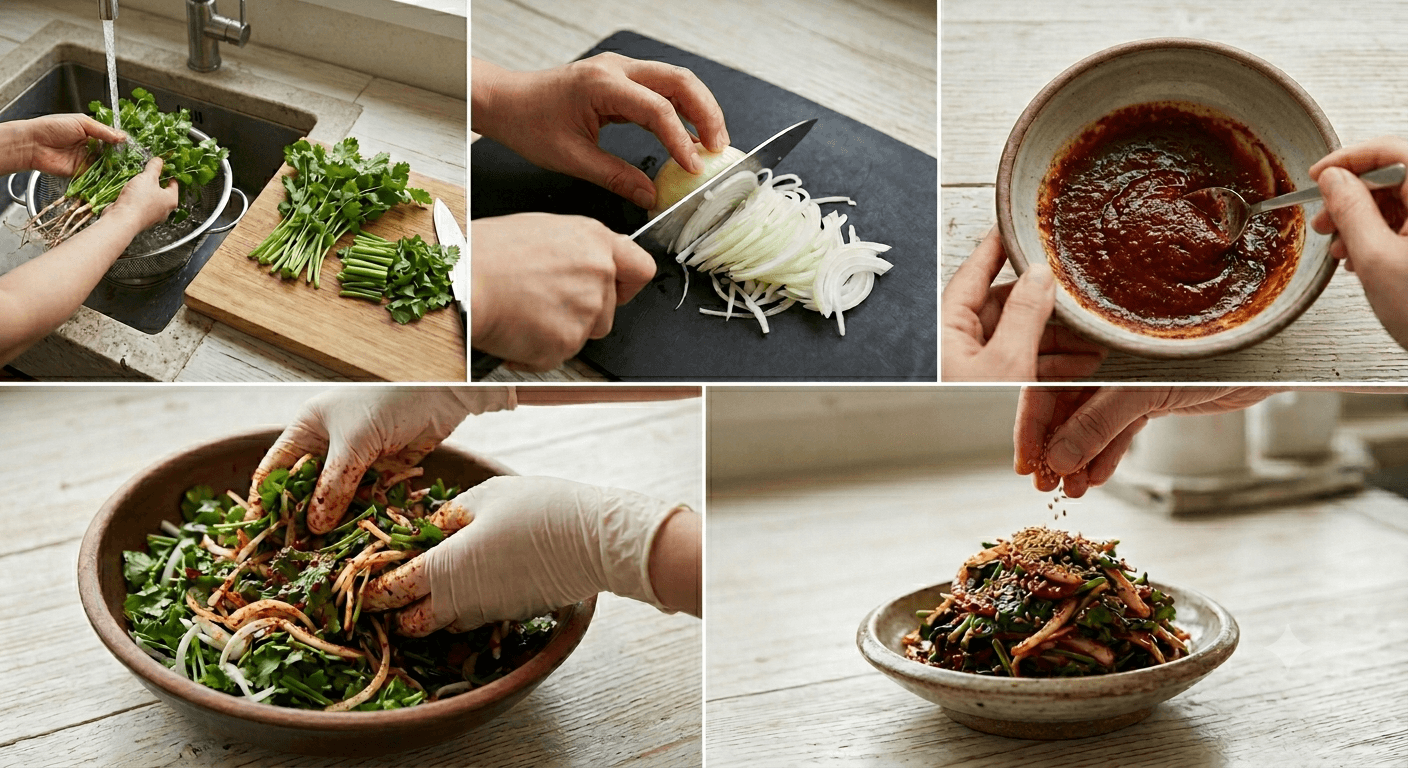
At a glance
Cilantro kimchi made at home in Korea is best treated as a fresh side dish. This recipe uses 100 g of cilantro and about 400 g of Korean radish for a batch to eat within two days.
Cilantro kimchi (gosu kimchi) is easy to make in Korea now that cilantro is sold by the pack.
The surprise is that the well-documented home version isn't fermented at all.
It's a fresh dish of radish and cilantro dressed with chili flakes, vinegar and fish sauce, meant to be eaten within a day or two.
The recipe here uses 100 g of cilantro, which in October 2026 meant one pack from Oasis Market or two from Kurly.
This guide also covers what to buy, the label names to look for, a vegan version and how long it keeps.
Fresh or fermented: which one are you making?
Make the fresh version.
The recipe documented by America's Test Kitchen tosses radish matchsticks with cilantro and is eaten like a salad, with no fermentation.
It comes from a family whose grandmother was born and raised in North Korea.
She called the dish gosu kimchi, and the authors note that its technically correct name is gosu musaengchae (seasoned cilantro and radish shreds).
We found no published recipe for a long-fermented cilantro kimchi, with weights and fermentation times, from a Korean government or kimchi research body.
So this guide doesn't make up a fermentation schedule.
Plan | What to make | Fridge life |
|---|---|---|
Eating it tonight or tomorrow | The fresh radish and cilantro recipe below | Up to 2 days |
Wanting a jar that keeps for weeks | Not covered here; we found no recipe with fermentation times | — |
The two-day limit comes from America's Test Kitchen's published recipe.
Where the dish comes from
The background is thin.
The National Institute of Korean Language's dictionary says gosu is widely grown at temples.
An English-language reference on Korean temple cuisine names gosu kimchi among the kimchi known in Buddhist temples in some regions, and gosu muchim (dressed cilantro) among the specialties of Haeinsa Temple.
Where can you buy cilantro in Korea?
Look for gosu, the Korean word for cilantro and coriander leaf.
Korean online grocers sell domestic cilantro in small packs.
In October 2026, Kurly listed a 50 g pack at and Oasis Market listed a 100 g pack at before discounts.
If you can't order online, large supermarkets and vegetable stalls in traditional markets may have it, but don't count on it.
What to buy, by the name on the Korean label
Korean labels use Korean names, so here are the romanized names to ask for, what to choose and what to use if you can't find an item.
Ingredient | Name to look for | What to choose | If you can't find it |
|---|---|---|---|
Cilantro | gosu | Domestic packs of 50 g or 100 g | Any fresh bunch with firm stems |
Korean radish | mu | A firm, heavy radish; this recipe needs about 400 g | Daikon |
Chili flakes | gochugaru, in gulgeun (coarse) or goun (fine) grind | Either grind works in this recipe | — |
Fish sauce | myeolchi-aekjeot (anchovy) or kkanari-aekjeot (sand lance) | Anchovy for a fuller, funkier flavor; sand lance for a cleaner one | Soy sauce, for the vegan version |
Plum syrup | maesil-cheong | Any brand; it adds fruity sweetness | A little extra sugar |
Salted shrimp | saeujeot | Not needed for this recipe | — |
The fish sauce notes come from Korean cooking coverage comparing the two kinds.
Anchovy sauce has a stronger, fishier smell, so add it a little at a time and taste.
Fresh cilantro and radish kimchi, scaled to 100 g
This scales America's Test Kitchen's published proportions down to 100 g of cilantro.
It makes four to five side-dish servings.
Spoon measures are 15 ml tablespoons and 5 ml teaspoons.
Ingredients
100 g cilantro (one 100 g pack or two 50 g packs)
About 400 g Korean radish
1½ Tbsp sugar
1½ Tbsp gochugaru
1 Tbsp plus ½ tsp white vinegar
2½ tsp maesil-cheong
2 tsp fish sauce (aekjeot)
2 tsp minced garlic
1¼ tsp fine salt
1 Tbsp toasted sesame seeds
Method
Peel the radish and cut it into matchsticks about 7–8 cm long.
Wash the cilantro, trim off the roots and dry the leaves completely.
Wet leaves dilute the dressing, and it won't cling.
Cut the cilantro into lengths similar to the radish.
In a large bowl, toss the radish with the sugar, gochugaru, vinegar, maesil-cheong, fish sauce, garlic, salt and sesame seeds until it's evenly red.
Add half the cilantro and toss lightly with your fingertips, separating any clumps.
Add the rest and toss the same way.
Serve right away or chill until the meal.
Variations
Cilantro only, no radish. This is closer to gosu muchim.
The seasoning above is balanced for 400 g of radish, so with cilantro alone start with about half of it and adjust to taste.
Thin onion slices add crunch if you miss the radish.
Vegan or temple-style. Use soy sauce in place of the fish sauce.
Traditional temple cooking also avoids garlic and other Allium vegetables, and it leaves out jeotgal (salted seafood).
To cook in that style, leave out the garlic too and let the cilantro carry the flavor.
For the brining and seasoning basics of a napa cabbage version, see our guide to quick-pickled napa cabbage kimchi.
How long does it keep, and when should you throw it out?
Keep it in a covered container in the fridge and finish it within two days.
It isn't fermented, so treat it like a dressed salad rather than a jar of kimchi.
The radish keeps releasing water, and by the second day the bowl is wetter and the cilantro softer.
That's normal.
As with any dressed salad, throw it out sooner if it turns slimy, smells off rather than just tangy, or shows any mold.
To spread a pack over more than one meal, keep the herb dry and paper-wrapped in the fridge and dress a small batch each time.
How this article was prepared
Sources checked
- America's Test Kitchen, Gosu Musaengchae (Seasoned Cilantro Radish Shreds)— Ingredient amounts for 8 servings, method and 3-inch cuts; grandmother born and raised in North Korea; gosu kimchi vs gosu musaengchae; eaten like a salad with no fermentation; refrigerate up to two days
- America's Test Kitchen, About Us— The company's own page; brand written as America's Test Kitchen
- National Institute of Korean Language, dictionary entry for gosu (Korean)Linked page is in Korean— Gosu is the Korean name for coriander; the entry says it is widely grown at temples
- Korean temple cuisine (Wikipedia)— Gosu kimchi famous in Buddhist temples in two regions; gosu muchim among Haeinsa's specialties; temple kimchi made without garlic, scallions or jeotgal because Allium foods are avoided
- Korea Heritage Service, World Heritage page for Haeinsa Temple— Official English heritage page; writes the temple's name as Haeinsa Temple
- Ministry of Unification (Republic of Korea), English websiteLinked page is in Korean— The ministry's official English site; uses the country name North Korea throughout
- Kurly product page, cilantro 50 g (Korean)— Domestic cilantro, 50 g, 2,990 won, refrigerated in paper packaging; dry washed cilantro, wrap in newspaper and refrigerate; no set use-by date, eat soon after receipt; checked October 2026
- Oasis Market product page, domestic cilantro 100 g (Korean)Linked page is in Korean— Domestic cilantro sold in 100 g packs, 7,200 won list price before discounts, shipped unwashed; checked October 2026
- KED Global report on Oasis Market (July 2021)— English-language business news; refers to Oasis Corp. as Oasis Market, an early-morning grocery delivery platform
- Lady Kyunghyang article on using aekjeot (Korean)Linked page is in Korean— Anchovy fish sauce: rich umami, strong fishy smell, little sweetness; sand lance fish sauce: clean taste, less fishy, slightly sweet
Related reading
Making geotjeori in Korea, from buying the right packs to a small batch
For one small batch of fresh kimchi in Korea, buy one albaechu, coarse sea salt, coarse chili flakes and anchovy fish sauce. If you'd never finish the pantry packs, a kit or ready-made geotjeori is the better buy.
Korean persimmons: which ones you can eat firm, and how to ripen, dry and store the rest
Only dangam is meant to be eaten firm. Most other fresh Korean persimmons are astringent and have to go jelly-soft, or be dried or frozen, first, so read the label and squeeze before you buy.
Korean winter street snacks: what to order, what they cost, and how to pay
Carry small won notes. Bungeoppang ran from 3 for 2,000 won to 1,500 won apiece in 2025/26 news reports, some stalls refuse cards, and a transfer-only stall is off-limits without a Korean bank account.