Korean Food
Korean persimmons: which ones you can eat firm, and how to ripen, dry and store the rest
Dangam, daebong, hongsi, Cheongdo Bansi and the dried forms, plus where to see persimmons drying in Sangju
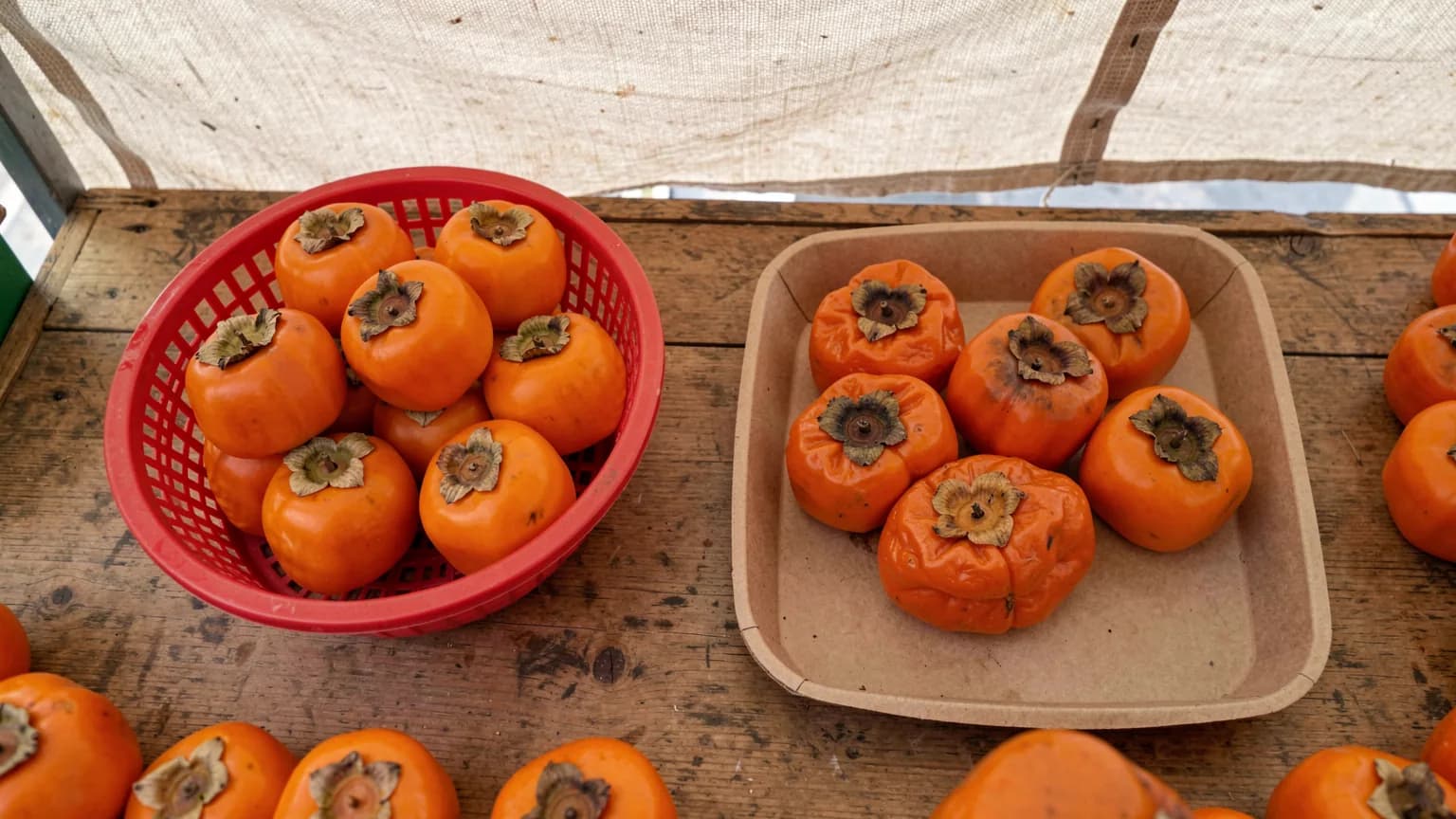
At a glance
Only dangam is meant to be eaten firm. Most other fresh Korean persimmons are astringent and have to go jelly-soft, or be dried or frozen, first, so read the label and squeeze before you buy.
A Korean persimmon is one of two kinds of fruit, and you can't tell which from the shape.
Dangam, the sweet persimmon, is eaten firm and crisp, like an apple.
Most other fresh persimmons in a Korean market are astringent: they have to soften completely, or be dried or frozen, before they taste good.
Bite into a firm astringent persimmon and your mouth goes dry and furry.
That one mistake is the reason most of this guide exists.
Sweet or astringent: the split that decides everything
According to Korea's National Institute of Forest Science, dangam was introduced from Japan and is now grown in many cultivars, while Korea had been growing astringent persimmons long before that.
The astringency comes from tannin.
That is why astringent fruit isn't eaten firm the way dangam is.
It is turned into hongsi (the soft, fully ripened fruit) or gotgam (dried persimmon).
Drying and freezing get rid of the astringency too.
The institute lists dried persimmon pieces, bangeonsi, gotgam and ice hongsi as easy ways to eat astringent fruit, because drying or freezing turns the soluble tannin into an insoluble form, and the puckering taste goes away.
That dry, furry feeling is the soluble tannin.
One expat blog warns that a hongsi eaten before it is fully ripe "tastes bitter and leaves your mouth feeling fuzzy and dry." That means the fruit wasn't ready yet.
Eight persimmon forms you'll see in Korea
Box and price-tag names are romanized below, with what the word means.
Form | What it looks and feels like | Eat it now? | How to eat and store |
|---|---|---|---|
Dangam (sweet persimmon) | Squat, firm, crisp, orange | ✅ Yes, while firm | Peel or eat the skin, then slice like an apple. Refrigerate to keep it crisp. |
Daebong | Elongated, bright orange; sold firm | ❌ Not while firm | Ripen at room temperature until jelly-soft. It then becomes hongsi. |
Hongsi (soft ripe persimmon) | Deep orange-red, slightly translucent, very soft | ✅ Yes, once fully soft | Too soft to slice. Eat it as it is, or freeze it whole. Eat soon after it ripens. |
Cheongdo Bansi ("tray persimmon") | Flat, round, seedless | ❌ Not while firm | Astringent. Let it soften into hongsi first. |
Bangeonsi (half-dried persimmon) | Dark orange, chewy, still moist inside | ✅ Yes | Dried about 35 days. Follow the storage note on the pack. |
Gotgam (dried persimmon) | Dark, dense, firm-chewy, often with a white powdery coat | ✅ Yes | Dried about 60 days. Keep it in the freezer, then bring it to room temperature before eating. |
Gammallaengi (dried persimmon pieces) | Chewy dried slices or wedges | ✅ Yes | Snack straight from the pack. Follow the pack's storage note. |
Ice hongsi | Frozen whole hongsi | ✅ Yes, partly thawed | Eat it half-frozen, like sherbet. Keep it frozen. |
Types and the tannin effect are from the National Institute of Forest Science.
Drying times and gotgam storage are from the Korean Food Promotion Institute.
Ripening and fridge advice are from US university extension guides, including UF/IFAS.
Checked November 2026.
Flat doesn't mean sweet: Cheongdo Bansi
Cheongdo Bansi is a seedless persimmon from Cheongdo.
The county's English site says the name means "flat persimmon," because the fruit is flat rather than elongated.
Because dangam is also squat, it's easy to assume a flat persimmon is a sweet one.
It isn't.
A National Institute of Forest Science fact sheet groups Cheongdo Bansi with Korea's astringent persimmons, and when bansi ripens, it becomes hongsi.
A 2005 report from Cheongdo noted that the seedless fruit is used for hongsi and should be eaten before it gets too soft.
How to pick at the stall: read the name, then squeeze
Shape won't tell you what you're holding, so use two checks instead.
Read the name on the box or price tag. If it says dangam, the fruit is meant to be eaten firm. Daebong, bansi or hongsi all mean astringent fruit. Labels are printed in Korean, so match them against the card below, or point your phone camera's translate feature at the label.
Squeeze gently. Firm dangam is right. Astringent fruit is ready only when it is soft all over. If it is firm anywhere, it needs more days.
If there's no label, ask the seller "dangam?" A yes or no is enough.
Firm astringent fruit isn't a wasted purchase.
It just isn't for today.
Buy it if you can wait (see the ripening steps below), or buy hongsi that has already softened if you want to eat it tonight.
When is dangam in season?
Dangam comes in waves from late September into November, depending on the cultivar.
Korea's Rural Development Administration gives these ripening periods, which vary with weather and region:
Seochon-joseng: late September, an early cultivar of about 200 g.
Taechu: mid-October, large fruit averaging about 380 g.
Buyu (Fuyu): late October to early November, the classic late cultivar.
So a firm persimmon you see in September is most likely an early dangam, and by November you'll find dangam, hongsi and the first dried forms on sale together.
Ripening a firm daebong or bansi at home
Leave it at room temperature until it is completely soft.
A closed bag with an apple or banana speeds this up.
Both fruits give off ethylene, the ripening gas.
A UF/IFAS extension guide suggests putting 3–4 persimmons and one apple or banana in a clean paper bag, closing it, and keeping it somewhere warm.
Check every day. The same guide warns that fruit left unchecked can overripen.
Timing is a range, not a promise. UF/IFAS says bagged fruit usually softens in 2–3 days, depending on how hard it was, and fruit left on the counter takes several days to a week. That guide was written for astringent fruit grown in the US. Use the squeeze test, not the calendar.
Ready means jelly. It's ripe when the whole fruit is soft and feels almost like jelly when pressed. Any firm spot means it isn't done yet.
There's also a shortcut if you can't wait.
UF/IFAS notes that freezing an unripe astringent persimmon for about a day reduces the astringency.
The thawed fruit goes soft, but it hasn't really ripened, so it works better for puréeing than for eating as fresh fruit.
Eating hongsi
Ripe hongsi is soft and very sweet, and it's eaten as it is.
There's no slicing, because the flesh is too soft to hold a shape.
A popular alternative is to freeze it and eat it like sherbet, which is the idea behind the ice hongsi sold frozen in shops.
Eat ripe hongsi within a short time.
It keeps softening, and the 2005 report from Cheongdo advised eating it before it gets too soft.
Gotgam and bangeonsi: the freezer, and the white powder
Gotgam goes in the freezer, not the fridge.
The Korean Food Promotion Institute explains that its high sugar content lowers the freezing point, so it doesn't freeze hard even in the freezer.
Take it out and let it sit at room temperature before eating.
The white coat is the part people throw away by mistake.
As gotgam dries, it forms a white, powdery coating.
According to the same institute, this is concentrated sugar and glucose that has come to the surface, not mold, and the fruit is fine to eat.
Bangeonsi is half-dried, so it stays chewy and moist inside.
The institute's freezer advice is for gotgam; for bangeonsi, follow the storage note on the pack.
The difference is the drying time: about 35 days for bangeonsi and about 60 days for gotgam before shipping, according to the institute.
Where to see persimmons drying: Sangju
Sangju is the heart of Korean gotgam.
A 2021 Korean Food Promotion Institute article put its share at 60% of the country's gotgam production.
Sangju Dried Persimmon Park is the city's public showcase for it.
Its exhibition and experience hall covers persimmon picking, peeling and hanging, and the building also has a souvenir sales area and a cafeteria.
Visit detail | What the city lists |
|---|---|
Summer hours | 09:30–17:30 |
Winter hours | 09:30–17:00 |
Closed | Every Monday, 1 January, Lunar New Year's Day (Seollal) and Chuseok |
Admission | No fee listed |
From Sangju City's English park page, checked November 2026. The page doesn't say which months count as summer or winter, so confirm before a late-afternoon visit.
The rows of hanging, drying persimmons are a seasonal sight.
Astringent fruit is harvested in autumn and then hangs for weeks, so late autumn into winter is when you're most likely to see it.
The Sangju Dried Persimmon Festival is held every year, and its dates are announced each year.
For the coming season, check the Sangju Dried Persimmon Festival official site and the park's page on Sangju City's English site.
How this article was prepared
Sources checked
- National Institute of Forest Science persimmon fact sheet (Korean PDF)Linked page is in Korean— Dangam came from Japan; tannin makes the other persimmons astringent, so they are eaten as hongsi or gotgam; drying or freezing turns soluble tannin insoluble; its research table lists Cheongdo Bansi among astringent persimmons
- National Institute of Forest Science English homepageLinked page is in Korean— Official English name of the institute
- Rural Development Administration, sweet persimmon post-harvest management (Korean)Linked page is in Korean— Ripening periods: Seochon-joseng late September, Taechu mid-October (about 380 g), Buyu late October to early November
- Korean Food Promotion Institute, Hansik glossary - GotgamLinked page is in Korean— Sangju 60% of national gotgam output (2021 article); bangeonsi about 35 days, gotgam about 60 days; freezer storage and why; take out to room temperature; white surface is concentrated sugar, not mold
- Sangju City, Sangju Dried Persimmon Park (English)— Official name, road address, summer and winter hours, closing days, Experience Hall contents; no admission fee listed; checked November 2026
- Sangju Dried Persimmon Festival official site (English)— Official festival name; held every year; no dates for the next edition listed in November 2026
- Asia Business Daily, Cheongdo Bansi (October 2025)— Cheongdo Bansi is a seedless persimmon, flatter than the elongated drying types, shaped like a tray
- Asia Business Daily, Cheongdo hongsi (October 2020)— Flat seedless bansi is grown in Cheongdo; when bansi ripens it becomes hongsi
- Cheongdo County, Cheongdo Bansi Festival page (English)— Bansi means flat persimmon, flat unlike the elongated Dongsi used for dried persimmon; official spellings Cheongdo and Cheongdo Bansi
- Korea JoongAng Daily, persimmons in Cheongdo (2005)— Seedless Cheongdo persimmons are used only for hongsi and should be eaten before they get too soft
- UF/IFAS North Florida Research and Education Center, persimmon ripening strategies— Astringent fruit must be fully ripe; paper bag with an apple or banana; check daily; 2-3 days in the bag, several days to a week on the counter; jelly-like when ripe; freezing about one day reduces astringency
- Ask Extension, persimmon FAQ— Ripen at room temperature; a bag with a ripe apple or banana speeds it up; refrigerator storage
- Gwangju News, making gotgam (2023)— Ripe daebong becomes hongsi and is eaten as is or frozen like sherbet; drying gotgam forms a white powdery coat; bangeonsi keeps some moisture
- Andrew goes to Korea, persimmons (expat blog, 2012)— Warns that a hongsi eaten before it is fully ripe tastes bitter and leaves the mouth fuzzy and dry
Related reading
Korean winter street snacks: what to order, what they cost, and how to pay
Carry small won notes. Bungeoppang ran from 3 for 2,000 won to 1,500 won apiece in 2025/26 news reports, some stalls refuse cards, and a transfer-only stall is off-limits without a Korean bank account.
Buying watermelon in Korea — which size fits your kitchen, what it costs, and where the rind goes
No knife or fridge? Buy a supermarket cut tray. A whole melon (about 20,000–30,000 won in 2026) only makes sense for three or more people with a fridge, and the rind goes out as food waste.
Korean BBQ in Korea: picking the right place, reading the menu, and ordering for your group
Choose the restaurant by group size and budget, then compare menus using the price per 100g, not per serving. Before paying Hanwoo prices, check the origin label. Solo diners often face a two-serving minimum.