Korean Food
Korean winter street snacks: what to order, what they cost, and how to pay
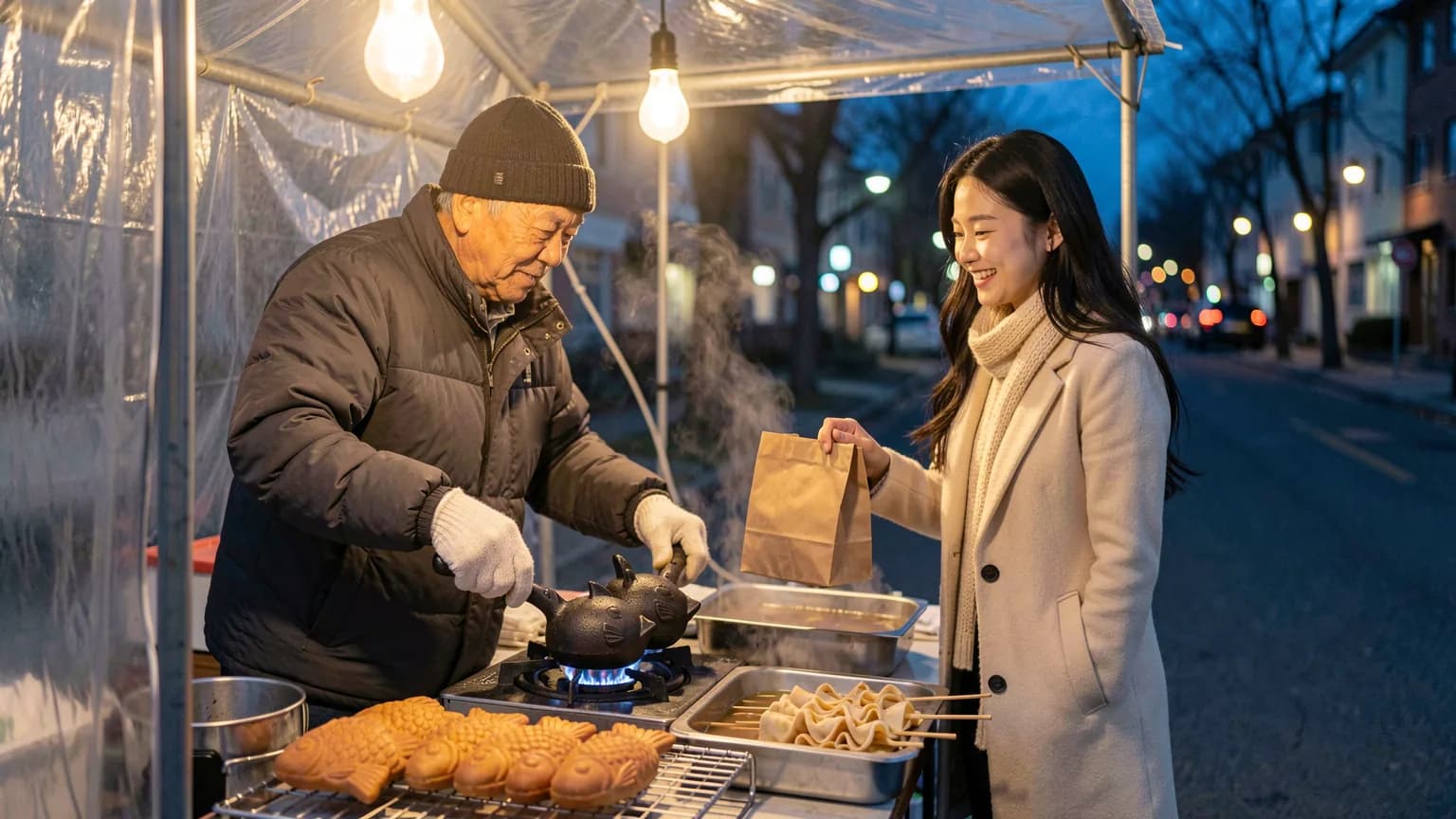
Bungeoppang, hotteok, gyeranppang, roasted sweet potatoes, fish cake skewers and chestnuts, plus finding stalls that move and paying when there's no card reader
At a glance
Carry small won notes. Bungeoppang ran from 3 for 2,000 won to 1,500 won apiece in 2025/26 news reports, some stalls refuse cards, and a transfer-only stall is off-limits without a Korean bank account.
Korea's winter street snacks cost little, but buying one isn't always simple.
Some stalls take only cash, some post a bank account for transfers you can't make without a Korean bank account, and a stall listed in an app may not be there when you arrive.
This guide covers what each snack is, what to ask for, what dated news reports say they cost, and what to do when a stall won't take your payment.
The short version
Carry a few 1,000-won notes and a 5,000-won note.
Cards work at some stalls, mainly in tourist markets, but you can't count on it.
If a stall takes only a bank transfer and you don't have a Korean bank account, you can't pay there, so move on to another stall or to a convenience store.
The six snacks, what to ask for, and how they're sold
The names below follow the romanizations Korea.net uses where it has them.
Say the name and hold up fingers for how many you want.
Snack | What it is | How it's usually sold |
|---|---|---|
Bungeoppang | Fish-shaped pastry filled with red bean paste, or with custard cream and other newer fillings | By the piece, often in bundles such as 2 or 3 for a set price |
Hotteok | Sweet pancake of glutinous rice dough filled with brown sugar; some versions add seeds such as sunflower seeds and peanuts | By the piece, often in a paper cup |
Gyeranppang | Soft, fluffy loaf of bread containing a whole egg | By the piece |
Gungoguma | Sweet potato roasted over a fire in its skin | By the bag, priced by size or weight |
Eomuk | Fish cake on a skewer, usually served with hot broth | By the skewer, with the broth |
Gunbam | Roasted chestnuts | By the paper bag or cup |
What do they cost this winter?
No October–November 2026 street-price report had appeared when this was checked in early November 2026. The figures below come from reports between August 2025 and the 2025/26 winter, each tied to the report it came from.
Expect prices this season to be the same or higher, and to vary from one stall to the next.
Snack | Reported price | Where and when |
|---|---|---|
Bungeoppang | 2 for 1,500–2,000 won | Four Seoul districts, report of Nov 7, 2025 |
Bungeoppang | each at many stalls; around 3 for 2,000 won still the average | Seoul, report of Nov 30, 2025 |
Bungeoppang | 1,000–1,500 won each | Central Seoul, report of Dec 11, 2025 |
Bungeoppang | 3 for 2,000 won | One neighbourhood stall, newspaper column of Nov 12, 2025 |
Eomuk | 1,200–1,400 won a skewer | A Busan market, summer report of Aug 22, 2025 |
Hotteok, gyeranppang, gungoguma, gunbam | No dated report found | Ask at the stall |
Each date matches a report in the source list at the end of this guide.
The December 2025 report noted that a year earlier the usual deals had been 3 for 2,000 won or 2 for 1,000 won.
Why prices rose
The reports point to similar costs.
Price data cited in the November 7, 2025 report put red beans at 13,893 won per 500 g in early November 2025, up 34.9% on a year earlier.
The December 2025 report cited a 33.8% rise in the wholesale price for 40 kg of red beans.
Vendors interviewed for the November 30, 2025 report also listed gas, paper bags and pitch fees.
Tourist-spot prices are a separate case
In August 2025, a news report found fish cake at 3,000 won a skewer near a Busan tourist site, against 1,200–1,400 won at a market in the same city.
If a price is two or three times what's above, you're paying for the location.
You're free to walk away before ordering.
How to pay at a stall
Work through these in order.
Cash in small notes. It's the safest choice, and some stalls take nothing else. A November 2023 report described a cash-only stall, and a November 2025 newspaper column described a neighbourhood stall that took no cards. Break larger notes at a convenience store before you go looking.
A card, if you see a terminal. Ask by showing the card before you order. A March 2026 news report found Gwangjang Market vendors calling out that cards were fine, while some stalls in Myeongdong had covered their card notices and hesitated when handed a card.
QR payments in some tourist areas. The same report found many Myeongdong stalls taking Alipay-style QR payments aimed at Chinese visitors. Outside the big tourist streets, don't expect it.
Bank transfer. Some stalls post the vendor's bank account number for transfers, as both the November 2025 column and the March 2026 report describe. This needs a Korean bank account and a banking app.
When the stall wants a bank transfer
If you're visiting and don't have a Korean bank account, you can't pay by transfer.
A foreign card or a phone number won't change that.
Ask whether cash is fine first, since a stall that posts an account number may still take cash.
If not, go to the next stall.
If you live in Korea and have a Korean account, paying by transfer is normal.
Check the amount before you send it.
A November 2023 news report relayed the case of a vendor who checked transfers only after closing, kept finding ones of just 200 or 300 won, and stopped accepting them.
Show the vendor your transfer confirmation when you pay.
For cash withdrawals and which cards work at convenience stores, see our convenience store guide.
Finding a stall that's actually open
Stalls are harder to find than they used to be.
City figures cited in the November 7, 2025 report show Seoul's street stalls fell from 6,079 in 2020 to 4,741 in 2024, about 22% fewer.
When the same report checked 15 bungeoppang stalls listed in a stall-map app across four Seoul districts on November 6, 2025, only 3 were open.
Vendors in that report blamed ingredient costs, enforcement, complaints and fines for unlicensed stalls.
Use a stall-map app, with a caveat
Gaseumsok 3cheonwon is a user-reported map of bungeoppang and other snack stalls.
As checked on November 3, 2026:
App Store. The listing is in the Korean store under a Korean-only title, and its Languages field lists Korean and English. It wasn't found in the US or UK App Store when checked, so it may not be available in your country's store.
Google Play. It's also listed there, again under a Korean-only title.
How it works. Users add stalls with photos and report whether a stall is open, or still has stock, that day. A recent report is worth far more than the pin itself.
A pin with no recent report is only a guess.
Search a map app
On NAVER Map or KakaoMap, searching the snack name often brings up shops and cafés that sell it rather than the street stalls themselves.
Those shops are a fallback with regular hours.
For setting up a Korean map app in the first place, see why Google Maps falls short in Korea.
Timing patterns
Treat these as tendencies, not rules.
Stalls cluster near subway exits, bus stops, markets and apartment-complex entrances.
They mostly set up in the afternoon and stay open into the evening.
Uncovered stalls often don't open on rainy days.
The season roughly follows the cold, from late autumn to early spring.
When you can't find a stall: convenience stores
Convenience stores sell winter hot snacks with regular hours, and they take foreign cards far more reliably than stalls do.
Item | Where | Reported price |
|---|---|---|
Roasted sweet potato | 7-Eleven, from Sep 14, 2026 | 2,200 won |
Vegetable fish cake skewer (new item) | 7-Eleven, from Sep 14, 2026 | 1,400 won |
Roasted sweet potato | CU, 2025 season | In the 2,000-won range |
Small roasted sweet potato (80 g) | GS25, 2025 season | 700 won |
Hoppang (steamed buns: red bean, vegetable, pizza and others) | GS25, 2025 season | No price reported |
The table comes from a September 15, 2026 news report, which also covered CU and GS25's previous season.
For bungeoppang without a stall, supermarkets and online grocers sell frozen versions you heat at home.
A December 2025 news report put a major brand's bag of 11–12 red bean pieces at , with its November 2025 online sales up 45% on a year earlier.
That's mainly an option for residents with a microwave or air fryer.
How this article was prepared
Sources checked
- Asia Economy, disappearing bungeoppang stalls (Nov 7, 2025)Linked page is in Korean— 3 of 15 app-listed stalls open in four Seoul districts; 2 for 1,500–2,000 won; red beans 13,893 won per 500 g, up 34.9%; Seoul stalls 6,079 (2020) to 4,741 (2024)
- The Korea Economic Daily, 1,000-won bungeoppang report (Nov 30, 2025)— Many stalls at 1,000 won each; around 3 for 2,000 won the average; red bean, gas, bag and pitch costs
- SBS Biz, bungeoppang at 1,000–1,500 won (Dec 11, 2025)Linked page is in Korean— 1,000–1,500 won each in central Seoul; a year earlier 3 for 2,000 or 2 for 1,000 won; red bean wholesale up 33.8% for 40 kg; frozen bungeoppang 11–12 pieces for 7,600 won, online sales up 45%
- Kyongbuk Maeil, neighbourhood stall column (Nov 12, 2025)— 3 for 2,000 won; no card payments; vendor's bank account number posted for transfers
- Financial News, underpaid transfers at snack stalls (Nov 21, 2023)— Cash-only hotteok stall refusing a transfer; a vendor who checked transfers after closing, found many of 200 or 300 won and stopped accepting them
- Financial News, Gwangjang Market and Myeongdong payment check (Mar 8, 2026)— Gwangjang vendors advertising card payment, some posting account numbers; some Myeongdong stalls hiding card notices; Alipay-type QR payments
- Seoul Shinmun, 3,000-won fish cake controversy (Aug 22, 2025)Linked page is in Korean— Fish cake 3,000 won near a Busan tourist site; 1,200–1,400 won at a Busan market
- Wikitree, convenience-store winter food launches (Sep 15, 2026)Linked page is in Korean— 7-Eleven roasted sweet potato 2,200 won and new vegetable fish cake skewer 1,400 won from Sep 14, 2026; CU and GS25 sweet potato and hoppang from the previous season
- Gaseumsok 3cheonwon, Apple App Store listing (Korea)Linked page is in Korean— Korean-only title; Languages field Korean and English; user reports of open status and stock with photos; checked Nov 3, 2026
- Gaseumsok 3cheonwon, Google Play listing— Korean-only title; checked Nov 3, 2026
- Korea.net, Korea's winter snacks (Dec 13, 2021)— Romanized names bungeoppang, eomuk, gyeranppang, hotteok, gungoguma; fillings, glutinous rice dough, egg in the loaf, roasting in the skin, broth with eomuk
- VisitKorea, Gwangjang Market— Official English name of the market
- Visit Seoul, Myeongdong— Spelling on Seoul's official travel guide
- Alipay+, consumer page— Alipay spelling
- Seoul Metropolitan Government newsLinked page is in Korean— Seoul spelling used by the city government
- NAVER Map— Map service name and spelling
- KakaoMap— Map service name and spelling
- CU official site— Chain brand spelling
- GS25 official site— Chain brand spelling
- 7-Eleven Korea official siteLinked page is in Korean— Chain brand spelling
Related reading
Buying watermelon in Korea — which size fits your kitchen, what it costs, and where the rind goes
No knife or fridge? Buy a supermarket cut tray. A whole melon (about 20,000–30,000 won in 2026) only makes sense for three or more people with a fridge, and the rind goes out as food waste.
Korean BBQ in Korea: picking the right place, reading the menu, and ordering for your group
Choose the restaurant by group size and budget, then compare menus using the price per 100g, not per serving. Before paying Hanwoo prices, check the origin label. Solo diners often face a two-serving minimum.
Making geotjeori in Korea, from buying the right packs to a small batch
For one small batch of fresh kimchi in Korea, buy one albaechu, coarse sea salt, coarse chili flakes and anchovy fish sauce. If you'd never finish the pantry packs, a kit or ready-made geotjeori is the better buy.