Korean Food
Jeolla-style kimchi for kimjang: what sets it apart, and a 5 kg batch by weight
What to buy at a Korean supermarket, how to store it, and what you can actually book in Gwangju and Yeosu
At a glance
Jeolla kimchi stands out for its thick, ground seasoning. For 5 kg of salted cabbage, start with 300 g gochugaru and 350 g jeotgal, then adjust by taste.
Jeolla kimchi is spicy, salty and rich in jeotgal (salted, fermented seafood), but so is kimchi from Gyeongsang.
What the sources single out for Jeolla, the southwest that includes Gwangju and Yeosu, is the seasoning itself: thick, and built on ground chili and rice paste.
For a first batch, work by weight: 5 kg of salted cabbage, 300 g of gochugaru and 350 g of jeotgal, then adjust by taste.
This guide is for fermented kimjang kimchi that keeps for months.
For a small batch to eat right away, use the geotjeori guide instead.
What actually makes Jeolla kimchi different?
Korean food writing usually groups the south together.
A 1990 literature review says cold northern areas use less chili, while Jeolla and Gyeongsang make spicy, salty kimchi with plenty of jeotgal.
A 2004 article adds that southern kimchi uses less filling and more chili, jeotgal and salt, so that it keeps in warmer weather.
Jeolla gets singled out for the texture of the seasoning.
The 1990 review names glutinous rice paste as a Jeolla feature.
The 2004 article describes cooks grinding chilies to a thick paste in a mortar instead of using powder, which darkens the color.
A 2003 feature calls Jeolla kimchi thick and deep, with generous anchovy and hairtail jeotgal, and blends its southern seasoning from glutinous rice paste, fine gochugaru, dried chilies, garlic, ginger, anchovy and shrimp jeotgal, pear juice and sugar.
Two shortcuts fall apart against these sources.
Heavy jeotgal doesn't identify Jeolla, because the 2004 article lists anchovy and hairtail jeotgal as a Gyeongsang feature too.
Glutinous rice paste doesn't either, because the 2001 recipe below uses it as well.
What holds up is a combination: more chili and jeotgal, less filling, and a thick seasoning that is often ground together.
Families differ, so there is no single correct Jeolla kimchi.
Region | Chili | Jeotgal | Seasoning and salt level |
|---|---|---|---|
North | Less chili | Croaker or shrimp jeotgal, clean-tasting | More liquid, mild and clear |
Jeolla | Plenty; ground chilies darken the color | Generous anchovy and hairtail | Thick and salty, with glutinous rice paste |
Gyeongsang | Plenty, with plenty of garlic | Plenty of anchovy and hairtail | Strongly salted and spicy |
Compiled from the 1990 review and the 2003 and 2004 articles above.
What to buy, and how to read the labels
Salted cabbage (jeorim baechu)
Buying cabbage already salted skips the longest job, and it is sold by weight.
Always measure by kilograms, because the head count in a box is unreliable. One seller's 20 kg box is listed as 6 to 10 heads.
Reported first-round pre-order prices for a 20 kg box in 2026 ran from to , depending on where the cabbage was grown and whether a promotional card was used.
A small kit for 1 or 2 people, with 5 kg of salted cabbage and 1.5 kg of seasoning, was .
These figures come from a report dated 10 October 2026, when at least one first round had already sold out and second rounds were due from 23 October, so treat them as a guide to the range and not as current prices.
The lowest prices depended on a promotional card, so a foreign-issued card may not qualify for them.
Haenam, on the southwest coast, is a major winter cabbage area, and Haenam boxes were among the 2026 pre-orders.
If a box arrives before you're ready, keep it cold.
One seller says 0 to 10°C and gives a use-by of 5 days from production.
Online pre-orders run in Korean and may ask for a Korean phone number or card; this was not checked store by store.
If that blocks you, ask at a supermarket's service desk, get a Korean-speaking friend to order, or salt whole cabbage yourself using the method further down.
For 2026 only, a government program offered up to 40% off kimjang produce at large and small-to-mid-sized supermarkets from 29 October to 2 December.
A separate seafood event offered up to 50% off items including sea salt, saeujeot, anchovy sauce and oysters from 28 October to 29 November.
The periods differ, so go by the shelf tag.
Matching the Korean name on the pack
The card below pairs each Korean label with its romanization and meaning, so you can hold it up to the shelf.
Name | What it is | Notes for this batch |
|---|---|---|
jeorim baechu | Salted napa cabbage | Weigh it after draining |
myeolchi aekjeot | Clear anchovy sauce | One option for the main 250 g of jeotgal |
jinjeot | Thick anchovy liquid, boiled and strained | The other option; thicker than aekjeot |
saeujeot | Salted, fermented tiny shrimp | The 100 g addition |
galchi sokjeot | Fermented hairtail innards | Optional; count it inside the jeotgal total |
gochugaru | Chili flakes | Often sold in a coarser grade for kimchi; the 2003 southern seasoning uses fine flakes |
chapssal garu | Glutinous rice flour | Not mepssal garu, which is regular rice flour |
gat | Korean mustard greens | Filling |
jjokpa | Slender Korean green onion | Filling |
minari | Water dropwort | Filling |
Jinjeot and aekjeot start from the same place.
One home recipe explains that boiling raw anchovy jeotgal and straining it through a colander gives jinjeot, and straining it repeatedly through fine cloth gives aekjeot.
Swapping 250 g of one for the other will change the taste, so taste before adding more.
Buying either one ready-made also spares you boiling anchovies in a small apartment.
Packs labeled "Jeolla-style" have no standard definition that we could find, so read the ingredients list on any pack you buy.
The 5 kg batch, by weight
The left column comes from a 2001 recipe video on Nongsaro, the Rural Development Administration's farm information portal.
The right column is not an official recipe. It is our starting point, between that video and a full-strength Jeolla home recipe.
We calculated it from those two recipes and have not fermented a test batch.
For 5 kg salted cabbage | Nongsaro video (2001) | Our Jeolla-style starting point |
|---|---|---|
Chili | 220 g | 300 g gochugaru |
Jeotgal | 250 g | 250 g myeolchi aekjeot or jinjeot + 100 g saeujeot (350 g total) |
Glutinous rice paste | 425 g | 425 g |
Garlic | 100 g | 150 g |
Ginger | 50 g | 50 g |
Sugar | 25 g | 25 g |
Sesame seeds | 25 g | 25 g |
Filling | About 1 kg (20% of the cabbage) | 1 kg or less |
For a 10 kg box, double every line.
One seller suggests 3 to 5 kg of seasoning per 10 kg of salted cabbage; counting the filling, our starting point comes to about 4.65 kg.
For the 5 kg batch, plan on roughly 7.3 kg in total before the cabbage releases liquid, so check your containers can hold it.
For the optional ground chili, replace up to 50 g of the 300 g gochugaru with dried chilies, weighed dry, soaked and blended.
For filling, use radish cut into 2 mm shreds plus minari, jjokpa and gat cut to about 5 cm.
Southern kimchi traditionally uses less filling, so staying under 1 kg fits the style.
The 2003 southern recipe adds oysters and the home recipe adds raw shrimp; both are optional.
One individual's Jeolla home recipe shows where full strength lies: 2 kg of gochugaru (the amount appears only in its steps), and 15 cups of jinjeot and saeujeot, for 10 heads of cabbage with no weight given.
Using the 6-to-10-heads-per-20-kg range above, that is about 300 to 500 g of gochugaru per 5 kg, with more jeotgal than our 350 g.
Add more of either in small steps once you have tasted the seasoning, keeping in mind that salted cabbage varies in saltiness.
If you salt whole cabbage yourself
The 2001 video soaks cabbage in about 15% brine, scatters coarse salt between the stems, then leaves it for about 8 hours, turning once or twice.
Rinse two or three times in plenty of cold water and drain face-down in a large colander.
The Jeolla home recipe salts longer, about 6 hours and then another 6 after turning.
Weigh the cabbage after draining and scale the table to that number.
Allow 8 to 12 hours for this before the steps below.
The day before, then kimjang day
The day before
Whisk 50 g of glutinous rice flour into 450 g of water (a 1:9 ratio) and cook, stirring so it does not scorch, until it thins out. Cool, then weigh out 425 g. For a 10 kg box, use 100 g of flour and 900 g of water.
Soak the dried chilies, if using.
Cut the radish and greens, and refrigerate them.
Blend the paste with the gochugaru, garlic, ginger, jeotgal and sugar, adding the soaked chilies to the blender. Refrigerate the seasoning overnight.
Kimjang day
Drain the salted cabbage. Follow the seller's instructions first, including whether to rinse: one listing says its cabbage is already washed and needs 2 to 3 hours upside down, a home recipe says 3 hours core-side up, and the 2001 video gives no time. Stop when water no longer drips.
Fold the filling and sesame seeds through the seasoning, and taste.
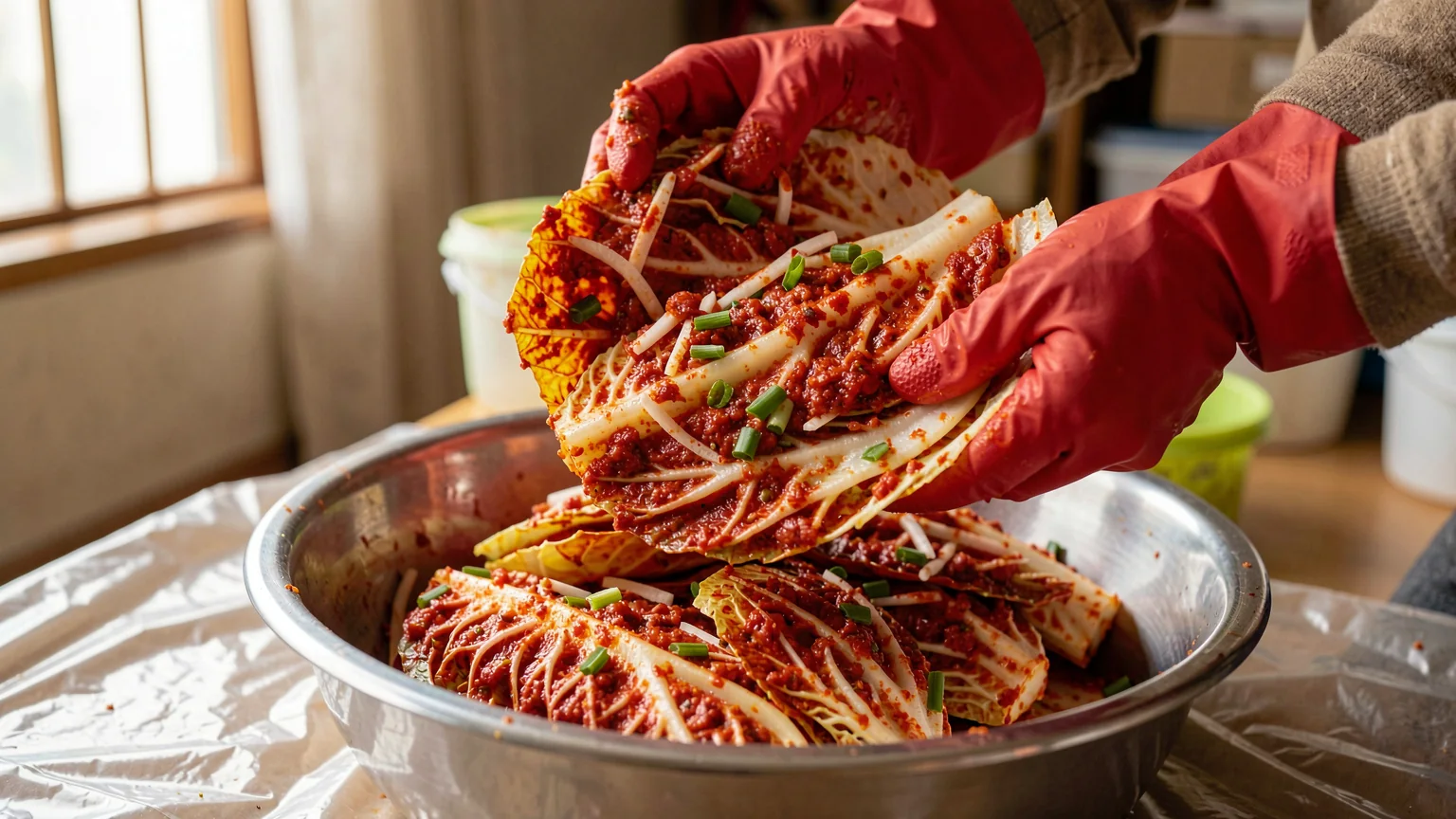
Spread seasoning leaf by leaf, working from the outer leaves in.
Wrap each piece in one of its own outer leaves.
Pack tightly into containers, pressing out air, and stop below the fill line marked inside the container, because gas from fermentation can push the liquid over the top. Cover the top with outer leaves or plastic.
Cabbage trimmings and scraps go out under your area's food waste rules, covered in the trash guide.
When to make it
Kimjang season runs later in the south.
A 2007 government release gives the Korea Meteorological Administration's guideline: make kimjang when the daily low falls to 0°C or below and the daily average stays at 4°C or below.
A report from October 2026 puts peak kimjang in mid-to-late November for the capital area and the central region, and from late November to early December for the southern regions, including Jeolla.
UNESCO inscribed "Kimjang, making and sharing kimchi in the Republic of Korea" in 2013, and describes late autumn as the season when communities make and share large quantities together.
Fewer households do it now: a November 2026 government release put home kimchi-making at 58.6%, down 5.6 percentage points on the year.
Ripening and storing it
With a kimchi refrigerator, use the standard setting and start tasting at around 2 months. Samsung's service pages list standard at -1.3°C, strong at -1.8°C and mild at -0.8°C, and describe the ripe stage at about 2 months and full maturity at 4 to 6 months.
Those figures apply to Samsung models, so check your own manual.
The same pages say kimchi sours faster if it sits outside for a long time before going in.
If it sours sooner than you want, go one step colder, and switch back if the liquid starts to freeze about a week later.
A 2012 study of winter kimchi in a kimchi refrigerator shows how much a warm start moves the timing.
Batches given 5 days at 10°C before going down to -2.5°C reached the ripening stage (pH 4.4, 0.6% acidity) in 2 weeks.
One day at 15°C first took 8 weeks, -1°C from the start took 12 weeks, and -2.5°C from the start took 22 weeks.
The study rated the 5 days at 10°C best overall, but a heated apartment is well above 10°C, so a day on the counter is not the same thing.
Going straight into -1°C scored comparably after 6 months, and that is close to Samsung's standard setting.
Without a kimchi refrigerator, no official or research figure for a regular fridge turned up, so no timeline is given here.
Warmer means faster, so start tasting sooner.
If storage space is tight, stick to 5 kg.
Two other Jeolla kimchis worth knowing
Dolsan gat-kimchi is made from mustard greens grown on Dolsan, an island district of Yeosu.
A Rural Development Administration magazine says the leaves have soft fiber and less pungency, thanks to the warm maritime climate and alkaline soil.
The same article says this mustard is not a native variety: it was brought from Japan in the mid-1950s and spread to Dolsan in the early 1990s.
Godeulppaegi kimchi uses a bitter wild green that a 2003 feature says toughens after late-autumn frost.
Whole plants, roots included, are soaked in brine to draw out the bitterness.
The feature then adds glutinous rice paste, sugar, sesame seeds and raw chestnut to the usual cabbage kimchi seasoning.
Where to learn it or buy it in Gwangju and Yeosu
Yeosu is the better fit if you only want to toss kimchi and buy some, provided its session is running this winter; Gwangju has a scheduled class on 28 November. Both need Korean, by phone or on a Korean-only site, so line up a Korean speaker before planning a trip.
Gwangju Kimchi Town
The town has a kimchi museum and a fermented food hall.
The museum is open 09:00 to 18:00 with last entry 30 minutes before closing, and is closed on Mondays, 1 January, and on Seollal (Lunar New Year) and Chuseok day.
The museum is closed for remodeling from 17 to 25 November 2026, while the fermented food hall stays open.
The class open to individuals is the seasonal kimchi-making session, held on the fourth Saturday of each month from April to November 2026, from 10:30 to 11:30. The fourth Saturday of November is the 28th, and that session makes 1 kg of cabbage kimchi for .
No December session is listed.
Minimum group. The session runs only if at least 15 people sign up.
Booking and payment. Book online in advance. Staff send the bank-transfer details individually 1 to 2 weeks before the session, and you can cancel up to 3 days before, so ask how to pay without a Korean bank account.
Language. No English guide or English booking page was found, and we could not confirm whether the online form needs Korean identity verification, so call 062-613-8226 or get a Korean speaker to help.
The main number is 062-613-8222.
Dolsan, Yeosu
Dolsan Gat Jangteo Village (a market village; we found no official English name) sits in the Yullim-ri area of Dolsan.
According to a 2024 Rural Development Administration article, it sells Dolsan gat-kimchi along with godeulppaegi, green onion and cabbage kimchi, and can pack and ship orders.
Its hands-on session has you toss Dolsan mustard greens in seasoning that has been prepared in advance.
Book 2 to 3 days ahead by phone at 061-644-8722.
Expect the call to be in Korean, and confirm first that the session is running this winter, since the details date from 2024. That article gives no street address, so ask for directions when you call.
How this article was prepared
Sources checked
- Lee Hyo-gee and Lee Hye-kyung, literature review on the history of kimchi cultureLinked page is in Korean— Less chili in the cold north, spicy and salty jeotgal-rich kimchi in Jeolla and Gyeongsang, glutinous rice paste as a Jeolla feature; the passage cites a 1983 thesis
- Weekly Kyunghyang article on regional kimchi, December 2004Linked page is in Korean— Regional descriptions of northern, southern, Jeolla and Gyeongsang kimchi, including ground chili, less filling and more seasoning in the south
- Kyunghyang Shinmun feature on Jeolla kimchi, November 2003Linked page is in Korean— Thick seasoning, generous anchovy and hairtail jeotgal, the southern seasoning mix, godeulppaegi handling
- Asia Economy report on Haenam winter cabbage, December 2021— Haenam County is a leading Korean cabbage area
- Nongsaro video on making cabbage kimchi, 2001Linked page is in Korean— Gram amounts per 5 kg, 1:9 paste, 15 percent brine, salting time, rinsing, covering the top
- 10000recipe Jeolla-style kimjang kimchi by an individual cook, 2023— Amounts for 10 heads, jinjeot and aekjeot explanation, salting and draining times
- Kurly listing for 20 kg salted Haenam cabbage— 6 to 10 heads per box, 3 to 5 kg seasoning per 10 kg, already washed, 2 to 3 hours upside down, 0 to 10°C and 5 days from production; seller example only
- Samsung Electronics Service guide to kimchi refrigerator temperaturesLinked page is in Korean— Standard minus 1.3, strong minus 1.8, mild minus 0.8 degrees Celsius
- Samsung Electronics Service guide to kimchi ripeningLinked page is in Korean— Ripe at about 2 months, fully matured at 4 to 6 months, sours faster after long storage outside, one step colder and go back if the liquid freezes after about a week
- Samsung Electronics Service guide to storing kimjang kimchiLinked page is in Korean— Fill below the line inside the container, gas can push liquid over the top, press out air, cover with outer leaves or plastic
- Study of winter kimchi stored for 6 months in a kimchi refrigerator, 2012Linked page is in Korean— Four storage conditions, time to reach pH 4.4 and 0.6 percent acidity, conclusion on 10 degrees for 5 days then minus 2.5
- Maeil Shinmun kimjang price report, 10 October 2026— First-round pre-order prices, kit contents, regional kimjang timing
- Korean government release on 2026 kimjang supply measures, 3 November 2026Linked page is in Korean— Discount periods and store types, seafood event, and the 58.6 percent home-making figure attributed to a state research institute
- Korean government release citing the Korea Meteorological Administration, 13 November 2007Linked page is in Korean— Temperature guideline for kimjang timing
- Rural Development Administration Green Magazine on Dolsan, November 2024Linked page is in Korean— Village location, products, hands-on booking by phone, Dolsan gat characteristics and history
- Gwangju Kimchi Town official siteLinked page is in Korean— Hours, closing days and main phone number
- Gwangju Kimchi Town seasonal kimchi-making session page, 2026Linked page is in Korean— Individual sessions on the fourth Saturday, April to November 2026, November cabbage kimchi 1 kg at 15,000 won, 15 minimum, bank details sent 1 to 2 weeks ahead, cancellation up to 3 days before
- Gwangju Kimchi Town museum closure notice, October 2026Linked page is in Korean— Museum closed 17 to 25 November 2026 for remodeling; fermented food hall stays open
- Yeosu City English page on Dolsan gat-kimchi— Official English spelling of the dish and the city
- UNESCO Intangible Cultural Heritage listing— Official title, 2013 inscription, late-autumn communal making and sharing
Related reading
Korean persimmons: which ones you can eat firm, and how to ripen, dry and store the rest
Only dangam is meant to be eaten firm. Most other fresh Korean persimmons are astringent and have to go jelly-soft, or be dried or frozen, first, so read the label and squeeze before you buy.
Korean winter street snacks: what to order, what they cost, and how to pay
Carry small won notes. Bungeoppang ran from 3 for 2,000 won to 1,500 won apiece in 2025/26 news reports, some stalls refuse cards, and a transfer-only stall is off-limits without a Korean bank account.
Buying watermelon in Korea — which size fits your kitchen, what it costs, and where the rind goes
No knife or fridge? Buy a supermarket cut tray. A whole melon (about 20,000–30,000 won in 2026) only makes sense for three or more people with a fridge, and the rind goes out as food waste.